

NEW YORK–The types of tools available to credit unions to manage their balance sheet have grown in both number and sophistication, and four people here offered their insights on how they are using those tools during NCUA’s Capital Markets Symposium here.
The first-ever event was organized by NCUA Board Member Rodney Hood and held in the ornate boardroom of the New York Stock Exchange on Wall Street. Related reporting from the event includes:
- Advice on Liquidity Risk Management
- How to Best Manage Interest Rate Risk
- Credit Unions & the FHLBs
- One CEO's Story About Rates
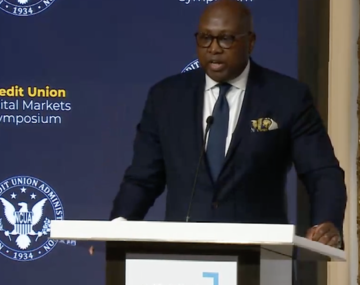
Rodney Hood in introductory remarks to symposium.
In his introductory remarks, Hood said the event was aimed at bringing togethers subject matter experts, Wall Street practitioners and credit unions for a “timely discussion of the current economic conditions and tools that credit unions can use to manage the associated challenges.
Participating in the panel on balance sheet management tools were Cathie Mahon, president and CEO of Inclusiv; Frank Santucci, managing director with Stifel Investment Services; James Schenck, president and CEO of Pentagon FCU, and Dan Prezioso, a partner with Olden Lane.
Here’s what each of the four had to say about the use of balance sheet management tools.
Fay asked each of the panelists for their thoughts on managing balance sheet risks and the tools they use.
A Proof of Concept
Mahon: (Inclusiv) is very laser-focused on using the credit union to reach and serve communities that have historically been left outside the financial mainstream and is really focused on promoting financial inclusion. We have a network of about almost 500 members in 48 states, D.C. and Puerto Rico. In the last couple years CDFI credit unions and MDI credit unions have seen a tremendous amount of growth. Lending in MDI and CDFIs combined has increased just in the past year by almost 36%. So, there is a tremendous moment of recognition, awareness and engagement of these institutions in their communities.
We've really focused a lot historically on investing in secondary capital. Secondary capital was really the vehicle by which so many CDFI credit unions really have been able to grow, the way so many low-income-designated credit unions have been able to grow their business and their balance sheet, and that is raising long-term debt that is subordinate to the insurance fund…It really helps to kind of pump up those institutions that had long been challenged to grow their operations solely by retained earnings.
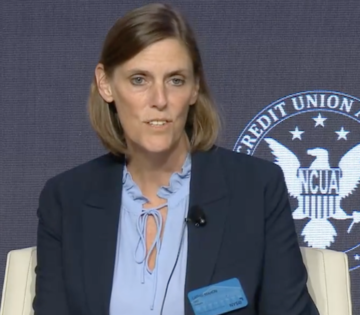
Cathie Mahon speaking to symposium.
‘Largest Continuous Private Lender’
For the last 20 years, Inclusiv has been probably the longest continuous private lender of secondary capital. We've deployed $120 million over 20 years…and allowed more lending to come into the into the marketplace. Between 2010 and 2015 credit unions were able to revolve that capital 60 times over in new loan growth. So, through that we really established a tremendous proof of concept across the field. We've really proven that investment in the credit union not just builds the balance sheet, but enables a strong balance sheet to be able to continue to deploy and get capital out in their communities.
We’ve been working very closely with the agency and secondary capital has now been included within the subordinated debt rule. We believe that there's a tremendous opportunity to continue to see this type of capital investment continue to grow. We also spend a lot of time educating the social impact investor movement and credit unions have risen to the top of their radar based on the best value and the best ability to track the impact of their investments.
‘We Are in the Business of Leverage’
Frank Santucci: When it comes to issuing subordinated debt, why wouldn't you? A lot of people say, ‘Well, it costs too much.’ The cost right now is astronomical compared to where it was two years ago, but it's not about the rate for borrowing the money. There are certainly cheaper sources for borrowing money. It's about your ability to leverage that capital and we are in the business of leverage--we don't want to admit it, but we are we're in the business of leverage.
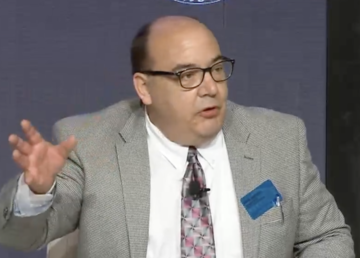
Frank Santucci speaking to symposium.
The NCUA says for every dollar of capital you have—and we don't think about it this way but you should—you can have $14.27 of assets. That gets you to a 7% equity ratio. Most credit unions are sitting at $10 with a 10% capital ratio. I want to get those other $4.27. Your members have the money. People say, ‘Well, my members don't have a lot of money other places.’ Yeah, they do…So, how do we get them to bring us that money? It means we're going to have to be more competitive on dividend rates, we're going to have to be more competitive on loan rates to get that money out the door and we can leverage that capital.
Securitization Must be Considered
If you're in a larger credit union, you need to consider securitizing your loans. Everybody knows about the loan participation market, it's been around since the mid-90s when NCAA updated the rules to allow participations. Most credit unions were doing almost $15 billion a quarter just two years ago. Now, with tight liquidity that number certainly has come down. What do you do when you get to be a bigger credit union? Right now it's hard to sell loans; nobody has liquidity to buy in the credit union space. So, we need to find people from outside of credit unions to buy those loans. How do we do that? If you're a larger credit union, you need to securitize, because now that asset-backed security backed by auto loans or home equity loans or whatever happens to be part of a universe that is a thousand times bigger. Who's going to potentially buy those right now?
That market is relatively small; there's only been four deals done so far, but it's growing.
Lessons from the Bicycle Shop
James Schenk: My philosophy, and my staff has heard me say this many, many times, is that we run a bicycle shop when it comes to my cost of funds, my deposits, my raw materials. I never want excess raw materials; I always want to be 100% loaned out. There are times in the capital markets where I loan out all my capital, all the extra bikes, but I never want to be paying for cost of goods that are just sitting there in the warehouse.
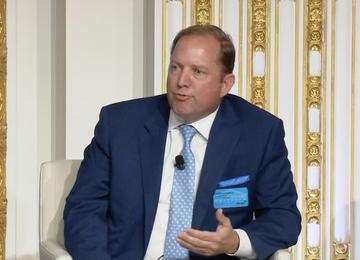
James Schenk speaking to symposium.
The first tool for balance sheet management is price, but everybody feels they have got to keep up with their neighbor or their competitor and be relatively close on price. There were times in 2022 when I was 117% loaned out, so I decided to raise my price 300% above the market in order to come out of the market for long-term assets, and I was able to reduce (the loan to share ratio) to about 100%. Price is an easy tool to control your balance sheet.
Where to Look
But at times when you're moving big flows you’ve got to look at other tools, so, first in wholesale loan sales are participations. I look around the room and I see some of our participation partners—it’s $20 million here, $40 million there. To replenish or modulate the asset side of the balance sheet we look to securitizations. I like to think of securitizations with a baseball analogy. This is truly a team sport. It takes everyone from the board of directors down to the lowest employee, the depth and breadth of the team, to have situational awareness every single day. You have to surround yourself with amazing partners in order to do a large securitization. Before you bring in the rating agencies you have to add industrial-strength processes in your underwriting and your charge-offs. You have to have the entire team understanding where they are, where the consumer team fits in, where the mortgage team fits in, the operational team, the compliance team, the legal team, the marketing team--because you don't want to misstep on your first securitization.
Participations Vs. Securitizations
When you go to the capital markets you want it to be oversubscribed. The great thing about securitizations versus a participation is there's an there's amazing depth and breadth in the ABS market…You have pricing transparency, which is good for the issuer and it's good for the investor. A lot of times with participations on both sides of the deal they feel like they're not getting the best deal, because there's so much uncertainty working through the brokers and on the pricing involved.
For us, securitization was the natural growth process in order to control the balance sheet to stay right about 100% loaned out. The one thing I would say in any sort of balance sheet management strategy, especially with NCUA here, is to communicate your strategy. So, I communicate sometimes daily that I like to run 100% or more loaned out and here are the tools I have in my toolbox in order to control those flows when I want to. Sometimes, if you're moving $2-$3 billion a month and flows are not exactly where you need them to be, you have to use derivatives in order to manage that risk or use securitizations to move large pools. That way you can continue to meet the demands of your members. If they want the car loans you can still originate, but they don't need to balloon up my balance sheet; they go to securitization market…in a single transaction.
Dan Prezioso: Four Tools Available
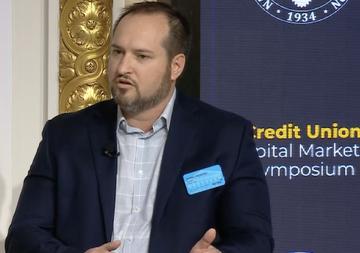
Dan Prezioso speaking to symposium.
There are many tools for managing the balance sheet, and certain tools have become more accessible to credit unions in the recent period and are rapidly expanding among them in the past year or so. These include the issuance of subordinated debt to boost levels of regulatory capital, the packaging of asset-backed securities to create additional liquidity valves for the liquidation of loans, the utilization of derivatives to hedge interest rate risk, and the fostering of partnerships with ESG investors who are mission-oriented investors.
These capabilities equip a credit union well to manage challenges that occur in market cycles and in the recent period where we've seen the market whipsaw from extreme conditions during the pandemic to an entirely different set of extreme conditions today.
Our clients are recognizing utility in these tools and the opportunity to help them navigate these conditions and, in fact, to make the most of them.
Multiple Strategies
Because of the nature of our business, all of our clients are engaging in one of these strategies. Many of them are engaging in more than one. I can even think of one client that's engaged on all four.
I want to remind the audience that, thanks to the admirable work of the NCUA in recent years, in 2017 they issued groundbreaking guidance in respect to the authority of credit unions to issue asset-backed securities. In 2019 through 2021, they issued abundant guidance on subordinated debt and an entirely new rule framework that while prescriptive offered pinpoint clarity on various matters that pertain to subordinated debt and expanded the universe of eligible issuers to include practically all complex credit unions.
Since then they've amended that rule on two occasions to facilitate the full participation of CDFI credit unions in governmental investment programs, and in 2021 they issued new rules on derivatives so that the use of derivatives is far less onerous for most complex credit unions. By doing that work they've made a very significant contribution to this industry and now it's for the industry to take up the baton as it has in the recent period to really install these tools with first-class adoption.
How Credit Unions are Changing
Fay: Credit unions have not historically been players in asset securitizations and subordinated debt until recently. How does the market see the credit union industry and what has changed?
Santucci: I think it’s size and scale, and NCUA taking a lead role in terms of modifying regulations and saying it’s OK to do these things. But it’s entirely about scale. With the first securitization we were involved in we went to Standard & Poor’s for a rating and said we have this credit union doing an asset-backed security. They said, ‘What's a credit union?’ We literally had a six-hour meeting with them and did education about what is a credit union, how do they work, what are the regulations et cetera. We had the same conversation with Fitch.
Mahon: It’s impact, too. We have great story to tell. I mean the credit union movement rings every bell as far as our openness, our governance structure, our accountability to the communities that we serve.