

STONE MOUNTAIN, Ga.–What is life like for women of color in the C suite of credit unions? Five such women shared some frank, personal, and sometimes humorous insights into what they have experienced, while also offering some advice to their younger selves.
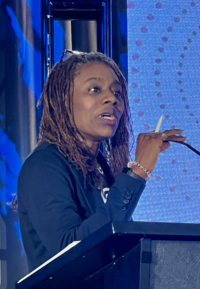
Carlene Alexander
Participating as panelists in the discussion during the African American Credit Union Coalition’s 25th annual meeting were Gloria Dixon, director, philanthropy and executive director of the BECU Foundation; Deborah Fears, president/CEO of Chicago Post Office Employees CU; Emma Hayes, chief culture officer with State Employees’ CU; Dayatra Matthews, chief legal officer/general counsel with Civic FCU and Local Government FCU, and Liz Ponder, EVP, chief retail officer with SRP FCU.
Carlene Alexander, AVP, Global DEI with UNFCU, acted as moderator.
Here is what each of the women shared about their experiences, what they have learned and what advice they have to share:
Alexander. Could you please share some of the unique challenges and opportunities you have encountered as a woman of color?
Fears: I started in 2000 as part of an employee diversity team. We trained executives on how to lead a diverse workforce. Very often I would get calls from women of color in the C suite--and I was not in the C suite at that time--and they were struggling with the micro-aggressions and being passed over for promotions for the nth time. They were asking, ‘What can I do?’
Fast forward and I’m now a CEO and it’s like déjà vu, because I am encountering some of the same issues I heard 20 years ago. You have this challenge where you see this lack of representation in the room and you’re wondering where can I get some support? I was in a management class with 120 people and I spotted one other person of color. In Illinois, we have 211 credit unions and for credit unions of more than $10 million in assets there is only one woman of color as CEO (me).
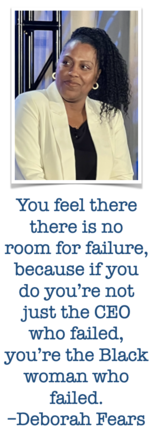
You feel this need to succeed, and it’s not from a standpoint of being ambitious or motivated or driven. If you’re in the C suite those (traits) are already embedded. But you feel there is no room for failure, because if you do you’re not just the CEO who failed, you’re the Black woman who failed. It carries so much more weight. You feel you are judged much more harshly than white counterparts.
Alexander: How have your diverse perspectives as a women of color influenced your leadership style?
Hayes: I am probably the youngest (on panel) in terms of tenure in the C suite and what I can tell you is the perspective that women of color add to the C suite is a perspective of empathy. We come to the table knowing what the struggle is, having experienced it not just as a woman, but also as a person of color. It’s compounded.
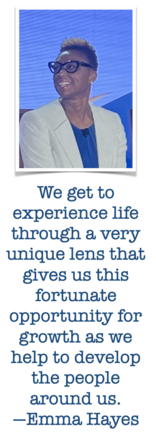
We get to experience life through a very unique lens that gives us this fortunate opportunity for growth as we help to develop the people around us. You end up kind of being the shoulder a lot of peers lean on to cover for the masses of people with whom they don’t have an intimate relationship. You come to the table representing them. You are their voice. It’s about pointing out the micro-aggressions in a way that doesn’t label you as the angry black woman.
It's how to show up authentic but also to toe the line. It’s about making people comfortable, disarming people. You have to do those things before you can even begin to have a conversation. We can’t forget about the people, and the perspective includes all the people.
Alexander: What strategies do you find effective in overcoming biases and barriers?
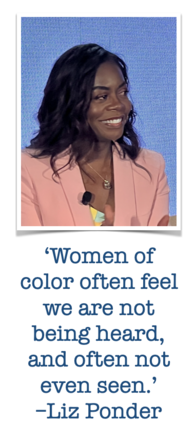
Ponder: In talking about biases and challenges we may have in our role, I am the ‘double-one.’ I am the only woman of color in our C-suite. Our walk is really real. It is exhausting. I say to my team we have to check to make sure we are balanced mentally. How many of you have walked into a room and you really know your stuff, and you start talking and nobody is listening? Women of color often feel we are not being heard, and often not even seen.
You have to find a way as a woman of color to navigate. These can be difficult conversations to have but they must be had. You have to find an ally in that room. You might have to co-sign (on an idea) with someone to get something done for the membership and employees; that is the outcome we are seeking. That is what I will do.
I will see women have been living DEI for a long time. I show up as my authentic self every day. I don’t know how else to do it. There was a time when I did try. People would say ‘You’re too much.’ Those are real things that happen in our world. But sitting on this stage today is already a w; we’re winning.
Hayes: You don’t always have to own the idea, even if it’s yours. If there is an opportunity to get the work done, get the work done. I have come to the realization I will drop something to someone if it’s something we need to do. It’s how you get the work done.
Ponder: It’s really not about us. It is really about the purpose you have been called to do. We all have one, you may not have found it. We do this work not for ourselves but for the people behind us. I am doing this work because I am hoping someone else will be sitting in this seat who looks just like me. I always say, ‘Send the elevator down because there is someone waiting for it.’
Alexander: Are there any intersectional challenges where gender and race shaped your experience?
Matthews: I’m working with myself; it is a continuing process of growing. I would say make sure you have people around you who can encourage you and build you up--women of color and non-women of color.
It used to be I couldn’t stand Webex. Now I love it because I have engaged colleagues to just short of check in, particularly when it comes to my facial expressions. When I was in front of a jury and I couldn’t speak I wanted them to know what I was thinking with my face. People will say to me on Webex, ‘Watch your face.’
Intersectionality is a real challenge for us as Black women in leadership.
There are stereotypes that women are really emotional or not really good at math or science. As Black women there are these other stereotypes, too. Being highly emotional has metamorphized into anger. Or you’re too aggressive. There is this stereotype of Black women that we are hyper-sexual. And you wonder why people are threatened by your presence sometimes. It’s a combination of things.
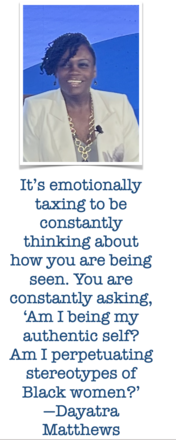
It’s emotionally taxing to be constantly thinking about how you are being seen. You are constantly asking, ‘Am I being my authentic self? Am I perpetuating stereotypes of Black women?’ You feel like everyone is looking at you. That’s the challenge of intersectionality.
The converse is you often feel invisible. When you’re talking about DEI and you lay race on it people get really uncomfortable. It is really important in order to be able to move in these nuanced, intersectionalized spaces that we have the intentionality and support of our white sisters.
The key is having the support of white men from a systematic structural standpoint, because they are the ones in power. But for us as women of color, our sisters who are non-diverse, we need you to understand the nuances of being a Black woman. I will tell you the times I have had the biggest challenges in intersectionality have been with white women.
Allies will support you. But advocates will put their name on the line for you.
Alexander: How have you maintained your authenticity and stayed true to yourself as you identify as a woman of color in a white corporate environment?
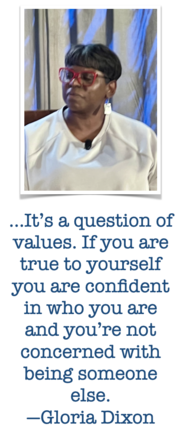
Dixon: I honestly think it’s a question of values. If you are true to yourself, you are confident in who you are and you’re not concerned with being someone else. If you do that, it’s easy for you to do. My mother had a saying, ‘You are not the boss of me.’ It meant you didn’t have to tell her who she was or how she had to behave. She was confident and 100% real.
When you pretend to be someone else, in the long run it harms you. Eventually that façade goes away and it causes you problems. In white corporate culture they assume you will behave a certain way and then you get angry and they say that’s who you really are. Being authentic and real every day pays off in the long run.
Ponder: I agree. However, I do think there are times we are not authentic, not that we don’t desire to be. Sometimes, it’s the circumstances. We try to fit in. People ask about our hair. You want to be authentic, but there are times you say, ‘Let me try to fit in.’ And when you do that you are not leading your best life. It really impacts you mentally. And it can create a trend of trauma that may not show up until years later. The hurt is real.
For our counterparts that walk up and say, ‘You have a new hairstyle today, you change every week.’ As a black woman we have more to bring than our hair and our shoes and our bag.
Hayes: Authenticity is important. But let’s keep it real. We have to show up and make ourselves—I will not advocate to make ourselves small--but to make ourselves palatable.
As a Black woman, as a child, you learn how to do that. The first thing your mother would say when you leave the house is ‘Don’t embarrass me.’ You can’t show up in every space as the same person. I am from deep country North Carolina and when I go home and talk to my family, I don’t talk like this (applause and laughter). It doesn’t work.
There is this persona you have to bring to the table as a professional. I would implore all of our young people to figure out when it is appropriate. It is part of survival. Part of being authentic is protecting your mental capacity, protecting all of those things that really sustain you long term.
Matthews: Your identity is your moral compass your ethics, your principles. Don’t ever walk in a space that causes you to change your ethics. But there is nothing wrong with changing your dialect. I am from Queens, and when I first started practicing law in eastern North Carolina, it was a show. I was talking really fast. And I couldn’t figure out why I kept losing my cases. One of my female partners pulled me aside and said, hey, how about you try just a blue suit? Slow down your speech. And I did. It didn’t change who I was and I was able to be successful.
Alexander: What has been the most significant lesson you have learned and what would you advise your younger self?
Ponder: I would tell young Liz to be patient. I am so impatient. I am always in a rush to get things done, but patience is a virtue. I think about growing up in the country. I remember my mother would take time to make sure food was really seasoned well. As we embark on this journey I would say to the young women who will one day sit in this seat, be patient. And always be kind. It doesn’t cost anything to do that. And I would tell the young Liz, you’re good enough.
Hayes: I would tell young Emma to thy own self be true. When the network is small, it’s lonely. So, you have to be comfortable with who you are and part of that is really being passionate with what you do, because that’s what fuels you. If it’s not part of your core values, the loneliness will drive you to failure.
Matthews: I would tell myself and I tell myself this now: Don’t be afraid of failure. But I also have to tell myself, ‘Don’t be afraid of success.’ When you do something well people want to hear more from you. Honestly, sometimes that makes me anxious, because the expectations are higher. ‘She won’t being it this time.’ And that can take you to a place of inertia where you don’t go out on the risk curve and challenge yourself. So don’t be afraid to keep killing it.
Fears: I would tell myself that you can’t be what you can’t see. What I mean is get into those rooms, find someone who can be an advocate for you when you’re not in the room, someone who is recommending you to be on boards and committees and to work on projects. Be a sponge, learn everything.
Dixon: For me, it’s take that chance. I would tell myself that now and I tell young people that. If you don’t take that risk you will always be afraid of failing. Invest in yourself and take that leap.