

By Ray Birch
LAKE FOREST, Ill.—With almost every financial service fee being challenged in some way, overall fee revenue is falling per checking account, a new report reveals, but there are steps credit unions can take in response.
According to Moebs $ervices, there are two reasons for the drop and the company is offering two potential pricing moves a credit union can make to stem the decline, including using interchange as a reward for reducing the price of overdrafts.

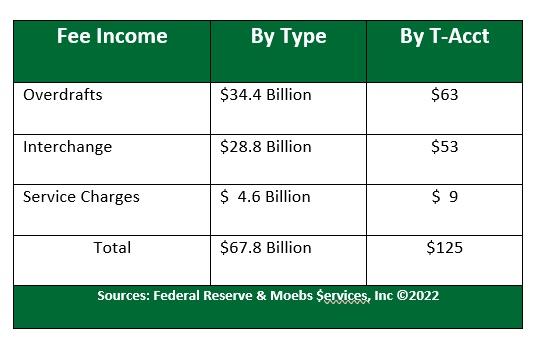
The Moebs $ervices study shows most checking revenue continues to be driven by overdrafts ($63 per account annually), with interchange second ($53 annually) and general service charges third ($9 annually).
“There are two ways transaction accounts—checking accounts—can be profitable: fees and balances,” explained Michael Mobes, economist and CEO at Moebs $ervices. “Rates can be used to retain transaction accounts (T-accounts), but that comes at a cost. Fees come from overdrafts, interchange or swipe fees, and service charges, such as falling below a minimum balance required or official checks. The actual prices are $21.52 for overdrawing, $0.34 for swiping a debit card, $5 minimum balance, and $10 for an official check for basic servicing.”
Moebs’ data (see table below) show total consumer fee revenue annualized for 2022 is $125 per T-account, or about $10 a month per transaction account. The Moebs Consumer T-Account Fee Revenue Analysis covers data from yearend 2019 to midyear 2022.
“This includes the implications of the 30-month COVID period and the beginning of the post-pandemic era,” Moebs noted.
In that period, overdraft revenue has stayed the same, decreasing only about $200 million.
The Pricing ‘Tortoise’
“However, led by Walmart ($15) and Bank of America ($10), the actual price of an OD fell from $30 per transaction to $22.52,” said Moebs. “Simultaneously, the volume of overdrafts rose as consumers used the OD service more because of the price decrease. So, what I have said for over 25 years is now happening for all those depositories who lower their price—their total revenue first falls, then grows more than ever. Ultimately, overdrafts are the tortoise of the financial service business, because, as all service or product retailers know, volume increases when price decreases.”
Chugging Along

Michael Moebs
Swipe fees keep chugging along. In the past 2.5 years, debit card transactions increased 6.8% in volume while substantially growing interchange revenue by 17.1%. Debit card transaction value, or purchase amount, has increased driving the average interchange fee up three cents to $0.34 per transaction.
“This is still a very low increase per item and well below inflation changes,” noted Moebs.
Other service charge revenue, such as minimum balance fees and official check charges, has been static since 2019 falling only a fraction at $28 million, Moebs data show.
While total consumer transaction account revenue has increased since 2019, fee revenue per T-account has fallen due to two factors, Moebs explained. First, the number of checking accounts in the COVID period increased 41.5%.
“This is a huge behavior change by consumers related to working from home, having time to expand budget and spending focus, saving stimulus funds in separate rainy-day accounts…,” said Moebs. “Our data show only about 40% of T-accounts incur a fee of some kind in a year. So, with so many new checking accounts—especially 60% that do not have a fee in a year—the fee revenue per checking account drops.”
Second, the dollar amount in T-account balances has grown due to stimulus funds, explained Moebs.
“T-accounts had a total of $1.4 trillion in balances at the end of 2019 and have 160% more with $3.7 trillion today,” said Moebs. “Consumers have higher balances and therefore overdraft less.”
The Consequences
Moebs said that due to what is taking place in the market, there are consequences for financial services:
- “The number of T-accounts will not shrink. Can depositories handle this many more T-accounts and keep costs down?” asked Moebs.
- “ODs are the tortoise who might win with volume, and interchange is the hare steadily growing fast,” Moebs said.
- ODs make up 50.7% of total transaction account revenue and interchange claims 42.5%. “Does the mix matter? Or the total revenue of both?” said Moebs.
- OD volume equals overdraft limits. “The national, median OD limit is $600. The OD tortoise cannot win with this small of an OD limit. Bank of America knows this which is why their limits go up to $5,000,” said Moebs.
Rewarding Behavior
Moebs believes interchange be used as a reward for reducing overdraft price, generating more total revenue from both.
“If a consumer used one T-account for almost all of their transactions this could accumulate transactions to reduce the OD price. For example, let’s say a consumer did 30 debit card transactions every month, this would total 360 in a year which would bring in $122 of yearly interchange. Using Bank of America’s $10 OD fee this would allow 12 free ODs per year.”
As more and more depositories move to making checking accounts profitable for the first time, fee revenue for the transaction account becomes very important, asserted Moebs.
“The challenge for financial institutions will not be to make either interchange or overdrafts more dominant, but to manage both in a way to improve the total net revenue position of the transaction account,” said Moebs. “The only finish line for T-accounts is the bottom line.”