

By Ray Birch
LAKE FOREST, Ill.—As credit unions stress to Washington that fairly priced overdrafts are needed by members, one person is questioning whether CUs have made it clear they have been steadily dropping their fees over the last 15 years.
It’s a point that Michael Moebs believes CU trade groups should be making as they take a stand against those in Washington calling for the elimination of all overdraft fees, including at the CFPB.

“What other industries have reduced their revenue for services or products in the past 15 years? The answer is only financial services, specifically depository service charges,” said Moebs, economist and CEO at Moebs $ervices. “And credit unions started the trend.”
Moebs explained that if service charges had kept pace with deposit and asset growth since 2006, service charge revenue in 2022 would be $84.6 billion annually instead of $43.1 billion, and overdraft revenue would be $64.4 billion instead of $33.4 billion.
Moebs pointed out data show that in 2008 at the start of the Great Recession credit unions were the first to start reducing their fee revenue, followed by banks in 2009 and then thrifts in 2013.
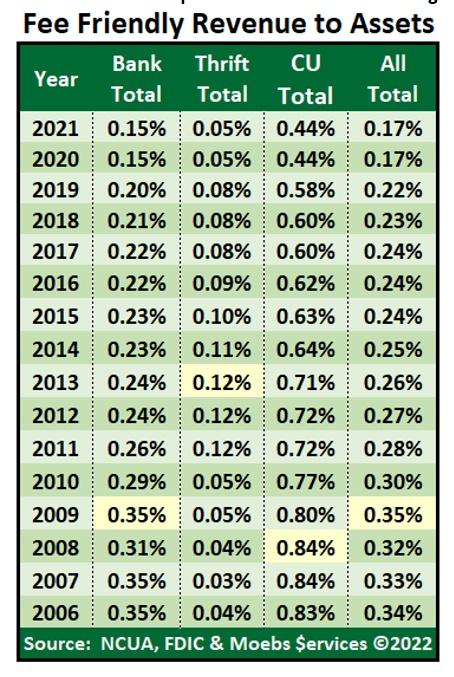
CUs Lead the Way
“In the past 15 years, credit unions have reduced fee revenue by volume,” said Moebs. “CUs were the first to put caps on loan fees. Credit unions were the first to give grace periods on deposit fees. CUs were the first to refund fees for relationships, although in the past 15 years banks have become much more relationship-oriented to reduce or not charge for fees on both loans and deposits.”
Moebs further observed that fee revenue has been falling for the past 15 years because financial institutions have introduced new features: one-three day grace periods before charging a fee, about $10 de minimis balances and transaction amounts not charged for ODs or NSFs fees, charging only one fee per day, refunding consumer errors, and reducing the price to zero for an OD or NSF because of low volume.
“These actions have cut up to $40 billion a year in fee revenue over 15 years for banks, credit unions, thrifts and fintechs,” he said.
A ‘Misunderstanding’
Moebs contended that much of what Washington is doing in focusing on fees comes from a “misunderstanding.”
“There is a total misunderstanding that fees are evil,” he said. “A knowledge of usage fees versus service fees is necessary. Usage fees are something like a toll fee on a highway or an entry fee into a park or recreational area. Behaviorally, people dislike usage fees because they believe roads, parks, and recreational areas should be free. The problem then becomes where do the funds come from to maintain these services?
“Service fees are for providing work to assist, help, or provide or advise. If you need surgery a doctor skilled in medical surgery is needed,” he continued. “Cleaning people help keep residences or business germ free and looking nice. Financial advice guides in preparing for savings for a house or retirement. The question then is are these services worth it?”
With any service there is a certain friction or start-up and maintenance cost, Moebs pointed out.
“Then there is compensation for the person or people providing the service,” he said. “Often people believe service, whether paid for with a usage fee or actual labor, should be free or low cost. Government, especially in election years, is fond of saying any service fee is evil or bad to get elected. Thus the major megaphone for evil or bad fees are elected officials. Consumers recognize a fee is necessary.”
A Loss-Leader
Turning to checking, Moebs noted that most depositories lose money on consumer checking.

Michael Moebs
“In particular, single-service checking accounts at any depository lose on average over $100 per checking account annually,” he said. “Checking is like milk or eggs in a grocery or convenience store. Buy just milk and the store loses money. Provide no loans or other deposits and the financial institution loses money on checking.”
Moebs noted that 31% of all checking accounts have an overdraft fee price of $15 or less.
“Consumers can shun depositories completely and go to in-person payday lenders or Internet payday lenders,” said Moebs, who suggested that’s exactly what could happen if the CFPB or Congress were to eliminate overdrafts. “The advantage of a payday lender is the term which is for 14 days. The price at a payday lender for covering the $116 average overdraw balance is $36 for $200—payday lenders advance in $100 increments.”
Moebs continues to advocate for an overall reduction in fees.
“To get to the point, credit unions need to cut their overdraft transaction fee to less than $20,” said Moebs. “They will then learn the consumer will use the service more and the CU will make the same amount of revenue or more. Plus, there would be no problem with Washington.”
Additional Advantages
Moebs pointed to what he said are additional advantages of fairly priced overdrafts:
- Overdrafts prevent more than 678 million debit card purchases from being declined. This can include critical purchases of gas, groceries, dentist, etc., he said.
- More than one-billion overdraft fees would not be charged to consumer checking accounts if overdrafts were eliminated. This amounts to more than $33 billion in uncharged overdraft fees, and 111,000 depository workers would lose their jobs.
- Sixty-million Americans’ cell phones, auto payments, mortgage payments, and rent charges would not be paid without overdraft limits provided by depositories to cover shortfalls on consumers’ checking accounts.
A Way of Life
“Overdrafts have become a way of life for many Americans. These Americans make errors,” Moebs said. “These Americans are short of funds from time to time. These Americans need to pay unexpected health expenses, auto repairs, etc. Americans rely on banks, credit unions and thrifts to help them—and all these depositories do help with reasonable fees.”