

ANAHEIM, Calif.–The economic forecast? “Meh.” And that’s not all that bad.
As for those worries over numbers related to retail sales and manufacturing? They’re not so important.
In an entertaining and quick-moving assessment of the economy and what credit unions are going to have to deal with moving forward, Dr. Elliott Eisenberg told the CUNA CFO Council annual meeting here that he wished his message was as optimistic as the Disneyland Hotel that was hosting the event. By the same token, the economy is no fleabag motel, either.
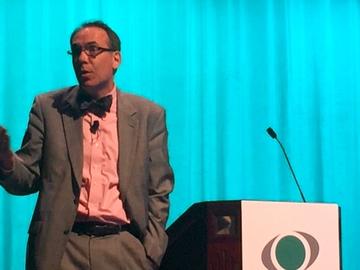
Dr. Elliot Eisenberg speaking to CFO Council.
Eisenberg, who is the chief economist for GraphsandLaughs, LLC, an economic consulting firm, and the former senior economist with the National Association of Home Builders, called the chances of a recession “very, very remote,” but added, “our economy is built for mediocrity.” That said, he forecast that the U.S. economy is plenty strong to withstand pressures from outside the U.S.
Eisenberg offered this formula to sum up where the economy stands: GDP = C (household consumption, which is good) + C (corporate investment, which “sucks”) + G (government, which is “OK”) + (X-M), which is exports minus imports (which are horrible).
“You can’t have a great rocking economy without all four parts contributing,” said Eisenberg.
What gives him reason for optimism, he said, is that household balance sheets are “OK” and that consumers have better cash flow due to lower interest rates and gas prices.
Eisenberg, who described the recession years as when “Everyone said ‘Let’s get a coke habit, a mistress and a penthouse apartment,” noted there are “catches to the improvement” in the consumer piece of the economy.
“We need to have increasing debt. You can’t rely solely on wage growth. But the growth in debt is coming from one, automobiles, and two, student debt, and student debt is now the largest item on the household balance sheet, with the exception of mortgage debt.”
Eisenberg’s view is that while more than 3.5 million people have defaulted on student debt, “I’m not convinced the problem is as severe as we think, at least for our (financial) institutions.”]
Contrary to Conventional Wisdom...
He noted that contrary to what conventional wisdom might suggest, those with the highest amounts of student debt are most likely to pay it, because they likely attended graduate or medical school and will move into higher paying positions. Those people will still buy houses and cars, he said.
“There are a lot of people who went to college for one year and dropped out and have the internal drive of a dead battery,” said Eisenberg. “They weren’t going to buy houses and cars anyway.”
Where Eisenberg did express concern was with the huge number of outstanding subprime auto loans now in the market, which he said are going to lead to “some repo problems.”
Overall, he said credit unions should not expect the auto lending market to get any better than it has been the past two years.
“As far as consumer confidence, it’s fine,” he told the CFO Council meeting. “It took us a long time to get here. Nothing is great in this economy, but everything is pretty much OK.”
As an example of how things have improved, he showed a slide of visitors to Las Vegas, which he dubbed the “most discretionary of the most discretionary” spending, which is now higher than it was before the recession began.
Here’s a look at some of the other broad economic issues touched on by Eisenberg:
Retail Sales
While there continues to be a focus on retail sales and especially how certain big box retailers are performing, Eisenberg said, “Macy’s doesn’t matter anymore. Nordstrom’s doesn’t matter anymore.”
“Let me disabuse you of this notion: retail spending is meaningless,” said Eisenberg. “I just want to see household spending. Retail spending is doing badly because A) no one goes to a store and B) we spend so much money on phones now that we don’t have much left for other things. It’s no longer the bellwether it once was. And this doesn’t include the online sales, like Amazon, which is doing really, really well.”
Eisenberg said that if all household spending were aggregated it would average 3% growth over the past few years, which is better than economic growth that is being held down by other factors.
Corporate Investment & The Yield Curve
The collapse in oil prices has not led to any new investment in exploration, and that is affecting the broader corporate numbers, said Eisenberg. “Stupendously low” prices for natural gas are another contributor.
“Corporate profits aren’t going anywhere. Profits at banks aren’t great and aren’t going to get appreciably better,” he said. “I don’t see the yield curve moving much up or down, especially up. We’re going to be living with this situation going forward.”
Capital Goods
The strong dollar means “Americans buying lots of imported stuff, and that’s hurting manufacturing, and there is nothing we can do about it, but it keeps our economy going kind of ‘meh,’” said Eisenberg. “The underlying mojo of our economy is 3% or 3.25% growth, but it’s not doing that due to crappy export numbers. Otherwise that’s why I’m relatively positive about economy.”
Federal Spending

Federal spending this year will be up by about $50 billion to $60 billion, and “given that the globe is cooling, that’s not altogether a bad idea,” said Eisenberg
Exports/Imports
“This situation is so bad, you want to take a pen and stick it in your eye,” said Eisenberg. “The dollar is so strong; it’s had a rampaging year and a half.”
Trade Deficit
“Our energy deficit is about zero,” said Eisenberg. “But it’s being counterbalanced almost dollar for dollar in rapid, worsening decline in our trade in other imported stuff. We are buying imported goods and not staying in America on vacation. The dollar is strong because our economy is fundamentally stronger than other countries’. People are selling Euros and buying Treasuries and dollars, which is pushing our rates down but making our trade balance worse.
“If you want to worry about something at night, it’s that both imports and exports are declining,” continued Eisenberg. “Historically that means a recession; I don’t think we’re going to go into one, but it makes me slightly nervous.
Manufacturing
Eisenberg said manufacturing continues to struggle, but the U.S. may finally be over the recession in manufacturing. “But like retail sales, manufacturing just doesn’t matter that much anymore, and that’s because no one works in manufacturing anymore. We are a post-manufacturing economy. It’s not enough to drive us into the drink, to push us into recession.”
Service Economy
Eisenberg noted that the service sector is now 65% to 67% of the economy, and it’s doing fine.
Labor Markets
The labor markets, said Eisenberg, are on the mend. “We are creating 2.5 million jobs per year. It’s more jobs than we need to absorb incoming high school grads, college drop-outs, college grads, etc. It’s enough to keep us out of the drink,” he said. “The canary in the mine shaft now is new job creation. We have 5% unemployment. The only time it’s been much lower in last 40 years was right before dot.com bust and the housing bust. So when we get (low unemployment) it can be a harbinger of something crummy. The reason it’s not going down so fast is we’re not creating jobs, because we’re running out of unemployed people. The other good news is the number of people quitting jobs has hit near historic highs, which means people are confident.”
The not-so-good news in labor markets is that wages have not gone up much, despite tight markets.
“It’s a bit of a conundrum,” said Eisenberg, regarding why wages aren’t growing. He said one theory is that employers held on to best employees during the bust, and now are catching up by “screwing” them.
“I’m not sold on that,” he said. “I’m more attached to believing that the number of Boomers who are retiring is so large that its depressing wage growth. Yes, these Gen Y’ers are coming up, but they are starting their careers. They are young. They are making $30,000 and those who are retiring are making $100,000. Now, that being said, the catch is income distribution, and this gets to the appeal of Donald Trump and Bernie Sanders. The rate of growth in your income is entirely dependent on how much you make. The more you make, the more your increase. Wages are going up, but they are not going up easily. The Fed wants to see wages go up at the lower end.”
The Federal Reserve
Eisenberg said what the Fed is very focused on is PCI, or the Personal Expenditure Index.
“The Fed wants this number to be 2%, but it hasn’t been since 2012, and at that time it was that way for an hour,” said Eisenberg. “It was really last there on 2009. So the Fed is going to have to start raising rates, because unemployment is low and we’re running out of people. Inflation seems to be starting to take off a little bit, wage inflation is taking off a little bit. The Fed would like to raise rates, but they can’t, because the globe has some problems.”
The Fed Forecast
Eisenberg predicted rates will rise “S.L.O.W.L.Y.” for the next three years. “I think there a 25% chance of a .025% rate hike in June.”
One year from now Eisenberg said he’d like to see the Fed Funds rate at 1.675%, and he’d like to see four rate hikes in the year after that.
“Don’t worry about interest rates ruining your business; it ain’t going to happen” he said. “Don’t forget the 30-year mortgage is based on the 10-year Treasuries and long-term inflation expectations, not the Fed funds rate, so don’t confuse these two.”
Housing
“The good news here is that residential fixed investments have been climbing but slowly, but it continues. The Gen Y’s and Millennials are getting older and we are getting all-important household formation. And that will drive home construction activity.
That’s the good news. The bad news, said Eisenberg, is that credit is generally very hard to get.
“Today, there are more auto loans than there are home loans. Subprime auto loans came down, and then went right back up. Subprime mortgage loans came down, and then stayed there. First time homebuyers really have a problem: home prices growing faster than wage growth and putting a lot out of reach.”
Refinance Market
“We’ve burned refi’s out. There is no one left to get a refi. And if they are eligible, they are too stupid to find it. So you’ve got to find them.”
Millennials
“We have to start talking about them. They are now entering the home buying age, and they are going to start driving the single-family market,” said Eisenberg. “There is a tsunami wave of these people buying houses and cars. You need to capture these people using mobile (solutions).”