MUSKEGO, Wis.–While it will add to the average credit union’s workload, NCUA’s new interest rate risk metric is a positive step, insists one analyst who sees the guidance providing regulatory certainty and consistency.
“We now have clarity on the topic of net economic value (NEV) testing and that is a sound step forward,” said Kevin Chiappetta, senior VP of investment services for Corporate Central Credit Union. “This guidance will help credit union managers not only understand the standards to which they will be held, but also how those standards are measured by NCUA.”
With this new NCUA guidance that addresses market risk, clearly defined parameters regarding a “long debated” subject—IRR—are now available, as are clear thresholds for risk categories, said Chiappetta.
“Using this guidance in conjunction with the other four metrics—earnings at risk, stress testing, measurement systems and risk management—we can feel confident that a high measurement in the net NEV category won’t necessarily lead to an exam action letter,” he said. “Well-managed earnings, good governance, adequate measurement systems and frequent, meaningful stress testing, can all lead to a positive examination experience for IRR.”
Monitor Industry
Chiappetta emphasized that NCUA’s job is to monitor the industry and determine where to focus attention. With nearly 6,000 federal credit unions managing more than $1.2 trillion in assets, it’s no small task, he said.
“Reliable risk-ranking within the system is necessary. That reliability requires a standardized approach to assessing risk, and to that end, NCUA has developed a standard metric to measure the one predominant variable used in the practice of IRR modeling: non-maturing deposits (NMD),” Chiappetta said.
Chiappetta acknowledged that in addition to driving debate, IRR is the source of “endless disagreement” among practitioners and regulators alike.
“In order to address that debate, NCUA worked to develop a consistent measurement standard,” he said. “The specifics of the standard will be deliberated for as long as there are balance sheets to manage. But for now, credit unions must abide by the new metric. The new metric will be used to measure IRR for all exams that end on or after Jan. 3, 2017.”

Kevin Chiapetta
Chiappetta reminded that the only assumption undergoing change in the risk model is the measurement of NMD.
“All previous standards, best practices, and policy requirements are still part of our risk measurement and management process,” he said. “In short, credit unions can now take a 1% valuation benefit—price reduction—in the base case, a 4% benefit in extreme rate scenarios, or for the current case, an increase of 300 basis points.”
Risk Threshold
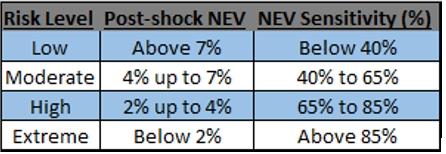
NCUA also introduced a risk threshold to categorize each credit union using the new standard NMD assumption, explained Chiappetta.
“As before, there will be only four risk categories: low, moderate, high, or extreme. What’s new is the level of volatility in credit union NEV and overall post-shock NEV defining each of the risk categories,” he said (see table below).
Chiappetta noted that the thresholds have changed from what was previously considered the unofficial limits in the Examiner’s Guidelines.
“While limits regarding the assumption on the lives of NMD accounts have been set, the limits on NEV results are more generous,” Chiappetta pointed out. “What we give up in assumption variance we gain in sensitivity limits.”
Risk Measurements
As CUs focus on adjusting to this new market risk metric over the next several months, Chiappetta said shops should remember there are other, just as important, risk measurements that remain. He said the Examiner’s Guide will continue to focus on the five areas of IRR measurement and monitoring—which also include earnings at risk, stress testing, measurement systems and risk management.
“This new directive clarifies how to handle market risk but does not eliminate any of the remaining four areas of focus, nor are they replacing any other metrics used in measuring IRR with an NEV-only approach,” Chiappetta said.
Will this new risk measurement lead to adding a new component to the CAMEL rating as many have predicted, asked Chiappetta.
“Time will tell. But for now, we have clarity on the topic of NEV testing and that is a sound step forward,” he restated. “We need to begin model assumption tuning, test the results, and then make sure we develop intelligent scenarios and sensitivity testing.”