

By Ray Birch
ALEXANDRIA, Va.—Credit unions are facing a pivotal moment in their history and must take a hard look inward, warn former NCUA Board Members Todd Harper and Tanya Otsuka. They caution that certain CU trends—like investing in major sports sponsorships and drifting from their core mission of serving people of modest means—are putting the credit union tax exemption in serious jeopardy.
They are also concerned about the future of credit union—and all financial services—regulation.
In a Q&A with CUToday.info, Harper and Otsuka discussed their dismissals, their lawsuit against the Trump administration, concerns over efforts to consolidate federal financial industry regulators and diminish their authority, and what lies ahead for CUs and the entire financial services system.
CUToday.info: How troubling are the Trump Administration’s apparent attempts to consolidate federal financial regulators?
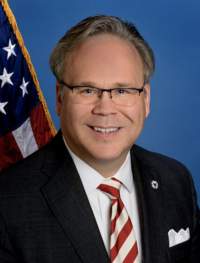
Todd Harper
Harper: The points that Tanya and I are making are not theoretical. If you go back and look at the savings and loan crisis, you had an administration in the Reagan years that did not want to admit the size of the problem and the problem grew. They would not allow regulators to go up to the Hill to explain the problem. In addition, politicians were controlling the budget of the Federal Home Loan Bank board through the appropriations process and limiting its money. That affected its ability to do its job effectively. We saw what happened with the savings and loan crisis. It was a multi-billion-dollar bailout, and that could happen again. Neither Tanya nor I want to see that happen.
Project 2025 calls for consolidation of financial regulation, bringing financial institution regulators under a single regulator. I'm deeply concerned that my unlawful and unprecedented removal, along with Tanya's unlawful and unprecedented removal, is part of a plan to consolidate regulation. If we were to consolidate regulation, I guarantee the cooperative model of credit would not get the attention it deserves—and that's because the cooperative model of credit is often quite small. Sixty percent of our 4,500 or so credit unions are below $100 million in size.
The total credit union system has $2.3 trillion in assets. Yet we have the largest bank in the country at the $3.46 trillion, and the total banking system is between $23 and $24 trillion. That's where the attention is going to go, and I deeply worry about the withering away of the credit union system as we know it—especially its ability to serve people of modest means.
Otsuka: From my standpoint the most important thing is our ability to protect the financial system. But stripping down and removing the independence of federal financial agencies, like the NCUA, is going to leave us in a much more precarious position when it comes to protecting people's money, when it comes to making sure we can create confidence in the banking system and credit unions, and making sure we have durable policies that benefit from different voices and stakeholders. All of this is chipping away at the very foundation of our financial system. A lot of businesses and companies view the United States as a stable and safe place to do banking. They view it as a stable economy. If we break that confidence in the financial system, it's going to reverberate through the rest of the economy in ways that I think is not going to be beneficial to the American people.
CUToday.info: Regarding your lawsuit, is there more at stake than your jobs?
Otsuka: This is really not about our jobs. This is about more than that. Of course we are dedicated to doing our jobs. We're committed public servants. It was an honor to be nominated and confirmed to these roles. But I think that's part of the reason why we continue to view our jobs as bigger than us. We both care about the state of our credit union system and the state of the financial system at large.
Harper: I agree with everything that Tanya said. I'd also add that we are one of several regulators (the Trump Administration) is looking at. Whether it's us, the FDIC, or ultimately the Federal Reserve, our lawsuit makes it very clear this situation is a slippery slope. Once you start to remove us then it becomes easier to go to those other regulators and get rid of those board structures—those very structures that Congress intended to insulate our regulatory, financial and economic systems from politics. And we can't allow that to happen.
CUToday.info: You are asking for reinstatement. However, in previous cases where federal agency board members won their suits for improper removal, they received money. Yet none have returned to their board roles. Do you expect to be reinstated?
Harper: Yes. The other cases that have been outlined do not involve the fact pattern involved in this case. We are serving within our terms. There was no cause for our removal. We've also seen that at other federal agencies, like the National Labor Relations Board and the Merit Systems Protection Board, that the board members removed were reinstated by the courts. I anticipate that Tanya and I will be reinstated as well.

Tanya Otsuka
CUToday.info: If you are reinstated, how might your relationship with Republican Chairman Kyle Hauptman be impacted?
Otsuka: I would approach my working relationship with my fellow board members the same way that I have since I joined the board—in a collegial and professional manner. I don't anticipate acting any differently. I'm there to do my job. I'm there to raise the issues I think are worth raising. I'm there to ask questions. And I'm there to work with my fellow board members. Generally speaking, we have a very good working relationship (with Hauptman). There are a lot of things that we work together on. The three of us came to consensus a lot when we worked together on the board. I think that's the way we would continue to operate.
With any board there's always going to be policy differences. There's always going to be debate. And I think that's healthy. The whole point of having a board is to flesh out ideas. And even if we ultimately disagree, I hope in the end policies are better because they're better fleshed out.
Harper: I agree 100% with Tanya. I've had a long working relationship with Kyle that started in December of 2020. That's more than four years of working together. During that time I think we have more often agreed and ultimately come to a consensus. Several recent examples come to mind. For example, in the budget for 2025 and 2026, we were able to reach a consensus on that. For example, for the succession planning final rule we were able to reach a consensus with all three board offices voting together, as well as with the agency's annual performance plan. I would say that Kyle and I have ended up voting in the same place 95% of the time or higher. Tanya's absolutely right, there are going to be times when there are differences. But that's what a board structure is for.
CUToday.info: What's ahead with the lawsuit?
Otsuka: I'm optimistic. But I defer questions about timing to the attorneys. We are well represented. We've got a great team.
CUToday.info: Are credit unions entering a potentially challenging chapter in their history?
Harper: Yes. In the 25-plus years that I have worked on credit union policy issues, both on Capitol Hill and at the agency, this is the most tenuous moment I have ever seen for credit unions when it comes to the tax question. The underlying purpose of the credit union system and its statutory mission is to meet the credit and savings needs of members, especially those of modest means.
There are many credit unions that are living that mission and doing it each and every day. But, we also have seen an increasing number of credit unions acquire banks. Now that's allowable under the law, but what ends up happening is a blurring of the lines between the cooperative movement and the private-sector banking movement. We're seeing big stadium naming rights deals. We’re seeing high overdraft charges at some credit unions overall, which sometimes hurt people of color and people of modest means in a disproportionate way.
Credit unions really are at a moment where they need to take a look at themselves—at where they are and where they are as a movement. At some of our smallest credit unions I see 20% or more of loans going to people of modest means. And by people of modest means I'm defining them as non-prime borrowers. Then, you look at many of our largest of credit unions, and some of them are only doing these types of loans with 3.5% to 4% of borrowers.
Those credit unions who are making 20% or more of their loans to people of modest means are doing much more with the credit union mission. We need to see more credit unions doing that in order to protect the tax exemption.
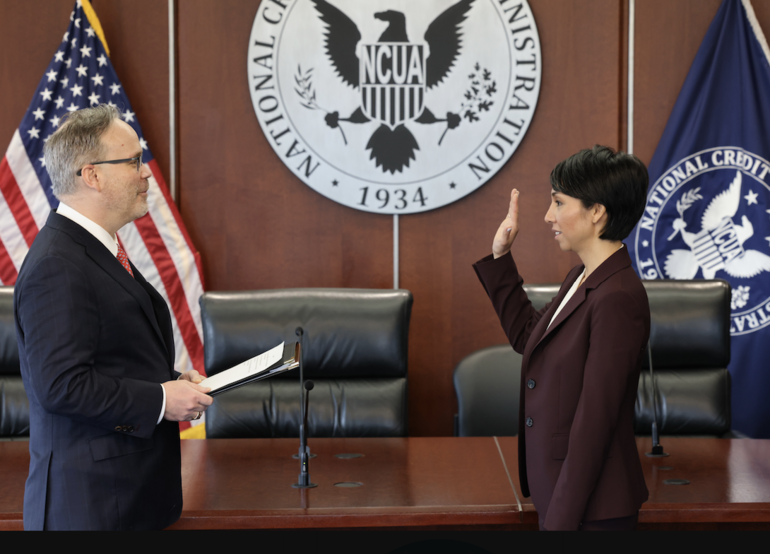
Tanya Otsuka being sworn into office by NCUA Chairman Todd Harper.
One last thing on the tax exemption, if Congress were to tax credit unions, I would have safety and soundness concerns. Credit unions, at this point in time, generally, can only raise their capital through retained earnings. If you are taxing the earnings that are coming in, it would mean growing those earnings at a slower rate. That could lead to safety and soundness and solvency issues at certain credit unions.
Otsuka: A lot of things are happening all at once. In addition to the tax exemption concerns…And I agree with Todd that the tax exemption may not be a given anymore in the minds of lawmakers. But, now you have a potential weakening of the independence of the NCUA, that also plays into this. NCUA was specifically created as an independent agency, tasked with supervising credit unions and protecting members’ deposits in credit unions. The credit union structure is different than the bank structure. When I arrived at NCUA, I really understood even more how important those distinctions are.
There is a lot of value in having a regulator that really understands all of the idiosyncrasies of credit unions, the different business model of a credit union. There are, of course, similarities. But when you get into the weeds there are a lot of distinctions that I think would be lost if we didn't have an independent credit union regulator that's looking out for the safety and soundness of credit unions and protecting credit union members.
Harper: America's Credit Unions has long said that an independent regulator should be comprised of boards, and they've been calling for a board at CFPB ever since the Bureau was created. Now, in the midst of this, they should want to maintain the independence of the NCUA, and yet they're sitting on their hands when it comes to calling for the reinstatement of board members.
What's more, you've seen other groups, like Inclusiv, which understand what's at stake, putting out very strong statements about how deeply concerned they are and how they want to see the independence of NCUA. ACU is trying to play both sides of the coin to get what it wants. It needs to really pick what side it is going to stand for in the future.