

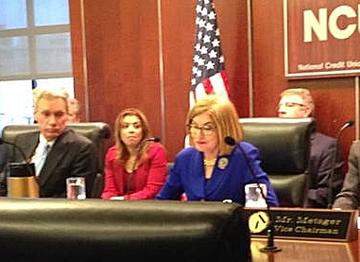
RBC exchanges between Mark McWatters (L) and Debbie Matz have continued outside the board room.
ALEXANDRIA, Va.—In a case of who said what and when did they say it, two NCUA board members have gotten into a war of words over an agreement the agency has with an outside law firm.
At the center of everything is this question: did NCUA Board Member Mark McWatters violate a legal agreement between the agency and Paul Hastings, LLP, which had provided it with an opinion letter on its authority to issue a two-tiered risk-based capital proposal, when he quoted from that letter during NCUA’s January board meeting?
Or had NCUA Chairman Debbie Matz already let “the cat out of the bag,” as McWatters has charged in a newly released statement, with her own statements at the board meeting?
That question is at the center of what is literally a he said/she said disagreement, with both Matz and McWatters issuing opposing statements on who said what, and when did they say it.
Much like a legal case itself, the debate comes down to a single question: when NCUA board members cited Paul Hastings at the Jan.15 board meeting, were they quoting from what that law firm said during an oral presentation to the board prior to the vote on the risk-based capital proposal, or were they citing language in the written legal opinion letter on which the oral presentation was based, which is bound by a confidentiality agreement.
Latest Disagreement
The disagreement between Matz and McWatters is just the latest related to risk-based capital proposal. NCUA spent $150,000 to obtain from Paul Hastings an opinion letter that Matz, NCUA Board Member Rick Metsger, and the agency’s general counsel have interpreted to mean NCUA could fashion the proposal in the way that it has.
But McWatters, an attorney, has dissented, saying the legal opinion is, at best, a weak basis for NCUA’s actions. As part of his dissent he referenced sections of the Paul Hastings’ opinion during the January board meeting at which the risk-based capital proposal was voted upon, but spoke only after Matz had first addressed the Paul Hastings’ opinion during her remarks.
As part a Jan. 12 agreement with NCUA, Paul Hastings stipulated that NCUA could not quote in whole or in part from the legal opinion letter delivered to the agency by the law firm at the close of 2014.
Less than a week following the January board meeting, CUToday.info was the first to make NCUA’s legal opinion letter from Paul Hastings LLP available via a Freedom of Information Act request.
Last week, CUToday.info also obtained via a FOIA request the Jan. 12 follow-up letter from Paul Hastings to the NCUA Board regarding the agency's request to publicly disclose the written legal opinion letter. In that letter, Paul Hastings stated its opinion was provided only to the Board and only for the Board’s consideration, “and thus the disclosure or further distribution of the Opinion Letter is restricted . . . Without the Firm’s prior express written consent, the Opinion Letter may not be furnished to, or be used or relied upon, by any other person or entity, or in any other context, and may not be quoted, in whole or in part, or otherwise referred to, filed with or furnished to any other governmental agency or other person.”
Not Permitted To Disclose Opinion
During the January board meeting at the agency’s Alexandria headquarters, in a statement prior to the vote, McWatters said, “It is worth noting that a well-known law firm has rendered an opinion to the Board regarding the legal authority of the Board to establish a two-tier RBNW system. Regrettably, I am apparently not permitted to disclose the opinion letter itself or discuss ‘the substance, analysis or conclusions’ provided in the opinion letter, even though NCUA and, as such, the credit union community has committed to pay $150,000.00 to date for the legal services rendered.”
During his remarks at the meeting, and in a subsequent interview with CUToday.info, McWatters did cite some specifics from the Paul Hastings letter, in particular the use of the word “could.” McWatters, who has been a faculty member of Southern Methodist University’s law school, argued during the board meeting and then later when his full statement was released, that the agency’s was basing its entire case on a relatively weak legal standard.
In his formal statement, McWatters said, “During the January 15, 2015 Board Meeting, the Chair discussed ‘the substance, analysis and conclusions’ of the Paul Hastings legal opinion, and in order to clarify the record I remarked as follows: It is worth noting that a well-known law firm has rendered an opinion to the Board stating that a court ‘could’ conclude that NCUA has the legal authority under the Chevron doctrine to establish a two-tier RBNW standard. As a practicing attorney, I have served on the legal opinions committee of large, cross-border law firms and note that a ‘could’ opinion represents a relatively modest standard of assurance. In the obscure, arcane and highly technical and nuanced world of legal opinions, key words such as ‘could,’ ‘would,’ ‘should,’ and ‘more likely than not’ truly matter. The recipient of a legal opinion prefers to know that a court ‘will’ or ‘should’ or, at a minimum, ‘more likely than not will’ uphold the legal actions of the recipient. An opinion letter merely noting that a court ‘could’ uphold the actions of the recipient, although not entirely unhelpful, offers limited comfort to the recipient.”
In the 13-page opinion letter reviewed by CUToday.info, Paul Hastings said that it had concluded that “we are of the opinion that, under current principles of applicable law and existing case law, a court of appropriate jurisdiction, in a litigated matter or proceeding, could conclude that NCUA’s statutory authority pursuant to Section 216 of the FCUA permits the NCUA to establish the proposed two-tier RBNW requirement set forth in the proposed rule.”
During the Jan. 15 board meeting, Matz noted during her remarks that she and other NCUA employees were not permitted to quote from the legal opinion letter, as per the agreement. Last Friday, Jan. 30, Matz released a follow-up statement reiterating that the Jan. 12 follow-up letter from Paul Hastings binds the agency to “not reference the December 30, 2014, legal opinion letter contents in public,” and that any references she made during the January board meeting regarding the work of Paul Hastings were to the firm’s oral opinion delivered to the board, not the letter. She also noted that both the follow-up letter and legal opinion have since been released by NCUA under FOIA requests (by CUToday.info).
“My statement at the Board meeting on January 15 did not read from the written legal opinion letter. However, by prior agreement, a representative of the Paul Hastings firm verbally authorized me to reference the oral opinion at the Board meeting,” Matz said in her statement. “There, I stated that the oral opinion supported our proceeding with a two-tier risk-based capital framework comparable to other banking agencies. The bottom line is that the Paul Hastings law firm had verbally agreed it was acceptable to reference the oral opinion at the Board meeting.”
Matz Refers To Oral Opinion
During the Jan. 15 board meeting, Matz, reading from prepared remarks, said, “The oral legal opinion maintained that while certain parts of the Federal Credit Union Act are arguably ambiguous, it did support our proceeding with a two-tier risk-based capital framework comparable to the banking agencies—with one threshold to be adequately capitalized and a second threshold to be well-capitalized.”
On Friday, Jan. 30, McWatters posted an addendum on NCUA’s website to his Jan. 15 statement in which he stated Matz “has accused me of breaching the non-disclosure letter sent from the Paul Hastings law firm to NCUA when, in actuality, the Chair breached the non-disclosure agreement during her statement . . . ,” wrote McWatters.
“Specifically, the Chair advocates that the letter and spirit of the non-disclosure letter only covers the written legal opinion and not the oral legal opinion rendered by Paul Hastings,” stated McWatters. “She argues that since she referenced the oral legal opinion at the Board meeting she did not breach the non-disclosure letter, but since I referenced the written legal opinion at the Board meeting I breached the non-disclosure agreement.”
McWatters contends that when Matz disclosed the “substance” of the oral legal opinion at the board meeting she also disclosed the "substance" of the written legal opinion.
“She can't hide behind the ‘form’ of the advice rendered. It's a difference without a legal distinction,” McWatters stated. “The substance of each legal opinion is the same, and substance – not form – is covered by the non-disclosure agreement. Accordingly, the Chair violated the non-disclosure agreement with Paul Hastings. By the time I spoke at the Board meeting ‘the cat was out of the bag,’ as the key legal conclusion of both the oral legal opinion and the written legal opinion of Paul Hastings was already in the public domain. I merely commented on what had been disclosed by the Chair.”
Related
McWatters Challenges NCUA’s Legal Authority To Issue Two-Tiered Rule
CUNA, NAFCU & NASCUS Weigh In On RBC
A Graphic Overview of NCUA's Risk Based Capital Proposal
CUNA Sends RBC Message To Congress