

By Ray Birch
FOSTER CITY, Calif.—Digital wallet growth may be lagging in the U.S., used in just 3% of retail sales during 2018, according to one estimate, but Visa says help is on the way—and credit unions would be wise to get a strategy in place.
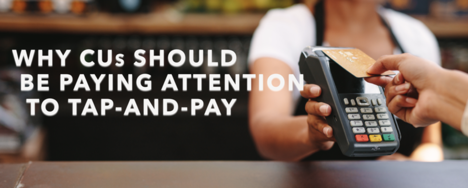
The help is coming in the form of contactless plastic, tap-and-go cards that are bridging the gap between digital wallets and chip or mag stripe.
As CUToday.info previously reported, there has been a wave of contactless plastic adoption this year, with Visa saying consumers, issuers and merchants are spurring the migration.
“We are seeing a substantial amount of our payment volume flowing through our terminals that are being made with tap-to-pay cards,” said Doug Leighton, head of community accounts at Visa. “And we are seeing a number of transit agencies announce plans to go to tap to pay. Chicago already has the technology and New York will roll out theirs this summer or late spring.”
When Apple recently announced its new Apple Card, it also promoted tap-and-go functionality with mass transit, including in Portland, Ore.
Leighton emphasized credit unions need to formulate a strategy soon around tap-to-pay plastic and how they anticipate rolling out these cards to their members.
“I think 100-million contactless cards will be issued in the U.S. by the end of this calendar year,” Leighton forecast. “I want to make sure credit unions know this and are participating in this evolution.”
PDQ at the POS
Contactless cards deliver a much faster transaction at the point of sale, which Leighton says will drive much more habitual use by consumers in retail lanes than digital wallets have to date. He believes pulling out a phone and opening up a payment app has simply been too much of a hassle to sway consumers in large numbers away from their physical cards.
“So now using a card gets consumers accustomed to tap-and-go, and the migration to the digital wallet will accelerate,” he said. “While we are certain that plastic will be here for some time, we will eventually migrate to mobile payments. This is a great intermediary.”

Doug Leighton
Leighton explained that in other countries that are moving to mobile payments, the typical steps have been EMV, contactless plastic and then digital wallets. In the U.S., he observed, not only has skipping the contactless plastic step been an issue, so has another factor.
“The timing of rolling out EMV and digital wallets probably has played a role in the slow consumer adoption of mobile payments in the U.S.,” said Leighton. “It was too much at the same time.”
Unique Situation in U.S.
What is also unique about the U.S. in the migration to mobile is merchants are now leading the way for contactless cards. Leighton said in countries outside the U.S., issuers have been driving the shift, while in the U.S. slow chip transactions merchants to make sure they can accept contactless payments, since the tap-and-go cards can dramatically speed up checkout lines.
“We see over 60% of our transaction volume today coming through contactless-enabled terminals,” said Leighton. “That doesn’t mean 60% of our transactions are contactless, it means the capability is in these terminals. We already see that 78 of the top 100 biggest Visa merchants are enabled with tap-to-pay.”
Leighton again encouraged credit unions to begin formulating plans to issue contactless cards to members.
“I understand credit unions just went through an EMV rollout, so a mass reissue to go to contactless is probably not something in the cards,” he said. “But certainly having a strategy around how to participate in this coming evolution of how we pay at the physical point of sale is going to be important.”
A Short-Term Solution
Leighton suggested credit unions at least adopt a short-term solution to address requests from members who ask for a contactless card.
“Especially for members who travel internationally,” he said. “Just be capable to give them a contactless card when they ask for one.”
Leighton said while banks are leading the way in reissuing among their cardholder base to contactless, credit unions are not lagging behind. He pointed out some large credit unions have reissued and are seeing strong results.
“I know Navy Federal has made the move and is already seeing a spike in the number of card transactions due to tap-and-go plastic,” he said.