MADISON, Wis.–Reopening branches involves far more than disinfectant and social distancing practices—credit unions are having to now consider everything from the risk of employee lawsuits to no more “entry-level” staff to whether an office chair should swivel.
Branches aren’t going to go away, but they are going to emerge from the coronavirus pandemic in an accelerated state of change, according to experts. Even with stay-at-home orders being lifted, most members, who have had no choice but to access their finances via desktop and mobile devices, are unlikely to drive to their branches moving forward now that they see they don’t have to.

The analysis included here is the first in a week-long series from CUToday.info examining the challenges to credit unions in reopening their facilities.
“Sixty percent of all traditional banking products are still sold directly in the branch environment,” said Carlos Molina, senior risk consultant with CUNA Mutual Group during a webinar hosted by the company titled “Employee Safety and the Workplace of Tomorrow.”
Molina’s insights are being featured here as part of a week-long series of coverage in CUToday.info related to the reopening of branches in markets where they have been closed.
Need for Rethinking
“It’s going to be hard to argue the brick and mortar channel isn’t going to continue to play a role in the retail financial services industry,” Molina continued. “But we also recognize that branches need to be rethought. So, how can we best use big data and analytics to make better decisions, ultimately with the goal of removing as much friction from the member journey as we can?”
Molina noted the traditional branch configuration calls for a large administration building with spokes out to smaller branches and then additional spokes to even smaller facilities and micro-branches.
But the future may all be micro-branches if there are physical facilities at all, he said.
“I think in branches going forward engagement is going to be a key issue–product sales, product resolution, financial counseling—all under the guise of relying heavily on the expertise of our branch staff,” Molina said. “Moving forward, I think new employees are going to have to be more than entry level. We are going to have to train them up toward what members expect when they come into the branch. We are going to see more use of digital channels and people will expect more in that environment.”
Molina emphasized the “human element will never go away,” but that doesn’t mean it will be in-person, face-to-face interaction. Instead, given a boost by all the Zoom and teleconferencing taking place during the pandemic, members will interact with their credit union via video and chat, both of which will “allow for a more expedited member experience,” he said.
System Under Stress

“The COVID 19 crisis, in no surprise, has put the entire CU ecosystem under stress,” Molina added. “There is quicker adoption of digital technology, remote work arrangements, flexibility and branch configuration. However, it’s still about good-old-fashioned response to behavior. This crisis highlights how important digital capabilities and product access are and how important speed and seamless integration are.”
In cases where a face-to-face meeting is required, Molina said he expects to see more of the kinds of scheduled appointments members are currently making with their credit unions.
“Despite state reopening plans, consumers are going to remain very cautious about visiting physical locations,” he said.
In cases over the last few months where members have been visiting branches they are doing so in new ways. Molina said CUNA Mutual is concerned after hearing from credit unions that many members have started to use the drive-through as a walk-through. He recommended credit unions put in place policies and signage around social distancing, as well as ensuring lighting and cameras are in place, curbs are painted, any parking lot hazards are addressed and more, including having a security guard on-site.
Best Practices for Remote Work
Meanwhile, with so many employees out of physical facilities and working from home, credit union leaders are also being challenged to rethink those environments, as well, said Molina.
“At this point most people have become experts,” he said. “Now is the time for some retrospective governance.”

When it comes to employees working from home, Molina urged credit unions:
- Ensure Data Protection. “Privacy and security of your member and CU information should be a top priority. If an employee is using personal mobile and desktop devices, identify minimum standards of security to access CU networks.”
- Avoid Fair Labor Standards Act Violations. Credit unions were urged to monitor and track the number of hours employees are working outside the office, especially those who aren’t salaried and are non-exempt. Make sure employees can only log in to the CU’s systems when they should be logging in. “Regardless of how long this current situation lasts, we should consider that remote work is going to be part of the new normal for the foreseeable future, and it’s going to have an impact on what constitutes a workday and work-life balance.”
- Provide a Safe Work Environment. Employee health and safety should remain a top priority, including in their own homes, said Molina. “Ensure the environment would be suitable for getting the job done without posing undue risks.”
- Define Availability, Responsiveness and Productivity. Molina said credit unions must provide clear and consistent communication to ensure employees can and do stay on task remotely.
Avoiding Injuries
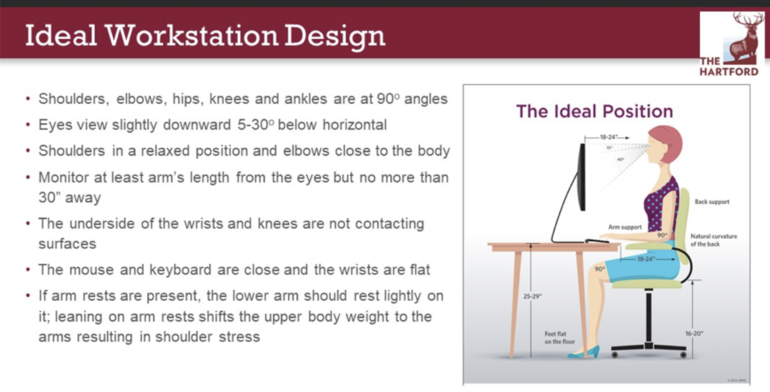
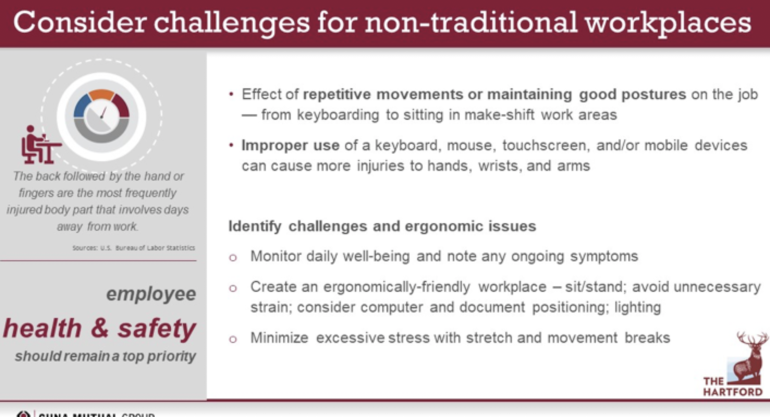
Employees working from home may not have the kinds of office equipment and setup they do at work. Brian Walker, a senior risk engineering consultant with The Hartford, said there are clear risks from the effect of repetitive movements or not maintaining good posture on the job, from keyboarding to sitting in makeshift work areas.
Improper use of keyboard, mouse, touchscreen and or mobile devices can cause more injuries to hands, wrists and arms, he said.
For those reasons he encouraged credit unions to monitor ergonomic issues and to note any ongoing symptoms.
Below are graphics illustrating issues relateed to work-from-home environments.