

Among those people who laughed: then Microsoft CEO Steve Ballmer, who said in 2007, “There's no chance that the iPhone is going to get any significant market share.”
By Ray Birch
BIRMINGHAM, Ala.—The iPhone officially turns 10 in 2017, marking a decade in which the revolutionary Apple smartphone and the mobile devices that followed have changed the very concept of how a financial institution—and the services market itself—does business, attracts new consumers, markets itself, and so much more.
To mark the 10-year anniversary of the iPhone, CUToday.info will be publishing a series of stories on the decade of change launched by the iPhone that’s likely unmatched in the history of financial services.
The impact the iPhone has had on consumers’ lives, and on banking, is evident in how much people depend on their phones each day, emphasized those who spoke with CUToday.info about the emergence of smartphones.
Mobile phones have not just for the most part eliminated land-lines and payphones, maps and calculators, flashlights and cameras, calendars and alarm clocks, but also—ironically—phone calls themselves.
Financial institutions haven’t been immune from the deep cultural change. The iPhone has changed the role of the branch by offloading an ever-growing number of transactions, especially payments, to a mobile device, reducing costs and extending the reach of credit unions beyond any fixed geography. But the iPhone, and the devices that have followed, have also meant new competitors often built specifically for the platform, while legacy competitors with deeper pockets are also as close as a click for CU members.
Jobs Steps On Stage
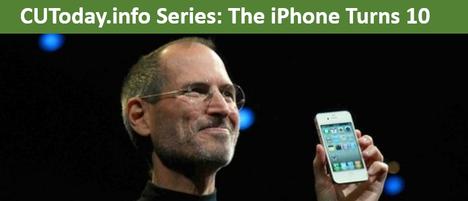
“When Steve Jobs stepped on stage and said let me tell you about the new smartphone we call the iPhone, I wonder how many people laughed at him,” said John Oldshue, principal at SaveOnPhone.com, which has been covering the phone industry since 1998. “Now we can’t imagine going anywhere without our smartphone in our pockets.”
(Among those people who laughed: then Microsoft CEO Steve Ballmer, who said in 2007, “There's no chance that the iPhone is going to get any significant market share.”)
With an impact that rivals or even exceeds inventions such as the printing press and radio, Bill Hardekopf, CEO at LowCards.com, says the revolutionary effects the iPhone has had on banking could not have been predicted when it was introduced 10 years ago.
“There are so many people that handle all of their banking needs today by never going into a branch,” said Hardekopf. “It would probably make our grandparents turn over in graves to know just how much money is handled with this little smartphone. To deposit a check remotely, 10 years ago, that was a mind-blowing concept . . . Who thought it would be a branch in your pocket?”
Lou Grilli, director of payments strategy at CSCU, emphasized that the iPhone, and the more than two-million apps that have been developed to support the device, have dramatically transformed the way people bank.
What the iPhone primarily accomplished, emphasized Grilli, actually can’t be found in the hardware of the phone itself.
“What really made the difference is not that the iPhone itself came out, but the ecosystem that surrounded the iPhone—the mobile apps, the app stores,” said Grilli. “That user interface of the new iPhone is what drove the change.”
The smartphone, and especially the “apps” ecosystem, has led to an environment in which consumers don’t ask as much what they can do on their smart devices, but instead become aggravated over anything they cannot do.
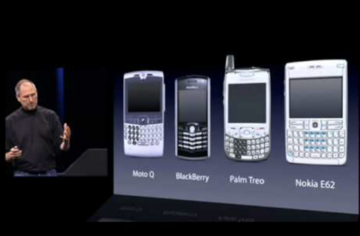
“That means every aspect of banking,” said Michelle Lemieux, product manager with CO-OP Financial Services. “It’s become a complete consumer mindset change in the past 10 years.”
Mindset shift
As well as a mindset shift for FIs, asserted Jeremiah Lotz, VP of product management at PSCU. When credit union marketers think about developing new products, one of the first things that comes to mind is how that product will interface with a mobile device, he said.
“Ten years ago mobile was not a big thing. Online was coming into its own, and when marketers thought about new products, online was on their mind,” said Lotz. “Now, in many cases, mobile is not just on people’s minds, it’s first and foremost. I think most marketers now develop first for mobile. They typically think more about how the consumer will experience their financial services product on their mobile device. CUs have had to reengineer how they think about delivering products.”
Follow CUToday.info this week and next for all of the stories in this series.