


WASHINGTON–If consumers have it difficult now trying to understand financial offers, imagine their plight not that long ago when “free” actually came with a cost and the higher advertised interest rate at one financial institution actually paid less than the lower rate advertised by another?
Consumer complaints over the confusion—much of it intentional–led to the enactment of Truth-in-Savings 25 years ago today on Dec. 19, 1991, when President Bush signed it into law.
Now, as what is best known to credit unions and their compliance departments as TISA marks its silver anniversary, it is considered by many regulators, consumer advocates, and bankers to be the most uniformly beneficial financial service laws for both financial institutions and consumers.
“Truth in Savings does seem to have withstood the test of time,” said Leonard Chanin, the attorney for the Federal Reserve who turned TISA (implemented by Federal Reserve Regulation DD in 1991) in 1992 into an implementable regulation.
In interviews conducted by Moebs $ervices, most sources gave credit to Leonard Chanin as the architect behind Truth in Savings, according to CEO and economist Michael Moebs.
For his part, Chanin notes the significant contributions of Richard Morse, an ardent supporter of Truth in Savings, who was a key figure in TISA’s passage. He recalled Jane Bryant Quinn of the Washington Post, observing, “On the Washington Mall, savers should erect a statue to Richard L.D. Morse, professor emeritus of Kansas State University. For almost 30 years, Professor Morse – the father of truth-in-savings legislation – has been badgering Congress…”

Leonard Chanin
What Was Checking & Deposit Culture In 1991?
To understand what led to the enactment of the law it is helpful to look at the retail financial environment of the early 1990s. A Moebs $ervices’ Study in 1991 found the average “free checking” account charged a $3 monthly fee if the required $100 minimum balance was not maintained. In the following year, another Moebs Study found that only 3.1% of all financial institutions offered free checking, where the average overdraft fee was $15 per item.
“Before TISA was implemented, many FIs did not properly disclose their fees or rates. Afterwards, the competition between depositories was welcomed, and so was the advertisement of these fees and rates to consumers,” noted Moebs. “Before TISA it was like pulling teeth to try to get a bank, thrift or credit union to tell our surveyists what the overdraft price was. It was easier to get away with lying to your mother than finding out an overdraft price.”
What Did TISA Do?
What did the TISA really do? According to Moebs, Chanin has the best answer.
“Regulation DD was the first federal rule to establish standardized disclosures and provisions for consumer deposit accounts. The rule created the concept of an annual percentage yield, which was the corollary to the annual percentage rate disclosed for loans,” Chanin said.
Moebs summarized TISA:
A. Every financial institution is required to disclose terms, rates, fees, and balances on deposit accounts.
B. Definition of accounts and features were standard. As an example, free checking:
-
- No minimum balance requirements,
- No periodic fees of any kind,
- No transaction limitations, and
- No conditions to get the account
B. There was a formula for calculating an annual percentage yield, and a rate was the rate.
D. Prices for some services, such as overdrafts, were required to be disclosed.
“The beauty of TISA is that it comprised only 10 pages of the 158-page FDIC Improvement ACT of 1991, and Reg. DD was less than 100 pages in final form. However, TISA and Reg. DD were so well crafted it gave very clear direction of what was required,” stated Moebs. “The consumer now had standardized information on deposit accounts to make a well-informed decision. As Edward Mierzwinski of the PIRG consumer group said at the time, “’This time the consumer won.’”
What Was The Result Of Truth In Savings?
Banks, thrifts, and even credit unions fought TISA very hard after it was enacted, Moebs recalled. However, according to Moebs, the only major thing that TISA’s detractors achieved was minimizing penalties that were included in the original act – something that had never really been done before TISA. This was answered by examiners who put violations in exam reports, leading to delays in new branches and other matters, explained Moebs.
The fight on TISA subsided when FIs starting making money from the uniformity and standardization of the Act. Along with the positive financial impact on FIs, the Act also gave consumers more transparency and better understanding of the services being offered and prices charged, Moebs said.
Free Checking & Overdrafts Provide The Measure of TISA
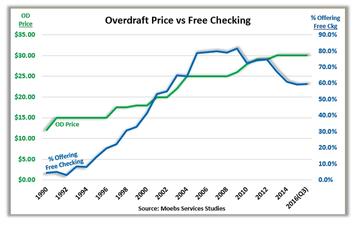
Moebs $ervices said a 1992 study it conducted found free checking was being offered by 3.1% of all financial institutions. For much of the next two decades the number of FIs that offer the service rose dramatically, hitting an all-time high of 81.5% in 2009. But after 2009 free checking has become less common, as only 59.4% of FIs are offering it today, according to Moebs $ervices data.
Moebs $ervices studies have also found that historically a higher percentage of credit unions offer free checking than do banks.
“Today we see that only 50.5% of banks offer it, while 79.5% of credit unions are offering it,” said Moebs. “This reinforces how banks and credit unions employ different strategies to succeed in the checking account marketplace.”
There is also a significant connection between free checking and overdrafts, added Moebs. Bank’s overdraft revenue in 1992 was approximately $10.7 billion, increasing to $26.9 billion today, a compound annual growth rate of 3.8% a year. Credit unions started out at $0.9 billion, growing to $6.1 billion today, a 7.6% growth rate per year.
“Another true measure of the full benefit of Truth in Savings can be seen with inflation,” said Moebs. “According to the Minneapolis Federal Reserve Inflation Growth Rate, an overdraft fee in 1991 of $15 per item is equivalent to $25.59 today.”
Currently only about one in four FIs offer ODs fees below $25.59 per item, noted Moebs. When taking size of an institution into consideration, nearly half of the small community institutions, below $100 million in assets, have OD fees less $25.59 per item.
“TISA had a large impact on the consumer’s knowledge of banking services and fees. It also impacted the level of competition between depositories,” said Moebs. “TISA standardized and leveled the playing field by defining APY. The significant impact of TISA on APY is easy to overlook the last eight years with record low rates since the Great Recession.”

Michael Moebs, Moebs $ervices
What Is The Future Of TISA?
Despite some adjustments over the last 25 years, TISA has stood the test of time, Moebs believes.
“Currently, it would appear there is no major overhaul needed for TISA,” said Moebs. “However, like baseball some tweaking with new amendments or rule changes improves the time tested.”
Moebs recalls famed economist Milton Friedman being asked about TISA at the time it was enacted.
“Friedman stated he did not believe in the regulation of services. To which he was asked if he believes in stop lights and stop signs,” recalled Moebs. “His response was classic: ‘If the stop lights and signs improve the flow of commerce then they could be useful.’ It would appear Friedman, on this 25th anniversary of the Truth in Savings Act, might find TISA useful.”