

By Ray Birch
LAKE FOREST, Ill.—As 2023 winds down, strategies are being shared to help credit unions ensure their checking offerings win back share from the major players in 2024.
A new study from Moebs $ervices reveals key points to consider to stem the outflow of checking accounts to giants such as the Walmart and BofA. Walmart currently leads the nation with 113 million checking accounts, while BofA is second, with 30.5% of the checking market.
In previous reports in CUToday.info, Moebs $ervices has underscored that checking providers with more than one-million transaction accounts—or “Big Checking” as the company refers to those institutions—have been stealing away smaller players’ checking accounts at an alarming rate.

Michael Moebs, economist and chair of Moebs $ervices, told CUToday.info his company’s latest Checking Study offers a roadmap that smaller institutions such as credit unions can follow to not just defend their checking account base but even begin to take back share from the checking giants.
“Since the Walmart checking explosion in June 2021, the type of checking service needed to compete is very important,” explained Moebs.
Can Smaller FIs Compete? ‘Yes’
He pointed out that in 2022 financial institutions (FIs) with consumer transaction account (T-account) portfolios of less than one-million accounts lost market share (-5.1%) nationwide. FIs with more than one-million consumer accounts gained market share (+1.9%). Those FIs with more than one-million checking accounts have 77% national checking market share.
“Can smaller depositories stop market share loss? They certainly can,” stated Moebs. “Our latest Checking Survey extensively examines the pricing, features, and profitability of the 28 FIs with more than one-million transaction accounts as well as a statistical sample of 3,536 FIs representing about 40% of the market with portfolios less than one-million accounts. The study has identified advantages, weaknesses, opportunities, and challenges to help small T-account providers be profitable and gain market share.”
An Outdated Approach
Moebs said the traditional model of defining success in checking as being measured by growth in deposits or number of accounts is now outdated.
“COVID upended this approach with the digitalization of the transaction accounts and increased competition from fintechs,” he said. “Checking success is now measured by profitability determined by transaction fee revenue, interchange, core deposits, direct and indirect costs, as well as transfer pricing of excess investable funds. This is essential. Don’t even consider other features until T-account profitability is achieved.”
While many credit unions offer multiple checking options, Walmart offers only one checking type and has a profitable portfolio, Moebs pointed out.
“In fact, a solid percentage of FIs with one-million-plus portfolios offer only one T-account,” Moebs said. “It is much more efficient to sell and service one account than multiple accounts.”

Michael Moebs
‘The Big Distinction’
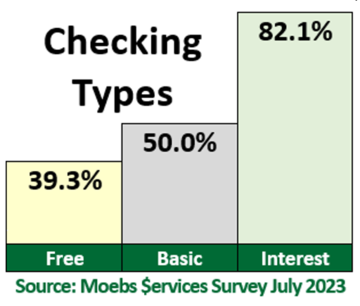
Moebs explained there are three basic checking account types—free, basic and interest bearing.
“The big distinction is free—39% of the Big Checking providers offer free compared to only 17% nationally for all FIs,” said Moebs.
Basic checking with a minimum balance to avoid a fee is done by 45% of Big Checking. Interest bearing T-accounts are the most popular type, offered by 83% of Big Checking.
“The rate offered is key to gaining market share and achieving profitability,” said Moebs.
FIs with low or no fees round out the final type of account offered by the top 28 checking providers.
“This includes 28% of Big Checking not charging for ODs,” said Moebs. “Basic T-account features include a $500 minimum balance with $10.50 fee for falling under. Interest paid ranged greatly from 0.01% APY to over 4.00%.”
A Point of Emphasis
Moebs emphasized pricing transparency is critical in attracting and keeping checking accounts, noting FIs with more than one-million T-accounts disclose all fees, balance requirements and rates on their website. Those with less than one-million have far less website transparency, he added.
“The website is where the action is,” stated Moebs. “Millennials and Gen Zs avoid in-person banking seeking robust websites and online chat to explain terms, conditions, pricing, and T-account services.”
Disclosures, compliance definitions, and communications need to be easy to understand and straightforward in “junior high-level language,” stressed Moebs. “Legalese and fine print are outdated and can be deceptive. The website is ideal to post plain language details on regulations from Reg CC (funds availability) to Reg DD (disclosure and overdrafts) to Reg Z (Truth-In-Lending) as well as privacy.”
Where to Focus in 2024
Is summary, Moebs pointed out what works best, and what credit unions this year should focus on to make next year a season in which they begin to take back share from Big Checking:
- Offer one checking account, at no cost to the consumer, with no minimum balance requirements.
- Structure interest paid via several balance tiers, rising from 0.01% up to T-bill/bond rates, paralleling the financial institutions’ interest-paying structure for term deposits and purchased funds, both insured and uninsured.
- Ensure full transparency on fees, list them on the website, along with access to disclosures and agreements for signature and consent, and all affirmed via text or email in less than 24 business hours.
“These financial puzzle pieces can make the smallest checking provider fully competitive with any million plus T-account bank, credit union, thrift, or fintech,” said Moebs.