

MADISON, Wis.–Three people representing small credit unions offered their insights into how a credit union with limited assets can build and sustain their operations in an environment in which many small CUs are struggling.
During a session on “Strategies to Sustain Small Credit Union Growth” that was part of CUNA Mutual Group’s online Discovery Conference, Ben Rogers, research director with Filene Research Institute, was joined by three leaders who shared their experiences and thoughts as part of a panel discussion. Joining Rogers were Jon Hernandez, the CEO of three credit unions–Calcom FCU, Nikkei CU and Mattel CU in California; Jed Meyer, CEO of St. Cloud FCU in Minnesota, and Linda Bodie, Chief Innovator with Element FCU in West Virginia.
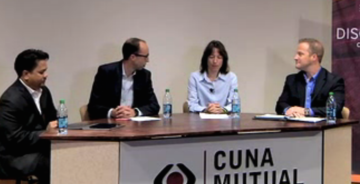
Below is a look at what each had to say in response to the questions posed by Rogers:
Rogers. While there are some advantages to being a large credit union, there are also some advantages to being a small CU and staying close to members. How do you do that?
Bodie: We are doing three things. We are behaving more like a retailer. We aren’t sitting back and waiting for people to come through the door. We are actively seeking out new members, such as through our SEGs and Facebook. We’re reaching those niche markets where it means something to the member.
Two, we are improving the workflow, the whole process of joining a credit union and being involved with the credit union. We are making it easy to be a member and to apply for a loan. The simpler the process the better it will be and the more people will want to do business with you.
The third thing is we are leveraging being a co-op. We have partnered with several charitable organizations and schools to create ‘Swipe it for Good.’ Every time a member swipes a card we donate five cents to that cause. The cause reaches out to their donors. It’s a new circle of business for us.
Rogers: If you had to call out retailers that Element takes inspiration from, who would it be?
Bodie: Definitely Apple, Google, Amazon. Even in our local markets seeing the local grocery store and how they deal with you in person and on line is an inspiration. We want to make the transaction and sales process just like a retailer to make people want to come back.
Rogers: Even the largest CUS can’t do what a Google or Apple does. What part of their operations can you mimic?
Bodie: We don’t try to be everything to everyone. We are designing processes and programs specifically for niche groups. We are developing an online channel for Swipe it for Good so they can market it to the cause’s supporters. For our state employee (members) we listen to what their needs are and then develop programs and plans that help them in that part of their lives.
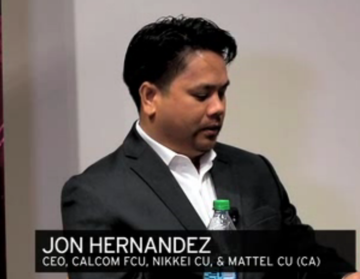
Jon Hernandez during Discovery Conference.
Rogers: Jon, you lead three different credit unions. How do you segment each?
Hernandez: Each of the credit unions is unique. Mattel (serves just that company). Nikkei Credit Union focuses on the Japanese-American community and that heritage. Calcom is primarily health care and city employees, so it is completely different from the other two. The things we do have to be customized. We use target marketing. We focus on using our members as our advocates; it’s free advertising. If you do well with the members you have, that word gets spread out and gets a better return for us. Our value proposition for our membership is we make sure they are aware we are a cooperative. We are not afraid of losing those who don’t contribute to our organization, but we also do more for those who do. We have loyalty rewards for those members. They should know that if you are contributing you should get something back.
Rogers: There is this interesting slide floating around Silicon Valley that takes a screen sot of the Wells Fargo home page, and for every service they offer it shows every start-up attacking that piece of Wells Fargo. If it’s happening to Wells Fargo, it’s happening to credit unions. So how do you balance responding to the traditional competitors with the new competitors?
Meyer: You have to start internally. You have to be convenient, competitive, and easy to do business with. What do you do well? Out of our strategic planning process identified eight offensive strategies and eight defensive strategies. Our full senior team looks at opportunities on quarterly basis. We do a very good job of understanding that we are. It’s hard to change on a dime when you’re large, but we can do that as a small CU. As the market presents itself to us we are very good at being able to adjust to the market competition. I think that’s one reason we have been very good at lending.
Rogers: Of those eight offensive and eight defensive strategies, how many are active?
Meyer: About half of those are active at any time. We have three pages of thoughts and ideas that have come out of our planning sessions where we could act right away. We have brainstormed and done work and done research on what it would take for a strategy to be brought to market.
Rogers: Linda, where are your best opportunities for lending and where do you compete?
Bodie: I’ve been (with Elements) for 17 years and we’ve been very good about lending. It’s about what do we learn from our members? We have learned they are not very well educated about loans, so we have focused on educating members. Our brand promise is to help members.
Rogers: What is it about your approach that makes you proactive during bad economic cycles?
Bodie: We are very active in managing the ups and downs in the economy. And West Virginia, being mining country, we are being hit hard now. So we are very active in reaching out to members and letting them know we can work something out. We work with people to be a partner to let them work through the hard times.
Rogers: Channel management is all about adding channels, not removing channels. How, as small CUs with limited resources, do you make sure you have the right channels?
Hernandez: We made a conscious decision to leverage technology to provide services to our members. With $65 million across five branches (for all three CUs), I would say that is probably four branches too many. But we made a commitment to maintaining those branches, (but) we have reached the point where it’s not cost-beneficial to add branches. We have mobile deposit and have signed up for shared branching. The choice of the clicks over the bricks definitely levels the playing field for us. Clearly, you have a concern over the contact with members, so we have dedicated people to our contact center. We now one person to communicate with members via text message. On the legal side our attorney is having a fit. We allow members to provide a lot of information to us by text. That makes it very convenient for members.
Rogers: in a midsize city such as St. Cloud, Minn., most would say a branch network is key. How are you managing that, plus all the things members want?
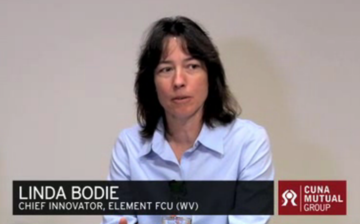
Linda Bodie during CUNA Mutual's Discovery Conference.
Meyer: As we all know today’s consumer wants it all. I think we have to do a better job of reassessing our own structure and what should be centralized and what shouldn’t be. We think we need someone who can come in and create a consistent experience across all channels. We did a focus group where we partnered with our social media vendor, and we survey our members often. We asked Millennials what are the reasons you may choose to stay with our leave a FI? They said we won’t choose to come to your FI due to quality of your app, but you have to have it, and it has to be at least somewhat relevant. What we learned is we don’t have to be first to market. We need to understand it, be well prepared for it, and ready to grow there. A good example is Apple Pay. We have had one member call and ask about it. You have to stay in really good touch with your communities and know what they are asking for.
Rogers: Linda, your credit union was allowing remote deposit before almost anyone else.
Bodie: We rolled out ‘iDeposit’ in the Apple Store and someone called and said, ‘You are the first financial institution in the world to have a remote deposit app.’ Now in 20115 we have listened to our members and we allow members to text us, Skype us, Facetime us. If that’s how they want to communicate with us, they can communicate with us. Our call center people can do all that through an iPad. All you have to do is plug in the channel; it’s not rocket science.
Rogers: This illustrates that you have the disadvantage of scale, but the advantage of nimbleness. We have found at Filene that small CUs have spend so much more on compliance, as no way to amortize it across numerous functions, as a large CU can. So how to you manage risk?
Hernandez: We approach risk in two ways, reactive and proactive. We have a VP of risk management and our certified compliance officers all report to him. The main thing for us is we try to identify what is the financial impact of any regulatory issues, and then decide whether to be proactive or reactive.
Rogers: What about the scale part? How do you either defend against criticism from examiners or anyone else?
Bodie: My approach is to develop a solution first, and then worry about compliance second. If it’s kind of crazy and out there, great, we can always scale it back. In regard to the communications channels, you have a strategy and (guidelines around what you can say, regardless of channel). I think some people make it more complicated. In other situations where we are doing some very different things I can spend hours and hours and days and days making sure this is not too risky and documenting everything.
Rogers: Let’s talk brand. Even for midsize city, St. Cloud has 19 financial institutions. So how do you think about brand in a saturated market?
Meyer. You have to do all the internal things. We really focus on culture and the issue of development in a formalized approach. As (one CEO told me), as you move forward in your career your influence increases, your ability to affect change decreases. Is my employee truly celebrating the fact the member is getting a mortgage. Your actions become your brand. You can’t just say ‘we are a credit union and we’re nice.’ We focus on proactive service. What can we do for you? Do we have a home basket prepared at the (mortgage) closing (for the borrower)? It’s all about how you make them feel. On a monthly basis there is a management meeting at which a component is leadership training and core values and our culture. The words we have built our core strategy around are ‘making a difference.’
Rogers: One of the watchwords in credit unions has always been collaboration. What do you do to collaborate?
Hernandez: There is a lot of collaboration in Southern California. We have a group that gets together on a quarterly basis. We had 22 CUs come together, most under $100 million in assets, where we did the core process vetting process together. And from there we identified four (companies) and did the demo together with all 22. Based on that, it was then up to everyone to make their own decisions, but the full intent there was depending on which CUs go with each system, to collaborate on back office. We do the accounting back office for some other credit unions, and other credit unions do some of our back office. Also, 15 credit unions have come together to get a much more cost-effective health benefit plan for their employees due to bundling. It’s not just about reducing costs, but being able to afford things we couldn’t do otherwise: sharing marketing officers, sharing business development officers, and more.
Meyer: In Minnesota we have a very collaborative group of CEOs, which is a cool part of this industry. We have gone through two different shared trainings with other credit unions where we were able to split the costs. We have partnered with another CU on disaster recovery. You have to look for the opportunities and continue to network.