

SAN FRANCISCO–Social media and even a new national brand awareness initiative may get much of the attention, but old-fashioned on-site events at companies and in communities remain a less sexy but fundamental membership building strategy for many credit unions. One CU that does more than 900 such events each year, has shared its successful approach to driving growth from the trenches. One tip: get rid of the business cards.

Spencer Carver, AVP-SEG Development with Mountain America Credit Union in West Jordan, Utah, walked credit unions at the CUNA Marketing and Business Development Council’s annual meeting through how he and his seven-person staff approach on-site company and community events, many of which he acknowledged often look the same, which only raises the challenge.
Mountain America CU may have $7 billion in assets, but Carver noted it serves just one community and remains primarily a SEG-based credit union. And that means meeting with lots of companies, often on a regular basis.
But Mountain America isn’t the only financial institution knocking on doors and making cold calls at companies. Utah is home to a number of large CUs and some very competitive (and strongly anti-CU banks). As a result, Carver said MACU has had to develop effective ways to stand out as well as to measure the effectiveness of its extensive efforts.
The Big Picture
What’s critical for every business development function and leader to do, said Carver, is to “start with the big picture.”
“Do you ever stop and think about what you are doing?” asked Carver. “Every company has a No Solicitation policy, but that’s exactly what we’re going. They have given you a hall pass to do just that. You have exclusivity, even if it’s just for that event. Don’t take it for granted that you are there.”
Taking things for granted also contributes to a common failing in business development at on-site events, said Carver, who observed, “Doing the small and simple things is easy; so easy, it becomes easy not to do them.”
A simple-and-easy strategy Mountain America said it has used is to make sure to speak with the other vendors in attendance at events where other companies are also on hand. He noted that recently it spent about $150 to take a number of vendors, many of whom are business owners, out to lunch.
“What came out of that was three or four different SEGs and other on-site opportunities,” he said. “We brought back to the credit union three auto loans and some business accounts. Sometimes in business development we get into our silos and forget about the people who are there with us also have financial needs.”
Two Recommendations
Regardless of the type of event, Carver recommended:
- Get out from behind the table. “That table is a barrier to trust. We like to sit behind the table, it’s a comfort zone. We experience that growth when we push ourselves a little bit. I’m a big fan of not having any chairs. Get out in front of that table.”
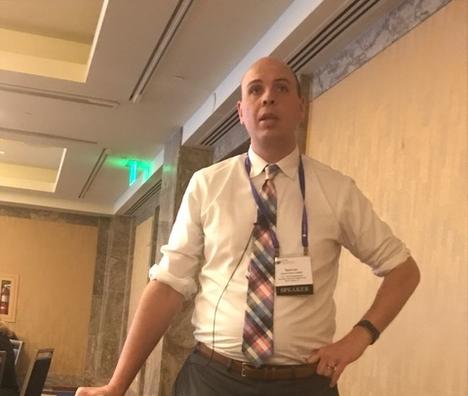
Spencer Carver speaking to CUNA MBD Council in San Francisco.
- Get rid of the phone and the business card at events. “Do you allow phones at events? Are you on phones at your events? What I don’t like about business cards is they are something else to hold on to. But if I’m talking to you I can say, ‘Let me pull out my calendar and schedule something with you right now.’ If I just took the business card I would have to go through those other obstacles of emailing and waiting for a response and time goes by. Social media can be awesome. But use it strategically to help growth.”
Mountain America has a goal of being present at 900 different events in 2018. Not each one will be a home run, Carver conceded.
“We can’t do it all on our own, and some are going to fall on their face,” he said. “I’m OK with that, at least that company had us there. Help your employees to understand that as well.”
The Game Plan
Mountain America’s strategy is to have a game plan with the events at which it is present. But as Carver clarified, “Often, when we talk about a game plan, we are too focused on the competition. We are an industry, not an individual credit union. I love to hear about the success of other credit unions. At an industry event, I never see a competitor. I can’t tell you what your game plan should be, but I can tell you to just be you. Just do you. Focus on that and let that drive the success of your event. Don’t worry about other organizations. Notice, I didn’t say don’t notice what others are doing. Be aware of it, but don’t let that consume you, because that other credit union is going to do what it’s doing whether you like it or not.”
Identify Objectives
Credit unions that wait until they arrive at an event to identify their objectives do so too late, said Carver. Every CU’s objectives are unique to it, he added, saying it’s critical that a credit union understand the demographics of the event at which it is present, which must be factored into the objectives.
Communicate Roles
Quoting George Shaw’s observation that “The biggest problem with communication is the illusion that it has taken place,” Carver said everyone on the CU business development team must know their roles with clarity.
When communicating with team members and SEGs and potential SEG representatives, he said it’s a common mistake to ask someone “Did you get my email?” Instead, the questions to ask should be “Do you understand the email and are there any other questions. And the better bet is to meet in person and discuss.”
Experience
When on-site at a company or event, Carver said it’s not “all about the trinkets and trash.”
While giveaways remain a fundamental of the business development process, “it’s important to use it strategically,” he said. “Are we just giving stuff away? If we take a pen to a tech company, it doesn’t speak to them. Tech-minded gifts might bring them to the table. And if we have paper, they don’t want to talk to us. We have to change what we’re giving based on the demographic.”
Carver said he subscribes to the “Triple Three Rule.”
“Will they be talking about you in three minutes, three days, three months. And just as importantly, what will they tell others about you?”
Engage
On-site business development, said Carver, is much like a conversation with a physician. It’s about “always asking, always listening and always closing.”
“Change the discussion, change the outcome,” said Carver. “On average, we have about two minutes with each person who comes by our table. It’s OK to ask questions. We have a philosophy in our credit union to take care of every member, every time. Every single vendor we meet with has a specific need, and it is up to us to identify that need. Everyone is thinking about something financially.”
Follow Up
Carver said it’s important to always keep the door open.
“When you leave an event, have you planned your next event?” he asked. “At the end of one year, members of our team schedule a planning session with their SEGs. They might set up 10-12 events, and may have to reschedule some of them. But it’s way better to reschedule something on the calendar than to try to get on the calendar.”
Win/Win
Carver urged credit unions to recognize that sometimes events simply need to be renegotiated. Mountain America had one company with which it had agreed to meet once a month for a year. But that was too often. “We realized it wasn’t worth our time to be there that often,” he said. “We said we felt we could better maximize the value. We were honest and transparent and the SEG loved it. Our business partners want to know, ‘Was this worth your time, too?’”
Debrief
Carver recommended business development staff hold regular debriefings. “Talk with them about their experiences. I learned so much from taking front-line tellers and finding out what they see and what they are experiencing.”
In addition, Carver urged CUs to send out recap emails that are all meant to “create momentum and excitement for participating with the SEG team.”
“We talk about how awesome they were and what went well with the event. We want to give recognition to that individual (with the company),” he said. “If you copy their supervisor, they will think that’s amazing. They will love you. That has value."
Never Quit
“Seventy percent of people make a buying decision after six points of contact,” said Carver.
Return on Investment
ROI on any event needs to be determined prior to every event, said Carver.
“We have profitability reports down to the SEG. We have an organization that is very large and one of our branches supports the entry-level employees. About two-in-10 charge-off. Another branch supports the corporate side of that same company where we have $100 million in loans. We show that data to each of the branches.”
To assess the ROI on events, Mountain America uses promotional codes it tracks through its CRM software.
“But in my opinion, what’s more important is the residual growth, what happens after the event,” Carver said. “You should establish goals, but avoid quotas. A goal is beneficial to both parties. A quota is good for only one. These are the small and simple things that sound simple. At events where we don’t set a goal, we get nothing.”