

By Ray Birch
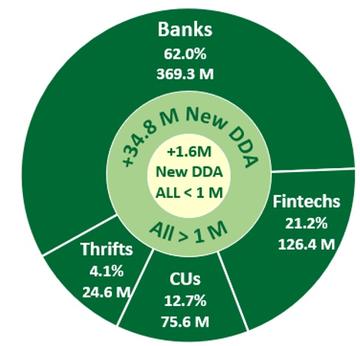
LAKE FOREST, Ill.—Is inflation having an impact on checking account growth? Apparently, according to a new Moebs $ervices study that shows 36.4 million new consumer checking accounts were opened in 2022—with the majority going to a few major players.
“This is a 6.5% annual increase, which ironically mirrors the current period’s inflation,” said Michael Moebs, economist and CEO at Moebs $ervices.

Moebs said 6.5% growth is higher than normal, but what’s “normal” is rather relative, given that checking growth data goes back only to 2020. “We believe the number of checking accounts is expanding much more rapidly today,” he said.
Moebs pointed out that COVID had stifled the increase in the number of checking accounts.
“People were scared to do much socially, especially go into a credit unions or bank, for fear of catching COVID,” Moebs reminded.
But according to Moebs, what’s more important in the new data is that 95.5% of new checking accounts went to just 29 financial institutions that currently have 74% of the national consumer checking market—a trend Moebs $ervices and CUToday.info have been following over the past year.
Where the Accounts are Going
Moebs reminded this checking migration is not only hurting small financial institutions, but most banks and credit unions, as more checking accounts and deposit dollars are heading out to non-banks—largely Walmart, which currently has more than 113 million checking accounts.
Moebs added this is particularly concerning for banks as their stability is being questioned and there is now a greater focus on their profitability. Moebs said the number of checking accounts impacts a financial institution’s overall ability to make money.
“These 29 financial institutions represent all FIs with more than one-million checking accounts and is up from 72.6% in 2021,” explained Moebs. “These 29 FIs dominate consumer checking. Can the cars starting in the last rows of the field in the Indianapolis 500 race—in this case FIs with less than one million checking accounts—overtake the pole position cars?”
The ’Big Checking’ Club
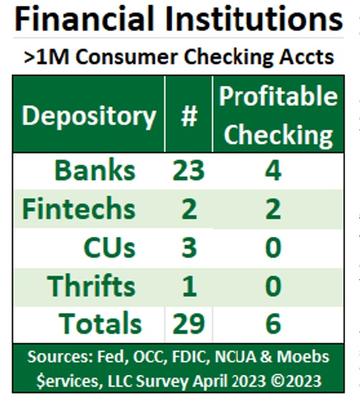
Moebs $ervices refers to the million-plus checking club as “Big Checking,” and it’s comprised of 23 banks, two fintechs, three credit unions and one thrift.
“Bank Investors do not know the significance of Big Checking. More importantly, these same Wall Street folks do not recognize over 33% of all consumer checking is held by non-banks,” said Moebs. “Investment portfolio managers with funds in banking—whether large cap, regionals or small cap banks—need to know who controls the consumer checking market. Wall Street needs to watch Walmart, with 19% of checking accounts—much more than Bank of America (11.4%), Chase (10.5%) or Wells Fargo (6.3%).”
As Moebs has pointed out in previous CUToday.info reports, only six of the 29 Big Checking members have profitable checking portfolios. This includes two fintechs—Walmart and Chime and four banks.
“The other 23 have unprofitable checking,” said Moebs.
While having more checking accounts typically boosts a financial institution’s ability to turn a profit, despite even losing money with checking, Moebs outlined how those major players are making money on checking alone.
Losing Money
Moebs’ research shows depositories with more than one million checking accounts that offer four or more types of checking lose money.
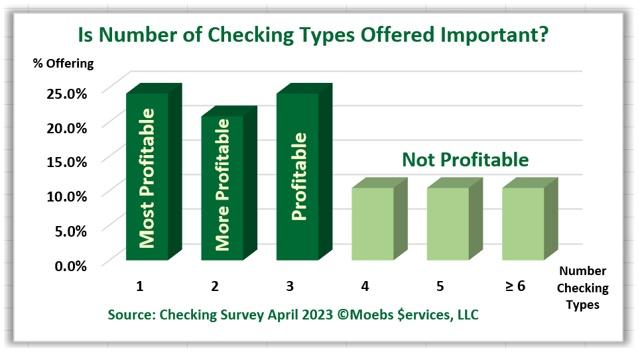
“The maximum number of checking types offered and maintaining profitability is three,” said Moebs. “However, the most successful are those FIs that offer just one checking account—namely Walmart and Bank of America.”
There are several reasons one account is most productive and efficient, explained Moebs. “Checking is very complex. The coding of checking by Fiserv or Jack

Michael Moebs
Henry—the two leading IT providers –is extensively comprehensive and intertwined with many different transaction types. One account is easier to sell for frontline personnel and service reps to assist users.”
Moebs asserted an investor or stock analyst can measure Walmart or Bank of America—which have one-third of all consumer checking accounts and each offers only one checking type—and draw an accurate conclusion they are good investments.
‘Important Component’
“Bank stock is an important component of any investment portfolio, from the small retail investor to traders, investors and fund managers,” said Moebs. “At one time asset growth ruled investing. Then deposits moved into first because of stimulus funds to help with COVID. The key to future financial institution performance and growth is those with one million or more in checking. The financial institution which has millions of consumer checking accounts controls its retail market and controls its fate.”