

By Ray Birch
LAKE FOREST, Ill.—Financial institutions have not been able to stem the outflow of money leaving for Wall Street funds even as rates have risen, according to new data that show savings and checking balances dwindled last year over 2022 levels, with interest checking taking the biggest hit.
A new Moebs $ervices report, which includes 3,618 financial institutions, has concluded the reason is banks and credit unions have not been willing to raise interest rates high enough on transaction accounts.
But there are other steps for credit unions can take to attract and retain more dollars, the analysis suggests.

“The banks, credit unions, thrifts, and fintechs are not paying enough on interest checking, savings, and even not high enough on uninsured deposits greater than $250,000,” said Michael Moebs, economist and chair of Moebs $ervices. “It’s like these financial depositories want to lose the funds.”
A Failure of Understanding
According to Moebs, what those financial institutions losing deposits have failed to understand is the traditional saver, the type who accept a lower rate in exchange for security, is disappearing.
“The view that savers are not investors and want no risk ended with COVID,” said Moebs. “Savers recognize a competitor to depositories are U.S. Treasury bills and bonds, along with Wall Street.”
The 2022 to 2023 balance change data among FI tell the story, Moebs said:
- Money market mutual funds are up 25.4%
- Insured savings are down 4.4%
- Checking is down 2.5%
- Non-Interest checking is up 0.4% while interest checking is down 11.6%
The Key
Interest checking is key, said Moebs, noting only two of the “Big Checking” FIs (those with more than one million checking accounts)—Citibank and Boeing Employees Credit Union—pay over 4% on checking.
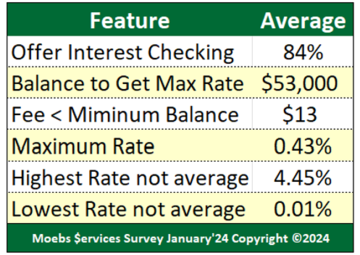
How can a depository control interest expenses and not lose funds? Moebs identified several steps he said bank and credit unions can take to keep and attract funds.
-
Offer interest checking. “Not all FIs, even as large as they may be, offer interest checking. Some of the largest checking providers in the nation are not paying interest: Walmart, Chime, Discover Bank and Truist Bank,” Moebs noted.

Michael Moebs
- Require larger balances to get maximum rate. “This varies considerably for all FIs, not just the bigger depositories. Institutions may not want deposit account volume, but rather larger dollar deposits. This strategy will determine the number of balance tiers offered. Many have zero minimum balance but some require over $1,000,000 to earn the max rate,” Moebs said.
- Charge a fee for falling below the minimum balance. “The reasoning for the fee is to avoid too many low-balance account holders,” Moebs said.
-
Test rates. “Everyone who prices deposit services needs to find out how far below benchmarks deposit prices can go,” Moebs said.
“The way to know this is to test the price based on volume obtained or lost. This is a dual testing process, meaning how high or low is the market willing to accept. The benchmarks for transaction accounts are Fed funds, U.S. Treasury bill rates as well as Wall Street money market mutual funds.”