

NASHVILLE, Tenn.–There aren’t too many budding entrepreneurs who can look back on their experience on Shark Tank and report they ended up taking the biggest bite. But Jamie Sminioff can, and he shared his story as well as 10 lessons he has learned and advice he now (reluctantly) offers, in remarks to credit unions here.
Sminioff is the founder of Ring, the doorbell camera and security system that was acquired by Amazon in 2018 for approximately $1 billion. But that only happened after the company came close to not surviving and, famously, after the sharks on Shark Tank not only declined to invest but after a few criticized the start-up company’s plans and vision. (Sminioff made an obscene gesture to Mark Cuban after showing a brief clip from the show.)
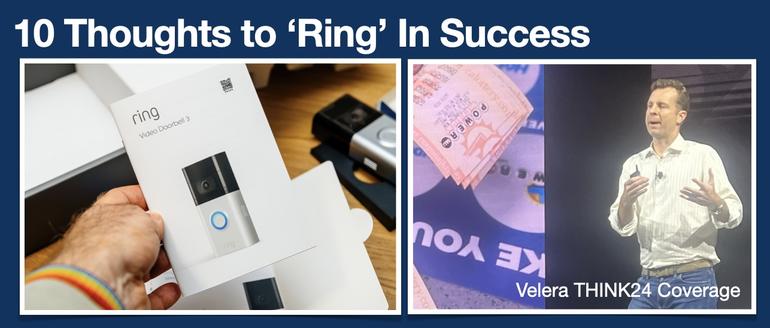
Speaking to Velera’s THINK24 Conference here, Sminioff noted the irony he was speaking to the group, as he generally “hates the idea of advice.”
“While we look similar, we are all fingerprints, we are all different. When giving advice you’re sharing advice as if your situation is the same,” he said.
Ring was developed, he explained, only because Sminioff couldn’t hear the doorbell in his home from his office, so he created an app for his iPhone. But as he made clear, the product isn’t a doorbell at all—it has a much larger mission.
Sminioff offered these 10 observations to credit unions:
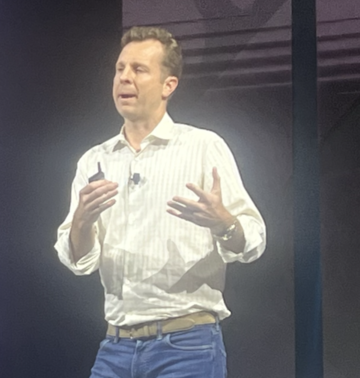
Jamie Sminioff speaking to THINK conference.
One: You Need Some Luck
Sminioff. “You can buy lottery tickets, but I think in business we get lottery tickets by working hard. I know there are smart people who do the right thing and do everything right and they never make it. Just because we work hard doesn’t mean we're actually going to make it.
There were a lot of lucky things that happened (with Ring). It also exploded because we were a camera making content and then all of a sudden we had platforms that were sharing this content, like Instagram, and NextDoor and then Tik Tok. None of those existed when we started, and if they hadn't come along I'm not sure if it would have gotten as big as it did.
“It’s not the product. No one can love plastic. No one loves a PCB board. We love what something does for us. It’s the higher value of it. Ring is now the largest social app for crime and safety in the U.S. It was a sort of a hidden secret that wasn't a secret.”
Two: Mission (To Reduce Crime in Neighborhoods)
Sminioff: “All of our success came from having a strong mission. From the first day we started and all the way through, every person we hired I would say, Listen, we're going to reduce crime in neighborhoods.’ That created that culture and that mission and just different enough to separate us from all of the competition. It's hard to see it now because Ring really has become the Kleenex of home security. But that came from the mission. It didn't come from us marketing harder or doing something else. That came from us having that different feeling .
“This transcends money. I really believe money is not something that we wake up every morning yearning for more of. Money is a treadmill, it's a hamster wheel.
“When you have a mission your team is excited to go into fight past those problems, to be there during the tough times to help you through that as a team. To me, the best missions are ones that you can't actually achieve but that you can understand. So, reducing crime in neighborhoods is a mission that absolutely 100% of people can understand. But it's also an achievable. You could never actually make every neighborhood safe, but trying it will build a very large business.”
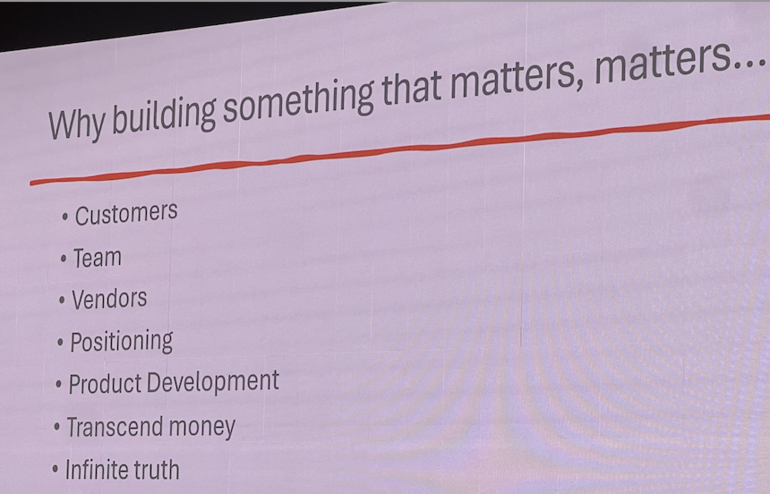
Three: It’s the People
Sminioff: “AI, schmay I. Ai is powerful and it will change lots of things in the world. But I believe that in 20 or 30 or 50 years companies will still be successful because of the people. It's the people who put together the culture and the mission.
“How do we find the Tom Bradys (who was the 199th pick in the NFL draft). You have to open yourself up to being more flexible on how you hire to allow these Tom Bradys to come.
“I started the company in my garage and we were moving into an office---which is quite stretch calling it an office. It was like a homeless shelter we pulled people out of. We had a U-Haul truck and I went on Craigslist and found someone for $10 an hour basically to move some crap for me. This guy, Bill, shows up and as we’re hauling packages and sweating we get Talking and Bill says, By the way, if you’re building electronics products I’m an electrical engineer.’ He said he had had an alcohol problem and he said, ‘If you give me a chance I'd love to do it.’ I said ‘An electrical engineer for $10 an hour? Done.’ He’s still with us and he’s one of our best. Finding a Tom Brady was our leverage point.”
Four. Fight failure. Excuses Don’t Matter
Sminioff shared a story of a very large technical issue the company encountered early on with the Ring camera that they eventually were able to work around by turning to 3-D printers even though there were plenty of people saying it would never work.
“Excuses get in the way,” he said.
Five: Leverage Pre Awareness
Sminioff: “Everything we did at Ring had some factor of pre-awareness to it. If I see Tom Cruise on a movie poster I don’t; even know what the movie is about but I’m going to see it.
“I think sometimes in our business we don't realize how powerful pre-awareness is and how we can utilize it. The sound of the Ring is new. but it sounded like a doorbell so it had some pre-awareness. I was very careful to make sure it sounded like something. What does motion detection sound like? it turns out that was like a very hard question to answer. I literally went outside the house and I heard a wind chime and that sounded like motion to me.
“I try to do things that have some grounding in something you already knew. You get a doorbell with a camera so you knew what it’s functionality is and now it has a camera
Six: Real Innovation Looks Stupid
Sminioff: “This is about how you innovate. How do you have the thing that’s going to break out? How do you leapfrog something? Real innovation looks stupid. With the floodlight camera, when I tried to get this made went to Taiwan, the factory said we’re not doing this. We were small enough they could say no even if we were paying. Over 10 hours I begged them. No one saw this thing, including, literally the factory that was going to make it
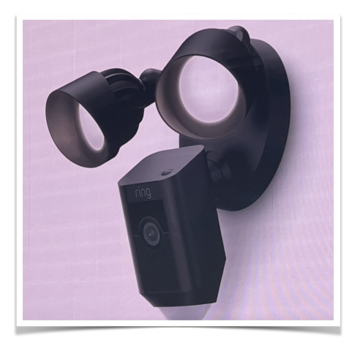
The Ring floodlight that factory did not want to build.
“I think in our businesses when we're sitting in these meetings we have to allow ourselves to have these kind of stupid ideas that maybe at the time don't seem realistic. If you think back a lot of times those age very well and those are the things that really break out
Seven: Goals Can be Ceilings
Sminioff : “We had crazy goals. But saying we’re going to get to something like $50 million next year in this line (in sales) makes me worry. A lot of times that actually is a ceiling, the 50 million becomes the top. Instead, what we're trying to do is actually tackle something to achieve. Ring has grown to multiple billions in sales, and that might not have happened if we had set a goal like $50 million.
Eight: Constraints Breed Invention
Sminioff: Grapes grow best when they are stressed…You have to give it the right amount of water, the right amount of fertilizer, the right amount of stress.
“In some organizations, success is hurting us, it’s holding us back because it is made us into big sugary grapes. So create those constraints. If you say, ‘OK, we can launch in January,’ ask, ‘What if we launch in November?’ Some might say, ‘I'm done, I'm leaving.’ But I’m that guy who says that’s achievable.”
Nine, Know Your Competition
Sminioff: At Ring, we had competition at every point. Investors would do a Google search and say ‘How about X company.’ I said they’re not our competition. Our competition is Apple. When someone buys my products, when someone bought the first Ring and took it out of the box and hooked it up, it has to feel like the premium product they're used to. Every piece we touched, everything we do has to feel like Apple.
“We were looking at playing a completely different game than the competition.”
Ten: Surveys vs. Ground Truth
Sminioff: “This gets me fired up. Personally, surveys are just not something I love in a business. I think they give us such a linear set of data and they just take everything down to a certain standard.
“I just don't love them. I love getting that ground truth at every single level and so it at Ring I had my e-mail address, my real e-mail address, available the entire time. I think it went out on over 100 million packages and the amazing thing is that at every single step of building the company, every investor meeting, they would say you're going to have to take that off. They said there’s no way that's going to be scalable for you.
“To me, it's so crazy that being directly in tune with your customer was the thing that was not scalable to someone looking at my business. To me, it was the most scalable. I got key insights. I got to see how to build the product better.
“If you're getting these insights directly you can see what people really want and build that next thing for them. I implore you in your business to definitely use the market research that you got yesterday. I'm sure it's really great. But try to really apply it to direct learnings, because as we get bigger in our organizations we separate off from the customer. We don't have that direct, anecdotal data with market research I think it allows us to create things that are nonlinear and really break out exponential growth.”
Sminioff closed by sharing his current email address.