

By Ray Birch
IRVINE, Calif.—Is entering the buy now, pay later (BNPL) space a good move for credit unions?
Maybe not, at least as the market stands today, according to one analyst, who adds that offering a point of sale BNPL solution would most likely be expensive and time consuming, while not generating much in the way of revenue for credit unions.
“We know that credit unions do a great job of serving their members with different loan options,” said Bob Hofmann, business solutions engineer at Equifax. “Data show that credit unions step up to fill the gap when banks step out of lending when times get tight.”
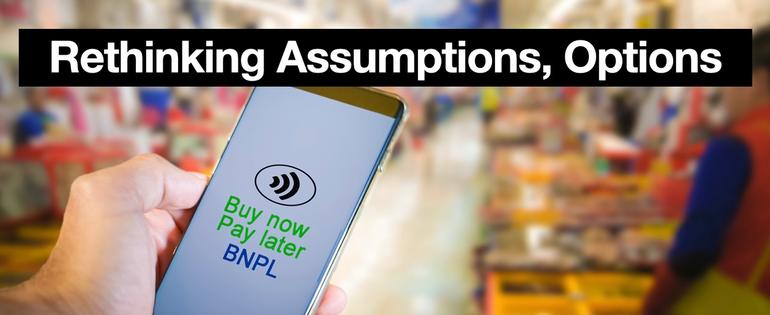
But stepping up with a BNPL point of sale option in order to go head-to-head with the likes of Klarna and Afterpay may not be the best choice right now for CUs, said Hofmann.
“One of the biggest challenges is in the margins on BNPL,” explained Hofmann, during a recent Origence webinar. “They are tight, like 1% on transactions. So, it takes a lot of transactions to make BNPL truly profitable.”
The tight margins are not a concern for the top five BNPL players, added Hofmann, because they have the scale—the large market—to make the business highly profitable.
“It really takes massive transaction volume to do well with BNPL,” explained Hofmann. “The big five have the market to generate the scale. I believe it would be hard for credit unions, given the smaller markets they have, to generate the scale needed for BNPL at the point of sale.”
A Need to be Creative
That does not mean credit unions cannot play in the BNPL space, continued Hofmann, who suggested CUs get creative and develop with some new small-dollar loan options.

Bob Hoffman
“I have heard a number of credit unions talk about an installment loan offer that would allow a member to put a purchase on their CU credit card and then convert it to a small-dollar loan with some installment payments,” he said. “It’s not competing directly with the big players at the point of sale, but it is an option for members. But I am not sure it would be best for credit unions to compete at the point of sale with BNPL, against the other national players. Plus, it can be very time consuming to develop a solution that would work.”
As CUToday.info has extensively reported, credit unions are facing some difficulty in devising a BNPL solution that can work at the point of sale for all consumers, especially given many credit unions’ field of membership restrictions.
A Question to Ask
Another question for any credit union considering entering the market is just who is using BNPL? During the webinar Hofmann said Equifax data has revealed it may not be just the credit-strapped, low-FICO score consumers, based on surveys Equifax has done of those applying for BNPL financing.
“The largest users of buy now, pay later are Millennials, ages 25 to 40,” said Hofmann. “The second-largest users are Gen X, 41 to 56.”
In addition, the analysis has shown the majority of BNPL users live in major metropolitan areas and come from “less affluent” households.
“As far as credit goes, they're highly credit active,” said Hofmann, adding most are revolvers, not transactors. “They also tend to be much more subprime. One-in-five have no credit history at all. They're heavy users of credit, outside of mortgages. They have existing credit cards.”
Picture May Be Out of Focus
But Hofmann said the picture of the typical BNPL user is not just the person struggling with credit and looking for new credit avenues, or a young person who has limited access to credit.
“It's not just people who have no income using buy now, pay later and can't afford to buy something immediately,” said Hofmann. “That is absolutely not the case. The median household income for the typical buy now, pay later consumer is about $85,000, compared to $105,000 for the general credit population.”
The Equifax surveys have further revealed the typical BNPL user is paying higher rates on their installment loans than the general credit population.
“The average auto loan balance for BNPL users is about $3,000 higher than the general credit population,” Hofmann said.
They also have smaller bank accounts, he added.
“The typical BNPL users has deposits of about $33,000, while the general credit population has $96,000,” he said.
Market Has Evolved
The perception that the average consumer using BNPL is one with low income, low savings, subprime and little access to credit may have been reality when BNPL first launched, but that is changing, Hofmann emphasized.
“In the early stage of buy now, pay later, consumers using it were significantly subprime, and they still are,” said Hofmann, saying early usage was based more on need. “But users are starting to skew to higher credit scores, and BNPL is moving up the credit scale to higher FICO borrowers who just like the service.”