

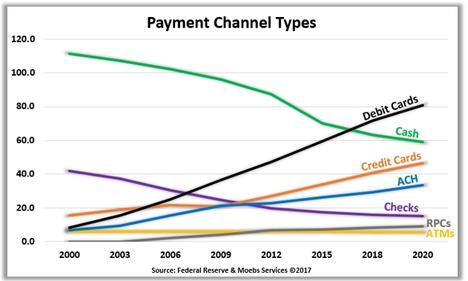
LAKE FOREST, Ill.—For the first time in history, consumers are swiping their debit cards more than they are using coin or currency, ushering in a “new banking era,” according to a new study.
One analyst said the findings mean two major implications for credit unions.
In the third quarter of 2017, debit cards will have reached 66.3 billion transactions, while cash will only constitute 65.9 billion transactions, forecast Moebs $ervices.
“This is equivalent to when gold nuggets were first used to exchange commerce for a good or service,” said Michael Moebs, economist and CEO of Moebs Services. “About 10 years ago, all non-cash transactions added together were equivalent to the total cash transactions. In a single decade, debit cards have now surpassed cash transactions.”
Moebs explained the analysis is based on the recently released Federal Reserve’s Payment Study for 2015, along with Moebs Services’ “conservative” estimates.
“It is interesting to note the central bankers who met at the Fed’s Jackson Hole Annual Economic Symposium last week did not address this historic event in their meetings,” said Moebs. “Yet this significant event will be remembered much more so than all the other agenda items.”
Major Implications
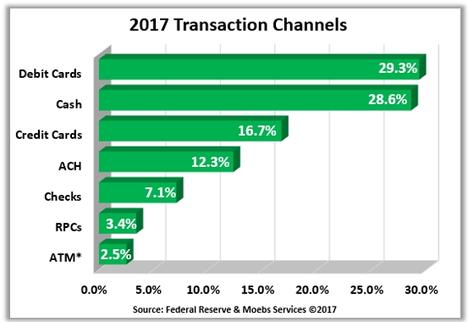
The Moebs Payment Study shows some major implications resulting from electronic payment dominance.
The declining payment types are: cash, ATMs, and check transactions, comprising 38.2% of all transactions—this will shrink to less than 20% in the next three to five years, said Moebs. Payment methods like credit card, ACH, debit card, and prepaid cards will dominant the transaction business with over 80% of all transactions, he said.
“Along with the current traditional payment channels, technology has expanded payment methods into new forms. Many apps and online avenues, such as Venmo and LevelUp, have created an easier and more efficient way for person to person transactions,” said Moebs. “The growth of new types of payment methods is also the reason there is less cash in the marketplace.”
Depositories have stiff competition with “shadow banking companies” that create their own apps for payment, said Moebs.
“Companies like Walmart have already begun to step into the depository business with their e-checking and prepaid cards. Other companies like Starbucks and Amazon have also created digital wallets used for payments,” he noted.
Stay On Top Of Payments
How will this affect credit unions and banks?
Moebs’ Payment Study identifies two major implications for all depositories.
“First, depositories must stay on top of payment channels in order to capitalize on the changing dynamics, otherwise shadow banking firms will dominate the business,” said Moebs. “Secondly, sales and service people will become invaluable to implement the changing payment system. John Naisbitt in his 1982 book Megatrends summarized it best. He said, ‘Banking is information in motion, and for every advancement in high technology there has to be an equal and offsetting advancement in high touch.’”