

Editor’s Note: 2023 marks the 25-year anniversary of a two-year battle in Congress to get the Credit Union Membership Act not just introduced, but passed. It was a historic fight that led to an even more historic change for America’s credit unions, which were deeply threatened by banker lawsuits and court decisions that had gone against FCUs and how NCUA had interpreted field of membership rules.
To mark the event a quarter-century later, CUToday.info is featuring coverage originally published as part of the 20th anniversary with a series of stories in which those close to that fight shared their recollections of the time and their insights into how it changed credit unions.
The first four parts of this series can be found here, here, here and here.
ST. PETERSBURG, Fla.—One person still remembers the “magnitude” of a decision. Another recalls just what the “fax generation” was able to do. A third says no one should ever forget Frank the hot dog vendor and some other little-known facts. And all of them remember that and more in the fight to get a historic piece of legislation passed.
PSCU President and CEO Chuck Fagan recalls right where he was in 1998 when the Credit Union Membership Access Act was passed by the Senate, and how he got the news.
“I didn’t get the news from email, like we all do today,” said Fagan, who in 1998 had recently moved over to PSCU as SVP of the eastern region. In 1997 he had left the then $600-million Virginia CU, where he was VP of card services.
When the historical news came down, Fagan was sitting in one of PSCU’s locations in Virginia.
“I was in our Herndon office on a conference call when all this came out—this was before we were active users of email,” he recalled. “Our email system was confined to the regional office. We weren’t even connected to corporate. Dave Serlo, our president, had just found out and announced the bill’s passage during the call.”
Fagan said he immediately had a strong sense of what had just occurred—the magnitude of what the law would mean to the growth of credit unions.
Unbelievable Accomplishment
“It was unbelievable what had just been accomplished. I guess that is what I really thought,” said Fagan. “This was going to have a sweeping effect, across all credit unions, and it was accomplished with a grassroots effort. Amazing.”
Fagan—who left PSCU to head CUES in 2013, and then returned to PSCU in 2015—said he knew what lay ahead for credit unions from the decision.
“This was just a great opportunity,” he said. “Credit unions had stayed loyal to their origin, serving employer groups. But corporate America was on the move, and sponsors were leaving geographies and many credit unions were being left without much ability to grow.”
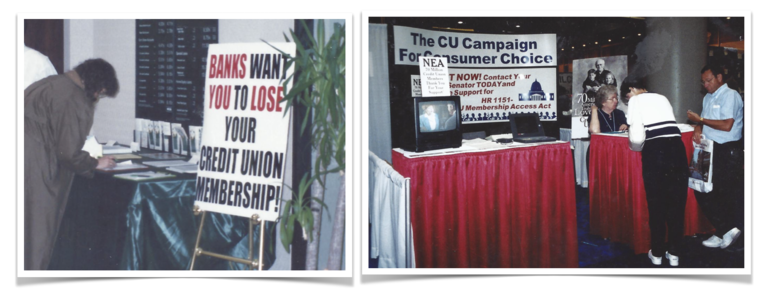
Credit union members signing petitions.
Short-Term Path
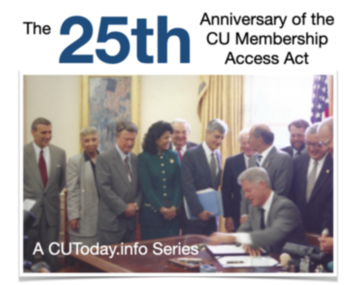
The signing of Credit Union Membership Access Act into law by President Bill Clinton gave all credit unions a boost by allowing them to continue to serve, or expand to serve, multiple groups.
“That gave credit unions an easy short-term path to the market, and then a broader path to expand into communities,” Fagan recalled.
In the years that followed the late 1998 enactment of the Act, credit unions lined up to send in applications to NCUA to expand charters and Fagan said PSCU partnered with many, helping them to grow.
“It is one thing to apply and get approval. But then you have to go into the community and try to grow,” said Fagan about what was a new step for many. “PSCU tried to play a role in helping credit unions expand.”
The original story appeared here.
The Great Lesson
For Pat Keefe, there’s a great lesson to be had for credit unions today in a battle that was fought by the “fax generation”—credit unions can accomplish extraordinary things when they unify and get behind something.
Keefe, who was with NAFCU at the time and who later joined NASCUS, said that has never been clearer than when the fight took place for the Credit Union Membership Access Act.
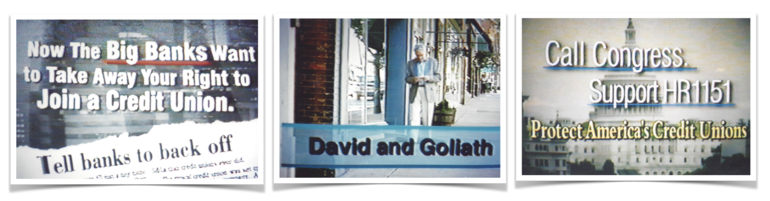
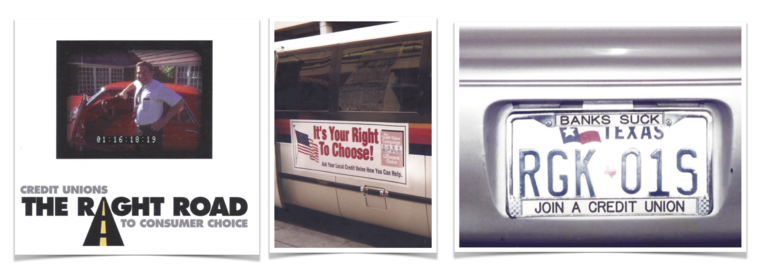
TV ads backed by CUs in the fight to pass HR 1151.
“I witnessed this. Credit unions talk about being cooperatives and cooperating among themselves, and I am witness to the fact they are and they did,” said Keefe, who was one of the leaders of the Credit Union Campaign for Consumer Choice—the unified effort by CUNA, NAFCU and the leagues to support the passage of the credit union backed legislation in 1997 and 1998. “I think it’s something credit unions should remember and think about going forward, because this kind of cooperation is unique. If you can’t take action and work as a group to protect and advance yourself, I don’t think things will work out as well for you. The whole effort around HR 1151 is living proof that credit unions can work together and make things happen.”
Feeling the Gravity
When the Credit Union Campaign for Consumer Choice was formed, Keefe said the team immediately understood the gravity of their role.
“This was very serious, we all knew that,” recalled Keefe, who in the 1990s headed public relations and communications for NAFCU. “This was not some overblown Washington political fight, this was the real thing. The federal court had made a decision that could restrict the ability of credit unions to grow. And if that did not hit you right between the eyes, then you were not paying attention.”
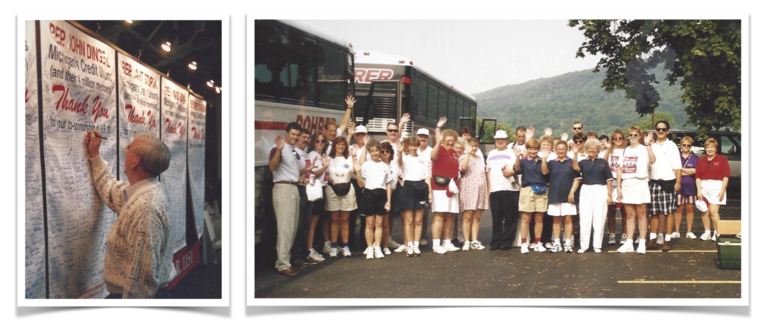
Credit unionists signing petitions, left; preparing to head to D.C., right.
Getting Down To Business
Then CUNA General Counsel Kathy Thompson was the primary CUNA representative on the steering committee that was headed by Larry Blanchard, then SVP of communications at CUNA Mutual Group. Keefe described Thompson as a “brilliant lawyer” who was invaluable to the effort.
“She knew the law frontward and backward,” recalled Keefe. “In fact, she knew the entire history of the (field of membership) court case.”
Keefe, as did Blanchard in his recounting of the months leading up to the passage of the CU Membership Access Act, said those days were about getting down to business.
“There was not whole lot of nonsense,” said Keefe. “Once we got everyone together and started heading in the same direction we were very focused . . . No question, we had two organizations run by two strong personalities (CUNA President) Dan Mica and (NAFCU President) Ken Robinson. They both had boards to report to and each side had strong feelings on what each wanted to accomplish. Yes, we had disagreements on how to approach things. But the challenge for us all was to was to work through that and get people on the right path.”
The seriousness of the matter facing credit unions was never more evident to Keefe than after he attended a Washington hearing in which Judge Thomas Penfield Jackson was speaking with a group of bankers about credit union activities.
“After the Appeals Court had ruled in favor of the banks, the court remanded the case back to the District Court run by the well-known Jackson,” said Keefe, noting that the judge was famous for being fair but extremely tough.
Bankers Complained
During the hearing Keefe said bankers complained about field of membership actions NCUA had taken after the Appeals Court ruling.
“Judge Jackson listened, and then stopped the bankers’ attorney, who was speaking,” said Keefe. “Jackson then said something about NCUA that startled all credit union people in the room. He said something like, ‘Sounds to me we have a rogue regulator here.’ I remember being struck with concern as I walked out of that courtroom.”
The original story appeared here.
The Little Known Facts & The Hot Dog Man
Buddy Gill says there are several “little known facts” that led to the passage of the Credit Union Membership Access Act, but none bigger than the story of the hot dog vendor, who for a short while became the face of the Credit Union Campaign for Consumer Choice.
In 1997, Gill was brought in by CUNA President Dan Mica, NAFCU CEO Ken Robinson and CUNA Mutual Group’s Larry Blanchard to help assist with the campaign, a coordinated effort between CUNA and NAFCU to drive passage of the Credit Union Members Access Act. Gill emphasized that attacking the banks was never considered a winning strategy.
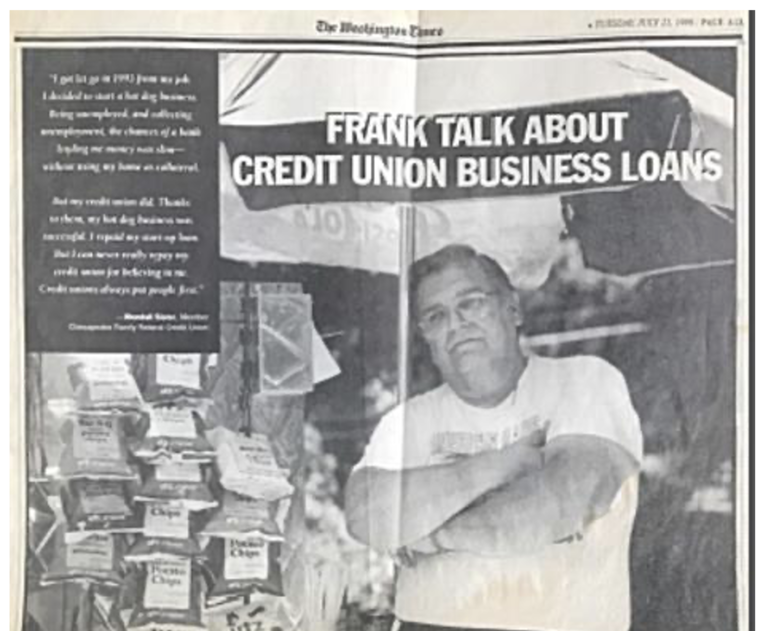
Frank the hot dog vendor who helped CUs respond to banks.
Shortening the Message
“One of the first things I did when I came to the campaign was shorten the message emphasis,” said Gill, a former senior advisor to two NCUA chairmen, who in 1997 headed Gill Consulting Group. “When I got there the campaign was in a way beating up on the banks, which was not going to get us any Republican votes for the bill. We needed two wings to fly the plane—we had a left wing but did not have the right wing totally in place. Trying to demonize big banks for picking on little credit unions as the fulcrum communications tactic would not get the kind of traction we wanted.”
Bankers Taking Shots
But the bankers in the late 1990s were glad to take shots at credit unions, noted Gill. Bankers took out a full-page ad in the New York Times—it was a picture of a hot dog vendor saying, essentially, “I will pay more taxes this year than the entire credit union industry,” recalled Gill.
“So, we went out and found a real hot dog vendor who had been laid off from work and then started his own hot dog stand,” said Gill. “No one would lend him money for his business except his credit union. No one believed in him except his credit union. His name was Frank. As I remember, Frank, in the ad, said he repaid his loan but that he could never repay his credit union for believing in him. We ran that ad up the Hill, through the ranks of
Gill said that ad killed the banker attack on the CUs “right then and there.” An attack that could have posed a serious threat to passage of HR 1151.
“We changed the subject from who’s paying taxes to who’s serving members and that banks were not making loans to people like Frank,” said Gill.
While Gill said the hot dog vendor ads may be recalled by some within the movement, other events occurred behind the scenes that many will not recall, or ever knew occurred, he said.
“There was a point in the campaign where we had our bill going, we had started building momentum after (Republican House Speaker) Newt Gingrich stood up at the GAC in 1998 and said he was behind the bill and that all Republicans should back it as well,” said Gill. “But at that time the House was already trying to pass HR 10, which would eventually become the Gramm-Leach-Bliley Act.”
House Paying Attention
Gill said there was an effort rising in the House, noticing the strength of the credit union grassroots efforts, to link HR 10 to HR 1151.
“They wanted to use the CU grassroots efforts to also fuel the passage of the big corporate bill that would help the big banks and insurance companies,” recalled Gill. “We had to kill that effort, and we did. But it was not pretty. There was this calculation by House leadership, someone got the idea, saying, ‘This credit union grassroots effort is the biggest thing we’ve ever seen. We have to tie these two bills together and get them both passed.’”
But Gill said the credit union lobby “screamed bloody murder, and stopped it. I think we stopped it in the Rules Committee, if my memory serves me correctly. People forget that those two bills almost became tied together, and if that happened that would have seriously jeopardized HR 1151.”
The Threat of CRA
Gill said that another story not many people outside Washington know is that when HR 1151 moved out of the House to the Senate, it had in it Community Reinvestment Act requirements for credit unions.
“Joe Kennedy (D-MA) insisted in putting it in for the Democratic side, and this is why Ron Paul (R-TX), who was really a credit union champion, was one of the seven or eight people who voted against the bill on the floor of the House,” explained Gill. “Philosophically, he could not stomach the bill having CRA for CUs.”
The Last Gasp
Gill also recalled how the massive grassroots letter writing campaign was likely the last of its type, since after the attacks on the World Trade Center in 2001, mail was irradiated as it arrived in Washington, which delayed it significantly, and the use of email also exploded.
“That was really the last big gasp for that kind of mail campaign,” said Gill.