

By Ray Birch
MANHATTAN BEACH, Calif.—What will the CFPB’s proposed rules on small-dollar, short-term loans mean to the only credit union in the country that owns a chain of “lending stores?”
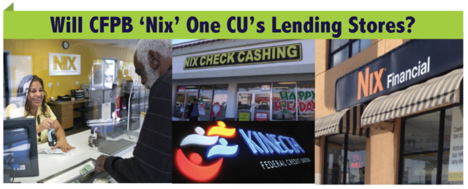
Kinecta FCU runs 30 Nix Neighborhood Lending stores, making from 14,000 to 17,000 short-term, small-dollar loans each month in the Los Angeles market—at least for now.
The future of those stores—and Kinecta’s goal to help the underbanked get a better deal on emergency needs loans—is up in the air due to the CFPB’s new payday lending proposal.
“We have been in this market for a while now and there is a huge need,” said Kinecta CEO Keith Sultemeier. “If folks like us get out of the market, or even folks not as generous as us get out, how will this consumer need be met?”
Some are forecasting that as a result of the CFPB’s payday proposal, small-dollar loan volume could fall at least 55%, and the $7 billion a year that lenders collect in fees would drop significantly.
Small-Dollar Lenders Forced Out?
That change may force a large number of small lenders out of business, The New York Times reported. The $37,000 annual profit generated by the average storefront lender would instead become a $28,000 loss, the Times stated.
Sultemeier, who was among those who testified before the CFPB’s recent field hearing in Kansas City, Mo., has similar concerns for the $3.9-billion Kinecta’s payday lending business—that the new rules will make what is now barely a break-even product simply unaffordable to offer.
“The real question is what are the costs of compliance (for the new rules) going to be?” said Sultemeier. “How much will we have to document to show we are complying? How much more servicing will we have to do because we can’t collect our loans electronically? If there is a huge addition of cost to the equation, the only way we will be able to stay in is if we increase the application fee to account for the increase in origination and servicing costs.

Keith Sultemeier
“All we are talking about is earning what we can on the spread, managing our losses and originating our loans as efficiently as we can,” continued Sultemeier. “So if the cost of compliance is egregious, we won’t be able to participate in this market anymore.”
And Sultemeier emphasized that he is referring, primarily, to Nix Lending’s small-dollar installment loans, as the credit union has already determined that the traditional payday loan is not a business model that CU can support long-term, even without the CFPB’s new rule.
“Long term, payday is not a viable model for us,” said Sultemeier. “The revenue we make from payday today helps us support our fixed costs, and right now it would cost us more to get out of the business than stay in it. But there is no net profit. I don’t think we will ever get to the point where we earn a net margin on our payday product.”
Payday Not Viable
Sultemeier emphasized that Kinecta bought Nix Lending in 2007 to gain entry into the central and southern LA markets and to help the underserved. It has worked to turn around the financial lives of borrowers, and works to move those borrowers into a fuller relationship with the credit union when they are ready to enter mainstream banking.
Meanwhile, with its payday lending product not being viable long-term, Nix Lending has been shifting its emphasis to an installment loan product that Sultemeier said can be profitable if it can be scaled—something the credit union is still looking at ways to accomplish.
While CFPB Director Richard Cordray and the CFPB have had positive words for NCUA’s Payday Alternative Loan (PAL) program, there is no specific carve-out written into the proposal, which concerns credit unions and their trade groups. But Nix Lending does not offer PAL loans, as Sultemeier said there is no margin to be made on the product and little interest among Nix Lending clientele.
“We tried the PAL loan for about two years. We marketed the product but our customers and members at Nix just were not interested. I think in two years we made 1,900 PAL loans,” said Sultemeier. “People felt PALs have too many restrictions—you have to be a member of the credit union for 30 days in advance of taking out the loan, and there are limitations on the amount and the term. Our Nix borrowers care less about the fee and the cost and more about convenience. How can you wait 30 days to take out an emergency loan when your electric is going to be shut off in two days?”
Sultemeier added that it cost Nix more to originate and service the PAL loans than the $20 fee the loan generates.
Breaking Debt Cycle
The Nix single-payment monthly payday loan charges a $32 application fee and 18% interest, and Sultemeier said that is about a 40% discount from going to other payday lenders in California. The installment product comes with a $50 application fee to cover additional underwriting costs, charges 18% and goes out as long as 24 months.
“The amount that we will lend and the term is based on the borrower’s level of income,” explained Sultemeier. “So we limit those to keep the payments at 5% or less of gross monthly income.
Nix data show that the installment product has been effective at breaking the cycle of debt, said Sultemeier, often raising a borrower’s credit score 100 points.
“That is what we want to do with this product, help consumers get out of debt,” said Sultemeier. “And, with a 540 score, you are excluded from most financial services lending. But we get you to 640, and while you are not prime credit you can now get a mortgage. We want to be able to continue to help people, but we won’t be able to do that if we lose a lot of money on each loan, which is our biggest fear about the CFPB’s proposal.”
Sultemeier said the CFPB, with its payday lending proposal, is only “saying what it doesn’t like” about small-dollar loans and offering no plan for the future of that product.
“There has been no mention of how this consumer need will be met going forward,” said Sultemeier. “I think there is a belief that technology or fintechs or some other model will magically come about to meet this need, provide consumer protections, and prove and document compliance,” said Sultemeier.
“I stated at the hearing that all this is ‘damn lies and statistics,’” said Sultemeier, referring to how data the CFPB used in crafting its proposal can be interpreted many ways. “What is lacking here is input form the people who use these loans. Where is the study on what they think is a right balance between access and consumer protection.”