

MADISON, Wis.–The leaders of five national credit union organizations shared their thoughts on what the pandemic will ultimately mean to CUs and regulators, their experiences with and responses to racism, what they are telling employees, and what’s ahead during a virtual round-robin discussion.
Participating in the 45-minute discussion as part of CUNA Mutual Group’s virtual Discovery Conference were NCUA Chairman Rodney Hood, CUNA Mutual CEO Bob Trunzo, CUNA CEO Jim Nussle, NAFCU CEO Dan Berger and NASCUS CEO Lucy Ito.
The ongoing conversation involved all five leaders offering insights and responding to each other, with Trunzo acting as the informal moderator. The discussion began with reflections on the emergence of the coronavirus pandemic and lockdown orders and how the various organizations responded.
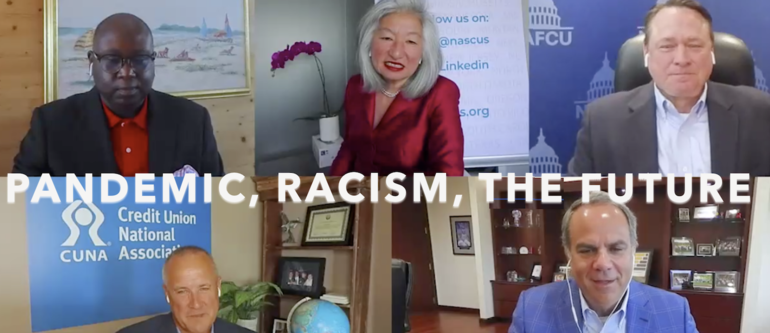
Here’s a look at some of what was discussed:
Berger: At the beginning of March we recognized we had a major problem. But several years ago we had invested heavily in technology and were able to turn the switch and go 100% remote. (The initial investment) was really weather related following a time when there was four or five feet of snow and it was very disruptive to NAFCU. We are still 100% remote. We cancelled several of our conferences and went virtual and we see that continuing through 2020. But I am very proud of my team; they switched on a dime.
Hood: The investments we have made have paid dividends. We are 100% remote. The workflow continues, but most importantly it gives our employees the opportunity to do so from their safety of their homes.
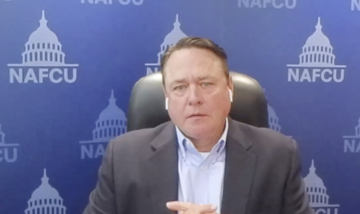
Dan Berger
Nussle: Back in March we were coming off our most successful GAC ever. We turned that very quickly to advocacy during this crisis. We already worked remote as we work together with our partner leagues. We continue to advocate in a remote setting and at the state level. We sprang into action. We created the first response page for COVID-19 so there would be a one-stop shop for information and resources. People were thirsty for information, for what was going on, for what resources were available. It was not just about the health crisis but the economic crisis facing consumers and businesses across the country.
And then we made sure solutions were flowing. People needed to do things differently. We launched a national compliance platform that is state of the art and has provided a lot of assistance.
Trunzo: Like all organizations you practice these disaster recovery drills. I remember a few years ago at CUNA Mutual the exercise was all about cyber. Halfway through someone came in and said, “Oh my God, half of our workforce is getting sick, there’s some sort of virus.” And we all pushed back from the table and thought this was ridiculous. And now, boom, we’re remote. No one knew in March what was going to happen. We told people to get somewhere safe, take care of your families. And then we’ll take care of our customers.
Ito: I was surprised in the immediate term over the stresses about potential job loss.
Berger: You’re right; anxiety was high. We did a survey of staff and one of the biggest things is we have a lot of young families and daycare and schools were nonexistent. So, all that has to be taken into consideration through 2021, as well. We said take care of your families. Our focus was the safety of our staff.
Nussle: One of my favorite stories is from NIH FCU. They gained a new member during the PPP debacle when a small business person joined (and left) their community bank as a result of the fact they had gotten an email from a member service rep at 1:30 in the morning answering their question. The good news is we got a new member. The challenge, of course, is what were they doing up at 1:30 in the morning? We have had to put new boundaries, new training, new ways of operating in place so as not to burn people out.
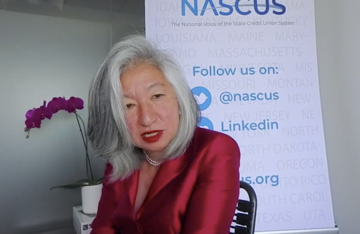
Lucy Ito, NASCUS
Hood: People were working 24-hour shifts. I’m not advocating that, but there is a collegiality in that. I was so proud of this industry and the (attitude that) we are all in this together.
Berger: We had the same thing with the hiccups of PPP. Our compliance attorneys were answering questions 16 hours a day, seven days a week for weeks on end. Credit unions were working overnight and so were we.
Trunzo: On one of the 6,000 Zoom calls I’ve been on, Jim Nussle said something that stuck with me, which is, “You will remember who treated you well during this pandemic.”
Ito: Everyone was working so hard, and then, boom, George Floyd was killed. We are a small organization of 10 staff, six of whom are of African American descent. That Memorial Day weekend broke us emotionally and led us to looking at ourselves at a staff level. We held an exchange with large credit unions and state regulators, and diversity and inclusion was on the agenda. Chairman Hood joined us in a separate conversation. What I heard from that group is we are at this tipping point in the country with awareness.
For credit unions and regulators, the key things are intentionality and doing things that are sustainable into the future on so many levels. We are not going to fix this overnight, but I am very encouraged by the response from all parts of the system.
Hood: I couldn’t agree more. George Floyd’s murder rocked me to the core. For me as the first man of color to oversee a federal regulatory agency, I must say that before that murder I probably wouldn’t have been so vocal. But we all saw this egregious disregard for life play out before our eyes, and the pandemic has (illustrated) other inequities. I think we as a nation need to come together and a lot of that healing can come about by calling on credit unions to be a part of the solution.
Rodney Hood
At NCUA, we are working to make sure in working with credit unions our diversity efforts aren’t just a check the box exercise, but that there is intentionality. We know from the McKinsey study that diverse organizations outperform nondiverse organizations. That’s why we want credit unions to fill out their diversity surveys so we can know where we are today.
Berger: We had a very serious experience to Lucy’s. It rocked our staff. A couple of years ago we created a culture committee and they did a yeoman’s job. They deal with DEI issues that come up on behalf of the staff at NAFCU. But the rubber meets the road, so we have to lead as organizations and our staff has to reflect the community
Nussle: I would echo that. Rodney, you were able in your one sentence, that “Financial inclusion is the civil rights issue of our generation,” to say what it took me at GAC a half hour. Let me add, I think it may not surprise people enough that you took that kind of eloquent stand. What I think it also takes is us pale white guys to take that stand, for those of us who have had privilege and have not experienced what you shared, and what many on my team have shared…from their lives, and it takes us as the pale white guys to also stand up and say enough is enough. And not just say it, but walk the walk.
And that’s why we have been encouraging credit unions and their boards to be thinking about this when they think about succession plans. Boards themselves will say we are not diverse enough, we have been here too long, maybe we’re too white. That is reflected in our management, as well.
Talking about and passing DEI resolutions is the today stuff; but what needs to happen is we have got to work on diversity in the way we hire, the way we promote and the way we lead our credit union industry into the future.
Hood: When it comes to board diversity I will never forget a credit union from New Mexico that visited my office and they said they were creating a small advisory board (of minority members), and one person had since moved onto the board. I also encourage all of you as leaders, and it’s one of the things we did, to give your employees a safe place to talk about the emotional toll the George Floyd murder was having on them. We did about 15 of these listening sessions and it was a chance for me to talk about some of the experiences I have had as a black man growing up. It has taken us as a society almost 400 years to have these difficult conversations. Yes, there good to have, but let’s couple those with action.
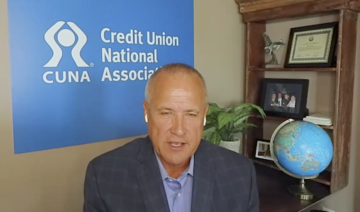
JIm Nussle
Ito: We do need to focus on social injustice against the black community, but I hope that leads to similar introspection about other groups. Not everyone presents as a minority, but I’ve heard from people who come from hearing disabled families, for instance, and the challenges they face, and I do hope we extend the empathy to other groups, as well.
Trunzo: If you believe as we do at CUNA Mutual that everyone should have a path to financial security, for me as a leader, every day I learn a little bit more of what folks of color are facing. One of my best friends in the company and an outstanding leader, Cedric Ellis, tells the story of driving a really nice car, a Range Rover, and he was stopped in Madison for something that was clearly something none of us would have been stopped for. I reached for the phone to call the mayor, and he said, “Bob, stop, I’m a black man driving an expensive car and (the cop) asked me, ‘Who’s car is this?’” And that for me was Bob, what a moron you are, you can’t relate.
You can tweet about it, post Instagrams about it, but you’ve got to do something about it, something substantial. And whatever you’ve done to date, you’ve got to do more.
All of us want to see something happen. At the end of the day these barriers have existed and had a profound impact on our country. What I worry about is the timing is now and it’s such an opportunity, and I see the country at such extremes. And Jim said, sometimes you got to get to the middle to get something done.
Hood: I would say there is middle ground here. We all stand firmly against racism and want people of color to have access to shared prosperity. I think there is more commonality in uniting around these issues than I’ve ever seen. I think the time is now.
I could have been George Floyd. People will say, “Rodney you’re a chairman, you don’t get stopped.” I get stopped twice a year. I’ve already been stopped once this year. The rationale is if you stop someone who looks like me there must be something in their past. I’ve had a cop say, “My goodness, there are no warrants out for your arrest, your record is so clean.” The mindset is if we stop him, let’s see what’s there. The difference is now we can have these discussions publicly.
Trunzo: Clearly, now is the time to act on DEI issues. Action is critically important now. As we transition to the future we must talk about vision and what we think the future will look like
Berger: I think Jim said it best, you can’t look back. In our industry you have to look forward; what does 2021 look like? You can’t allow the pandemic and everything else to paralyze you. You have to serve the American consumer. I will say if you’re doing strategic planning more than 24 months out, that’s a waste of money. It’s all very fluid.
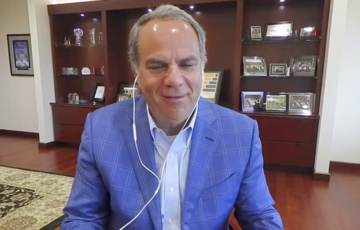
Bob Trunzo
Hood: I couldn’t agree more that we have to look forward. It is about strategic visioning. In August, when we have no board meeting, we will host a strategic visioning session on what does the agency look like in pandemic and post-pandemic world, and one of the things we will focus on is fintech. It’s never been more important. I have long wanted to pursue an Office of Innovation and Access through the use of fintech. It’s not just innovating for the sake of innovating, but we do it because it’s going to provide greater access to disabled populations, to rural communities. It’s about what can we do to keep one third of Americans who belong to credit unions to have access to their credit unions?
Ito: It would be interesting to hear from you what the silver linings have been. For examiners, (the pandemic) has accelerated the adoption of working offsite, something we would have thought would have taken a couple of years all had to happen in the space of a few weeks. I also want to applaud NCUA for its work on field of members, and kudos with the decision by the Supreme Court. We are believers at NASCUS in the dual charter and we think innovation at the state side on FOM did influence NCUA and now we hope that puts pressure on states.
Hood: You will now see us act following the Supreme Court ruling. There will be more opportunities, and with FOM I think that goes back to digital technology and how do we use fintech as a tool for service. The time is right. The remote exam posture is something I can see us continuing to do.
Nussle: I would just add that putting forth the stories about the credit union difference and what you have been able to do to serve your members during this time IS different. Don’t get tired of telling that story. Politicians need to hear it.
Trunzo: There are some positives. Number one, members are moving to digital. That will continue to be the future. It’s the ability of large organizations such as ours to be agile and to adapt. And we are excited about the future not just because of the liquidity of the space and the huge balance sheet of CUNA Mutual, which allowed us a few years ago to get into the fintech space, and I’m real excited. I spent a couple of years at (the Kellogg School of Management) and I did learn “CEOs must have a foot in the future and an eye over the horizon.” That’s what credit union leaders need to have now. I think it’s a great future for all of us.