

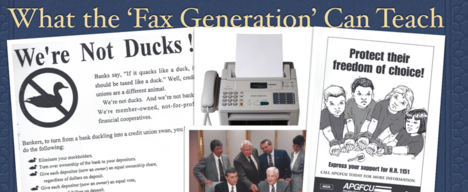
WASHINGTON—There’s a great lesson to be had for credit unions today in a battle that was fought by the “fax generation”—credit unions can accomplish extraordinary things when they unify and get behind something.
Pat Keefe, who today is the director of communications for NASCUS, said that has never been clearer than when the fight took place for the Credit Union Membership Access Act.
“I witnessed this. Credit unions talk about being cooperatives and cooperating among themselves, and I am witness to the fact they are and they did,” said Keefe, who was one of the leaders of the Credit Union Campaign for Consumer Choice—the unified effort by CUNA, NAFCU and the leagues to support the passage of the credit union backed legislation in 1997 and 1998. “I think it’s something credit unions should remember and think about going forward, because this kind of cooperation is unique. If you can’t take action and work as a group to protect and advance yourself, I don’t think things will work out as well for you. The whole effort around HR 1151 is living proof that credit unions can work together and make things happen.”
When the Credit Union Campaign for Consumer Choice was formed, Keefe said the team immediately understood the gravity of their role.
“This was very serious, we all knew that,” recalled Keefe, who in the 1990s headed public relations and communications for NAFCU. “This was not some overblown Washington political fight, this was the real thing. The federal court had made a decision that could restrict the ability of credit unions to grow. And if that did not hit you right between the eyes, then you were not paying attention.”
Getting Down To Business
Then CUNA General Counsel Kathy Thompson was the primary CUNA representative on the steering committee that was headed by Larry Blanchard, then SVP of communications at CUNA Mutual Group. Keefe described Thompson as a “brilliant lawyer” who was invaluable to the effort.
“She knew the law frontward and backward,” recalled Keefe. “In fact, she knew the entire history of the (field of membership) court case.”

Keefe, as did Blanchard in his recounting of the months leading up to the passage of the CU Membership Access Act, said those days were about getting down to business.
“There was not whole lot of nonsense,” said Keefe. “Once we got everyone together and started heading in the same direction we were very focused . . . No question, we had two organizations run by two strong personalities (CUNA President) Dan Mica and (NAFCU President) Ken Robinson. They both had boards to report to and each side had strong feelings on what each wanted to accomplish. Yes, we had disagreements on how to approach things. But the challenge for us all was to was to work through that and get people on the right path.”
The seriousness of the matter facing credit unions was never more evident to Keefe than after he attended a Washington hearing in which Judge Thomas Penfield Jackson was speaking with a group of bankers about credit union activities.
“After the Appeals Court had ruled in favor of the banks, the court remanded the case back to the District Court run by the well-known Jackson,” said Keefe, noting that the judge was famous for being fair but extremely tough.
Bankers Complained
During the hearing Keefe said bankers complained about field of membership actions NCUA had taken after the Appeals Court ruling.
“Judge Jackson listened, and then stopped the bankers’ attorney, who was speaking,” said Keefe. “Jackson then said something about NCUA that startled all credit union people in the room. He said something like, ‘Sounds to me we have a rogue regulator here.’ I remember being struck with concern as I walked out of that courtroom.”
Keefe said the comment concerned the entire credit union movement, since it suggested that credit unions could face further challenges, and that the fight to address the Appeals Court decision either in the courts or with legislation might be even more difficult.
“That comment stood out for me because it was so jarring,” recalled Keefe. “We really knew we had an uphill fight after that—but on the other hand it truly committed everyone to the challenge.”
That included state-chartered credit unions, whose commitment to the cause was needed, noted Keefe, who has a unique perspective, having spent part of his career working with federal credit unions at NAFCU, and now with state CUs at the National Association of State Credit Union Supervisors.
“State-chartered credit unions cooperated because they saw this as a threat to the movement itself,” said Keefe, who noted that despite state charters not being subject to federal rules, there was a belief that the effects of the Appeals Court decision could “fester,” someday filtering their way down to the states. “If one sector of the movement is in trouble, then the rest of the movement needs to get behind the effort. The state-chartered credit unions didn’t have to help, and today there even may be some sore feelings about it. But they did it because they saw what was happening in Washington as a threat to everyone in the movement.”
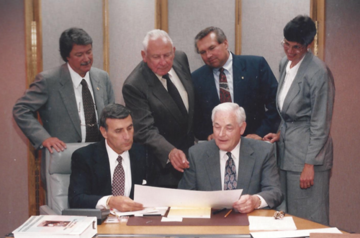
Credit Union Campaign for Consumer Choice leaders
Following the Appeals Court decision, Keefe recalls how interest grew quickly from credit unions for news on developments in the fight to address the ruling.
“At the time fax was the new and exciting way to communicate, and NAFCU at the time was using ‘fax broadcasting’ in a big way to communicate with our member credit unions,” said Keefe about his work before the Campaign for Consumer Choice launched. “NAFCU members loved that we were keeping them informed. And being in Washington we were at the forefront of the information flow. It was the fax generation’s version of breaking news.”
Looking back on the eventual win for credit unions that changed their future, reminded again that everyone in the fight deserves equal credit.
“CUNA Mutual Group’s support—and all the money they contributed . . . Buddy Gill played a key role in the latter part of the campaign as the campaign’s political manager . . . And the leagues, we could not have done it without them. We were fortunate to have (then Iowa league CEO) Tom Griffiths, then chairman of the Association of Credit Union League Executives (now American Association of Credit Union Leagues). He kept all the leagues in line,” said Keefe. “It was an extraordinary job done by everyone. You could not have achieved success without everyone working together in the same direction, committed to getting things done.”