

DUBUQUE, Iowa—Just letting members know the credit union saves them money with low loan rates isn’t enough anymore, asserts one CU that quantifies—to the dollar—how much it saves its members through loan refinancings.
Throughout 2014 and 2015 Dupaco Credit Union promoted “GreenBack Impact” refi campaigns that employed a “real-time tracker” to tally and post members’ loan refinance savings.” As soon as a loan was booked, the savings over what the member would have paid on their prior loan were calculated over the life of the new loan, and then added to the tote board for the whole community to see.
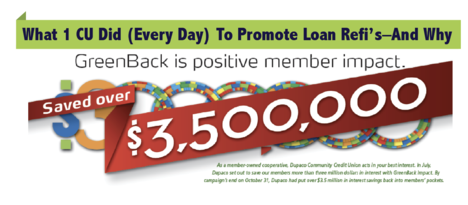
The tracker appeared on Dupaco’s website and on digital billboards around town. Members saved $3.5 million the first year and $3.7 million the second during the three-month programs.
Data Driven
CMO David Klavitter described the efforts as comprehensive, data-driven marketing campaigns. Not only did the credit union track refi savings at the loan officer, branch, member and aggregate CU levels, the data was also used to identify members who potentially had loans elsewhere.
“The concept is to help members quantify their value in the cooperative,” said Klavitter. “While giving back to members is the credit union difference, what really separates CUs from banks is showing them how much. Through the GreenBack Impact effort we quantify the impact we are having on our members’ lives.”
The impact the Dupaco is having on members was a lot greater than the $1.3-billion credit union originally projected. During the first campaign Dupaco set a goal of $1 million in interest savings—it more than tripled the target.

David Klavitter
Much of that success, said Klavitter, came from people seeing the tracker steadily move up each business day. That got a lot of people in town talking about Dupaco and understanding the value the credit union delivers, he said. It also motivated staff. Dupaco had trackers for each loan officer and one for each office.
“It was motivating for staff to see how much each of them were saving members and it drove some healthy competition among the branches,” said Klavitter, who added that internal contests were held.
Refi Candidates
Data, too, was used to target refi candidates. But instead of buying lists that showed which members had loans outside the credit union, Dupaco felt it was more effective to create profiles of potential refinance candidates from the CU’s database.
“We analyzed our membership base and from that data we created numerous profiles we overlaid across our account holders,” Klavitter said. “For instance, we would find a member with a high number of loans with us, look at who he is, demographically and socioeconomically, and then find members with that same profile. If those members did not have the same number of loans with us as our profile, we’d ask why, and then target those members.
“So there is Joe who lives down the street from a member who has a strong loan profile. He is similar in age, number of kids, and number of account relationships, but he does not have the same amount of loans with us. Joe is a target,” explained Klavitter.
Targeted Messages
The next step is to create targeted messages for what is generally a small group of members.
“The beauty of this kind of offer is that you can be very focused, which we feel has a tremendous impact,” said Klavitter, who said the time spent to create individual messages is worth the effort. “You have to have a customized message and customized artwork to be truly effective.”
Dupaco followed up with outbound calling.