

WASHINGTON—Dennis Flannigan is concerned that federally chartered CUs in Nevada are a dying breed, with only six left.
And his federal credit union, Great Basin, may not remain in the federal fold much longer unless NCUA does not do something to amend its FOM rules.
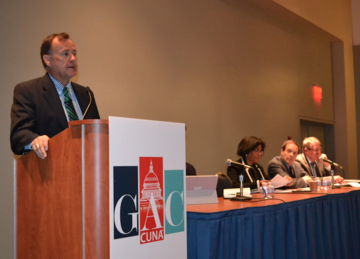
NCUA's Rick Metsger leads discussion on FOM rules.
“Remaining a federal charter is up in the air now,” the CEO told CUToday.info at CUNA’s GAC. “Right now we are deciding which way to go, and it will largely depend on the information that comes out of NCUA’s FOM working group in the next six months. Federal credit unions need some help.”
Flannigan cited the influx of big credit unions based outside Nevada impacting the ability of his credit union to compete and grow. He said current FOM restrictions do not allow his CU to expand into areas it needs to reach into.
“These big guys have come in, and a lot of the big credit unions in the state, as well, have already converted to a state charter. So they can do what they need to do to keep growing.”
Flannigan made those points clear to NCUA Vice Chairman Rick Metsger, who hosted an open microphone session at CUNA’s GAC on field of membership rules. Metsger spoke, and then turned the floor over to credit unions to see what issues they are facing, and what needs to be done. NCUA has formed a working group to address FOM rules.
Before attendees shared their insights, Metsger spoke with CUToday.info about the importance of the issue and of CUs taking an active role in working with NCUA on FOM changes. Metsger noted that the FOM rules are the most important issue facing credit unions, above risk-based capital.
“I think field of membership, leveling the playing field between state and federal charters, leveling the playing field between credit unions and their competitors, is the most important issue facing the movement’s future—more than any of the other issues we have talked about here at GAC. Credit unions can’t be operating under rules that others are not playing by, especially in a rapidly changing marketplace.”
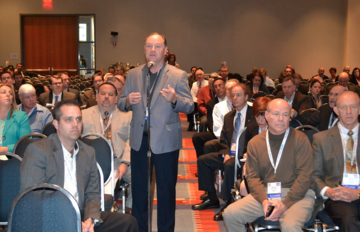
Audience members offer points during FOM discussion.
A large number of CUs stood up and shared their views at the session, many focused on how federal FOM guidelines make it too hard, if not impossible, to add an adjoining county or area, especially if the area crosses state lines. Representatives of credit unions in sparsely populated areas stood up and said they need to reach large distances, some up to 400 to 500 miles from the home office, to compete and grow.
A representative from the Pennsylvania CU Association asked NCUA to look closely at the FOM rules in his state and how they are restricting the ability of small CUs to merge. “We want to do many of these mergers while credit unions are still healthy,” the executive stated.
A CEO from Oregon made it clear to NCUA the advantage the state charter offers in Oregon. He explained that the FCU tried to add one county under the existing FOM rules, but was turned down. “If we switched to a state charter would could add more than 20.”
Tom O’Shea, CEO of Aspire FCU in New York, pointed out how the federal charter rules were written before CUs began to think about being virtual credit unions. His shop has reduced its branches from nine to two in an effort to boost efficiency, give more back to members, and serve members in the way they want to be served.
O’Shea noted that to expand, the FOM rules are based on the credit union’s physical locations.
O’Shea also asked NCUA to give credit unions more latitude to simply add small SEGs, less than 3,000 people, without having to cut through all the NCUA red tape. He further suggested allowing credit unions to add a small groups by simply adding the action in the board minutes, and then having NCUA examine the minutes to see what the credit union has done.
Metsger said the agency will soon have an e-mail address set up, fomsuggestions@ncua.gov, that will allow CUs to send their thoughts directly to the working group.
“We want (the group’s work) this to be fast tracked as quickly as possible—get much of this done by the end of the year.”
Metsger noted that the working group will look at changes in “three buckets”:
- Low-hanging fruit: changes that are good public policy and can be made by changing the interpretation of NCUA’s own documents and rules, with no board action.
- Changes that would require a proposed rule.
- Statutory changes through Congress.