


LAKE FOREST, Ill.—Consumer complaint data collected by the CFPB continues to show that most people are satisfied with their overdraft protection service and that the Bureau’s attention could be better directed to other banking areas.
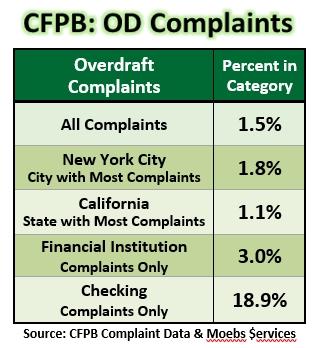
A new analysis of the agency’s year-end data indicates that of 500,000-plus consumer complaints, only 1.5% pertained to overdrafts.
With the CFPB continuing to indicate it will propose regulatory changes on overdrafts, the allocation of CFPB resources on this topic raises questions, explained Michael Moebs, economist and CEO at Moebs $ervices, whose company recently completed a review of the CFPB complaints.
“As the economy is improving and the election year is here, the CFPB will have to answer why any action on overdrafts is being put in front of enormous complaints about mortgages, debt collectors, credit reporting agencies, credit cards and others,” said Moebs.
CFPB's Agenda
The Moebs study on the complaints as of Dec. 31 shows that since the CFPB started collecting the data in late 2011, there have been 7,741 (1.5%) complaints about overdrafts out of 501,230 total complaints. In 2015 there were only 2,031 (1.2%) complaints out of a total of 164,722. The city with the most complaints is New York, and California tops the list for states.
“Both are in line with total OD complaints, as we see overdrafts for New York City and California are at 1.8% and 1.1%, respectively,” stated Moebs.
Nearly half of all complaints (49%) have to do with financial institutions. Breaking those down: 53.4% concern loans, 24% are credit card issues, and 22.6% are deposit related. Almost half of the total deposit complaints, or 55,649, are due to opening/closing, and maintenance of an account, and only 13.2% are attributed to overdrafts.
“It would appear that the CFPB is focusing on their agenda items and not listening to what the American consumer is saying,” said Moebs.
Year over year, total CFPB reported complaints increased 7.5% from 2014 to 2015. Financial institution complaint data increased 2.2% during the same period. While most categories reflect the upward trend, several were down: debt collection, mortgages and payday loans.
“The significant decline is payday loans, which is down 9% from 2014,” noted Moebs. “This is important because most payday loans are tied to overdrawn checking accounts and are another source of funding for over half of those who overdraw frequently.”
Data Delivers Direction
The CFPB acknowledged that it has received over 750,000 complaints through December 31, 2015. However, only 501,231 complaints are reported, pointed out Moebs.
The Moebs study, which looks at the data in broad categories, suggests the complaints give some direction for what consumers want and need.
“The consumers’ statements collected by the CFPB take us in a couple directions,” observed Moebs. “First, it’s evident that many consumers lack knowledge on services like loans, credit cards, or occasionally checking accounts. The industry needs to simplify agreements and clearly communicate what an overdraft is until the public sector can do a better job of educating the consumer. Second, the consumer’s indifference to overdrafts allows the financial institution to freely adjust price. Lowering the OD price would change the consumers’ indifference to interest causing greater usage and increasing revenue for the financial institution—making it a win for all.”