

MADISON, Wis.–The nation’s small credit unions are a mixture of misconceptions over their performance and future and are more efficient than many believe, and yet they are also staring at challenges that are the result of their lack of scale and that will be the deciding factors in whether or not they have a future.
That’s according to a new white paper that seeks to examine the key opportunities and challenges facing small credit unions. The State of Small Credit Unions Today white paper, from CUNA’s Small Credit Union Committee, offers suggestions for how “cross-industry support can lead to greater collaboration at all asset levels and provides recommendations for the preservation of small credit unions nationwide,” according to the trade group.

The white paper, a 20-year update from a 2001 report from the Small CU Committee, is being released at the same time industry trends would seem to suggest smaller credit unions are struggling. While the white paper defines “small” as $100-million or below in assets, as CUToday.info reported here, NCUA data for year-end 2020 showed lending and membership growth was negative in CUs in all asset categories below $500 million.
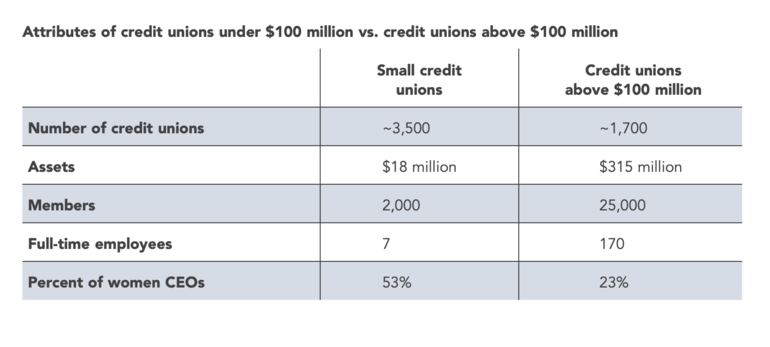
The paper states the average credit union below $100 million actually has just $18 million in assets and serves approximately 2,000 members.
But credit unions of $100 million and below, which comprise approximately three-quarters of all credit unions, are actually stronger and performing better than many people believe, according to Tom Sakash, manager of CUNA’s Small Credit Union Initiatives program.
‘Some Good Things Happening’
Sakash said during a call with the credit union media that there “are some good things happening in the small credit union space. In 2019 (the report’s findings are based on pre-pandemic numbers), a full quarter of small CUs reported loan growth at least 50% higher than that of larger credit unions. And despite some misconceptions over stagnant growth at small credit unions, there is a large cohort, 25%, of small CUs that grew membership at least two times faster than the U.S. population growth.”
According to the CUNA analysis, there are more than 10-million members served by CUs defined as “small,” representing more than $50 billion in loans.
Sakash described the seven-section, 33-page report as “detailed,” with a lot of input from the members of the Small CU Committee, CEOs from small CUs across the country, and state leagues. “We have a good grasp on where small credit unions are, what their biggest challenges are, and what we can do as an industry to support them,” he said.

Tom Sakash
The Small Credit Union Committee said in its introduction that the report is not for CUNA or its board, but instead for “all within the credit union movement who wish to sustain small credit unions. We believe stakeholders across the industry must come together to preserve this important segment of credit unions.”
Support for small CUs, however, does not mean “supporting poorly run financial institutions,” the report adds.
Challenging Assumptions
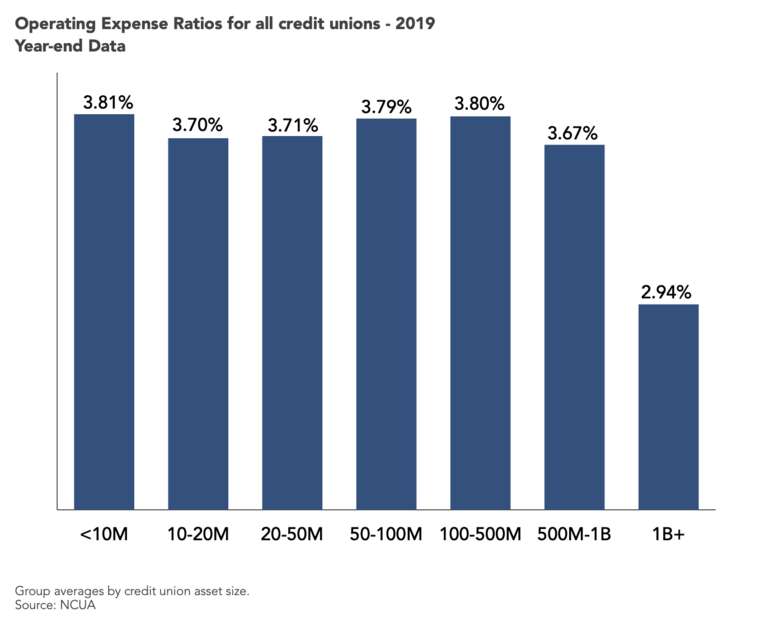
Addressing assumptions made by many within the CU community around the struggles and even demise of smaller CUs, the report said there is “no significant difference” between the average operating expense ratio of an average $10-million credit union versus that of an average $750-million CU.
The report also seeks to highlight a number of smaller CUs that have either shown robust growth or rolled out innovative programs, including Ironworkers USA FCU, Element FCU and Manchester Municipal FCU.
While those types of positive stories are highlighted in the report, it also suggests it’s unlikely credit unions in the asset cohort will be able to go it alone and survive.
“Small credit unions must collaborate in new ways to achieve the scale necessary to access the technology they need to remain relevant,” the report states. “A significant part of the burden that small credit unions face can only be addressed by the people who lead them, but those leaders need help.”
Not-So-Lucky 7
And the reasons for the need to collaborate are no secret, according to Sakash, who highlighted a number of challenges to smaller CUs that were identified in the report, including:
- Limited Human Scale. Sakash said the average small CU has just seven employees, while the average CU over $100 million in assets has 170. “When we think about the challenges of scale it starts with the employee totals,” he said.
- Heavy Burden. The regulatory burden is growing faster at smaller institutions than their larger counterparts, the report found. It notes that between 2016 and 2018, the cost of regulatory compliance for small CUs climbed 5% to $814 million, while for the rest of the movement the cost of regulatory burden grew by 2%.
Six Challenges
Beyond those challenges, the white paper identifies what it said are six of the biggest challenges facing small CUs and also offers suggested solutions:
- Technology and Tech-Related Costs, Including Human Resources. The white paper calls for more grants for smaller CUs to use to invest in technology and for more educational programing to improve knowledge of JT best practices.
- Board Leadership and Engagement. “Often in small credit unions that are not doing well and considering a merger as their succession plan, it is because the board has not done a good job, has not evolved, and has not found a successor to a long-time CEO,” said Sakash. The white paper outlines what’s needed for a “culture shift.”
- Member Growth. Limiting growth at many small CUs are “relevance and visibility,” the white paper states, calling for more large CU/small CU marketing mentorship programs.
- Generating Income. The white paper states the pandemic has slowed growth and hurt income at many CUs, and one strategy is to find niches and exploit them, said Sakash. He further noted many small CUs simply aren’t good at marketing and branding.
- Health Care Costs. The inability to provide a robust health care package for employees is only being exacerbated in a market in which it’s more difficult than ever to recruit and retain employees. The white paper calls for a “National Credit Union Health Care Task Force” and notes that several leagues, along with Corporate Central CU’s InterLutions CUSO, have stepped up to offer solutions.
- Increasing Overall Costs. Numerous costs, especially related to core processing, are “nickel and diming” small CUs, the white paper states, while other costs have continued to soar. The paper recommends buyer groups and vendor management collaboration.
(There is also the issue of growing personnel costs, which CUToday.info recently featured here.)
Reasons for Being
The report from the Small Credit Union Committee also seeks to lay out a case for the “continued importance” of small credit unions, making three primary arguments:
- Small CUs are Vital to Their Members and Communities. “When you think about mergers and the loss of small CUs, that hurts from an industry level, but if you think about the members and communities that relied on those credit unions for so long, those communities suffer when credit unions go away,” said Sakash.
Added Dale Hansard, president/CEO of Caprock FCU in Lamesa, Texas, and chair of the committee, in a statement accompanying release of the report, “We all run credit unions all over this country that mean a whole heck of a lot to our members “I’d contend we are more relevant now to the needs of our members than we’ve ever been before. The problem is that the operating environment keeps moving the goal posts for us on how we’re allowed to serve our members, and that continuous pinch and the shifting requirements means smaller shops just need an extra boost to keep doing this much-needed work. It’s on us as small credit unions to adapt, without question, but as we point out in the white paper, the whole movement has a stake in what happens to our smallest institutions. And we hope folks will stop and listen.”
- Small CUs are Critical to Preserving the CU Tax Status. “Imagine if the financial institutions that serve church congregations, fire departments, small towns, teachers, union halls, or undocumented immigrants, disappeared. What would the industry look like?” the report asks. “Would that picture be strong enough to protect against future attacks against credit unions? There is significant political strength in an industry that remains diverse, local, SEG-based, and, in many cases, small. The loss of the credit union not-for-profit tax status would be catastrophic for the movement.”
Sakash added that fewer CUs also means fewer CU leaders and board members available to do advocacy work.
- Diversity in Size & Type of Institution Ensures a Stronger, More Robust CU Movement. Sakash said a diverse CU community is critical to understanding local needs in local communities.
The Next Steps
Sakash said the Small CU Committee is now looking for new ways to provide simple resources and ideas to help small CUs collaborate, to understand trends, and to put plans together to evolve their organizations.
Committee Members
Members of CUNA’s Small CU Committee include:
- Lori Herrick, Manchester Municipal FCU, Manchester, Conn.
- Dale Hansard, Caprock FCU, Lamesa, Texas
- Linda Bodie, Element FCU, Charleston, W.V.
- Amy Brodersen, Family Focus FCU, Omaha, Neb.
- Becky Brosius, Combined FCU, Hot Springs, Ark.
- Deborah Fears, Chicago Post Office Employees CU
- Thomas Flowers, Calhoun Liberty ECU, Blountstown, Fla.
- Nick Fugal, Clarity CU, Nampa, Idaho
- Tina Jamo, Katahdin FCU, Millinocket, Maine
- Roxi Jensen, Embarrass Vermillion FCU, Aurora, Minn.
- Harlene Johnson, Light Commerce CU, Houston, Texas
- Tom Kane, Illinois Credit Union League
- Karen Madry, Afena FCU, Marion, Ind.
- Joey Minton, Mississippi DHS FCU, Jackson
- Stephen Nelson, Utah Credit Union Association
- Erick Orellana, Comunidad Latina FCU, Santa Ana, Calif.
- Teri Robinson, Ironworkers USA FCU, Portland, Ore.
- Brian Trotter, EPB Employees CU, Chattanooga, Tenn.
For the full report, go here.