

BIRMINGHAM, Ala.—Will a two-member NCUA board speed up or slow down the pace of federally chartered CUs converting to state charters?
Should that two-member board result in a slowing down of its ability to move forward with or pass new rules, could it affect the progress of the agency’s FOM proposal, for instance? Would that in turn might lead to more federal CUs converting to state charters if patience wears thin for new growth options under the federal charter?
Former Board Chairman Debbie Matz stepped down at the end of April, leaving Board Member Mark McWatters and new Chairman Rick Metsger at the table.
“With a couple important issues scheduled for this year—the field of membership rules rewrite and supplemental capital regulation—it will be interesting to watch what develops particularly on those two matters with the two-member NCUA board,” said Dennis Dollar, principal at Dollar Associates and a former chairman of NCUA.
Federal Charter 'Disadvantage' Today
While the dynamic of the NCUA board changed with Matz’s departure, the situation does not necessarily mean the FOM rewrite or the supplemental capital proposal won’t happen, said Dollar.
“I think the new field of membership rules should happen, and I’d like to see them happen,” said Dollar. “The federal charter is at a distinct disadvantage to the state charter on field of membership issues.”
That is quite apparent in the interest shown by federal CUs in converting to a state charter. Dollar said that his company is currently working with 14 CUs on federal-to-state charter conversions.
“And each one of them is being driven by the current field of membership rules,” said Dollar. “The field of membership flexibility at the state level is so much broader in most states than it is at the federal levelthat there really has become a disparity in the viability of the federal charter as it relates to field of membership.”
Dollar said he believes it is essential that some modernization of the FOM rules happens, and happens soon.
“I don’t know that the new rules go far enough that they would make any state charter decide to convert to a federal charter, but it could stall some decisions to move from a federal to a state charter,” he said.
Dollar applauded Metsger for “taking the lead” on the FOM issue, heading a task force that led to a proposal for a “much-improved” field of membership rule.
“It does not go as far as I think it could or should, nor does it go as far as the 1999 or 2003 rules,” Dollar said. “But it is certainly an improvement over the existing rules and is well within what the statute allows.”
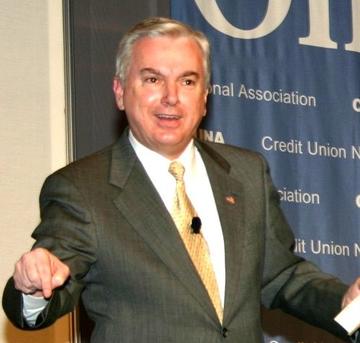
Dennis Dollar
Dollar said McWatters has also been “very supportive” of the idea of modernizing FOM rules to help credit unions compete in the marketplace through his public statements.
“So I certainly think this is an area where there should be some common ground between the two,” Dollar said.
Moving another key 2016 issue forward—supplemental capital—will be more “complex but is just as important,” explained Dollar, since the agency would be starting from “virtually scratch on an extensive supplemental capital rule, unlike field of membership where there already is a rule and it’s a matter of adapting it and updating it. If the devil is in the details, there is a lot of devil to deal with in supplemental capital availability for all credit unions—not just low-income credit unions.”
McWatters Supporting Supplemental Capital
Yet McWatters has been very outspoken in his support of supplemental capital, noted Dollar, who feels giving credit unions an option for building additional capital beyond retained earnings is important for long-term industry viability.
“I think there will be a real push from him that will bring about some substantive discussions between his staff and Mr. Metsger’s staff as to ways to proceed there,” offered Dollar.
“I see no reason a two-member board can’t deal with both of these issues effectively,” Dollar said. “In fact, a two-member board, with responsible members like Metsger and McWatters that realize there are some areas where action is needed, should still be able to make the right things happen at NCUA.”