

ANAHEIM, Calif.–How can credit unions best manage the transition to a digital marketplace, especially when so many members still favor analog offerings?
Answers to that question and others were offered by representatives of airbnb, Google, and a digital marketing agency during the CUNA Marketing & Business Development Council meeting here as part of a far-ranging Q&A session.
Participating panelists were Dana DiTomaso, partner with Kick Point in Edmonton, Alberta; Andrew Schapiro, creative director with airbnb in San Francisco; and Ben Polk, senior account executive with Google in New York.
Here is a look at the questions about the digital economy, branding and related issues that were asked by credit unions, along with the responses:
Q: What is the recommended transition as we move from print to digital? Do you build everything and make the switch, or do you do it slow?
Polk: We see that a lot of times, such as with TV marketing, that the spend is not following up with the actual consumption. It’s not uncommon to see brands doing things they are comfortable with, and my recommendation is not to go past what you’re comfortable with and go slow. We see this with companies like Taco Bell, which took their entire TV budget and moved it to YouTube.
DiTomaso: In our experience it’s been a slow transition to ensure their other segments, such as the younger demographics that are on Snapchat, know they are valued. You are going to have to invest in digital and we spend a lot of time convincing C level executives about this. It is not free and not cheap.
Schapiro: As a designer coming from a print background, I say you should not completely let go of that. People can have a more intimate experience with print.
Q: How do you keep the aging demographic from being pushed to the side in this type of transition?
DiTomaso: One of our clients, the community foundation, has been set up by older people and for older people, and their donor services team is really worried about suddenly chasing the younger demographic. They have continued to keep their magazine; we are slowly moving the newsletter from print to email marketing, and we’re pushing a little more social media. And older demographics are heavily on Facebook; maybe not Twitter and Instagram. We ran all our emails through Full Contact and found a huge number on Facebook. But we are doing this over a period of years.
Polk: There has been a shocking amount of the audience that is over 55 that is on YouTube, especially videos that teach you how to do something.
Q: A lot of credit unions and other organizations use social media to advertise services. What do you think will be the next big digital platform?
Polk: If I knew that I’d be really, really wealthy. But it’s interesting to see the Twitters and the Snapchats of the world that are doing so well could also be like a flash in the pan. Facebook’s demographic might be skewing older, and where will people want to be in 10 years? Mobile is huge and won’t be going away anytime soon. But the next big thing is tough to say.
Schapiro: It’s hard to not think about virtual reality right now. It seems inaccessible at times, but Google is giving away a cardboard device to create a virtual reality platform yourself. It feels so far in the future, and yet it’s already here. I think it’s just on the cusp of being mainstream.
DiTomaso: We’re seeing participatory marketing, such as Google Now, that anticipates what you are going to want to search before you do that search. And then there is beacon technology. The Edmonton Eskimos just put beacons throughout their stadium. Their app is connected to Facebook. We know where they sit, that they went here and here and here, and it allows them to think about what choices they will make in the future and to try to reach them before they make their choice.
Q: Airbnb is sexy and cool? Do you have tips about something that’s slightly less glamorous, such as a credit union’s offerings?
Schapiro: It’s hard for me to agree with that. I’ve stayed with people who are in their 60s. And I also think about what other people in your sector are doing, such as American Express, which built up Small Business Saturday. They have created a sense of community. I think the parallel there is this opportunity for you to look at something like airbnb to think about how are we marketing our product? We do it through story telling, and I think credit unions can do that. There is nothing more powerful; it draws out emotion.
DiTomaso: I totally agree. We have one client that is an accountant and they do cool things all the time. It’s important to get out of that mindset. You can think of ways to make that credit union the heart of the community and brand it that way. These are people who care about you; there is this separation between a bank and a credit union. I think those kinds of stories are easy to tell, but also easy to overlook when you are on top of them every day. People think they’re cool, but you don’t.
Schapiro: Squarespace is a good example. What they have really nailed as a brand is being a site that’s all about aspiration. They talk about being a platform for sharing stories. Perhaps it’s more about nailing that element of aspiration. How do you see yourself as a better person because you are a part of this organization?
Q: How do you know when it’s time to reshape or evolve your brand?
Schapiro: Suffice it to say, in our case we recognized the way we talked about our brand inside our walls were very different from the way people outside our walls saw us. We talked a lot about connecting to people and aspiration, but the biggest a-ha moment was the way were thinking was different. We needed to reconcile those things. A big part of that has to do with your image and what are you communicating. We realized we had to revisit everything about how we were communicating. In essence, it’s about how do you see yourself and how do those around you see you?
Q: Is the gap between credit unions and the fintechs going to widen and are we going to be left in the dust?
DiTomaso: I think a lot of companies have not invested in technology and it’s catching up with them. Many companies have technologies that don’t talk to each other and it creates barriers. You have to start by mapping out what a cold customer journey is like. What parts of it can be done better, be automated?
Polk: I think ease of use and customer experience is one of the big things. Mobile is really, really important. If I’m trying to apply for something with the credit union and it doesn’t work for me that well, I’m immediately going to be swayed away from that company.
Q: As CUs, we hang our hats on service. As trends move to the digital space, how do credit unions continue to provide the services upon which they pride themselves.
DiTomaso: I think it’s become easier than ever to provide good customer service, and if you pride yourself on good service you have a lot more competition than you used to. A lot of this is about talking to customers about how can you be of service in ways that are unexpected but which they will appreciate.
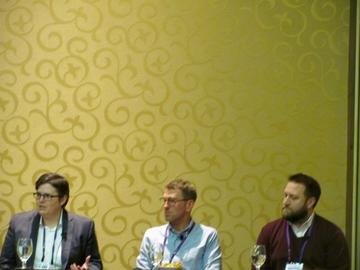
From left, Dana DiTomaso, Andrew Schapiro, and Ben Polk.
Q: What can small CUs with small budgets do?
Polk: YouTube and being social are both free platforms.
DiTomaso: Arm your customers to let them to do your talking for you. We have a plastic surgery client who asks people to take pictures after the work is done and to post those. And people do.
Schapiro: The single greatest source of growth for us is word of mouth. During the first several years at airbnb we had no marketing team.
Polk: Another point to that is asking for engagement; not just expecting it. We see at Google brands that dare people to do or not do something.
Q: When does the time come to rip the Band Aid off of a logo and branding and start all over again?
Polk: If you’re trying to disrupt the environment, it might be great way to make an impact and make a change when others are not.
Schapiro: I think that has to do with the equity you have in a brand. What does ripping off the Band Aid do to that equity? Is it because you’ve made a mistake? Or are you just trying to reposition?
DiTomaso: I would say maybe don’t start with the logo. Instead of starting with the visual parts of the brand, start with the written part of the brand. At end of process you will have some attributes, and at end of it you might say this logo and other brand elements don’t represent us at all, and then you create a visual identity.