

CHICAGO—It’s not quite a 50-50 balance, but state chartered credit unions have about reached parity with their federal counterparts when it comes to total assets and membership, and the gap in total numbers is closing as well.
Meanwhile, representatives of state-chartered CUs also expressed concerns over and updates on issues ranging from interstate branching to serving marijuana-related industries to what ongoing fallout from the Wells Fargo scandal might mean to credit unions.
NASCUS President/CEO Lucy Ito made that point during the 2016 State System Summit sponsored by the National Association of State Credit Union Supervisors (NASCUS) here, adding that state CUs have noticeably closed the gap in the last few years across a number of metrics. That shift, experts have noted, has been fueled by conversions of large federal CUs to state charters to take advantage of what is often more flexible field of membership rules under various state regulations.
48.6% Asset Share
Ito pointed out that state charters (2,333) still trail federals (3,679) in numbers, but in terms of assets and membership the two systems are a lot closer.
Ito said that today state-chartered credit unions hold 48.6% of the movement’s assets ($602 billion) and 47.7% of the industry’s total membership (50.6 million).
Ito noted that in the last year state chartered credit unions have outperformed federally charted CUs on the balance sheet with membership growth. She said net worth from both groups is nearly identical—10.82% for state charters vs. federals’ 10.88%, as well as ROA—0.79% and 0.76%, respectively.
“But in the last 12 months state-chartered credit unions have grown assets by 9.8% and while federally chartered CUs have grown assets by 5.3%,” Ito explained. “State charters, too, have seen twice the membership growth in that same period, growing by 5.3% compared to 2.5%.”

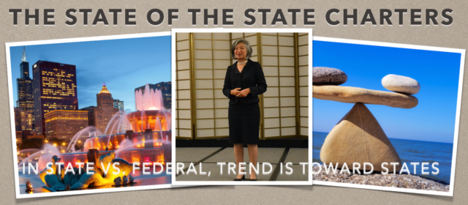
Lucy Ito speaking to NASCUS meeting in Chicago.
Ito emphasized there isn’t competition between the two systems, but that the numbers show “the state system is in good shape and thriving, which bodes well for the future of credit unions.”
State-To-Fed Conversions
In the last two years 24 federal charters have converted to state charters, while over that same period seven state-chartered CUs have gone the other way.
“In those changes there has been a shift of $16.6 billion in assets to the state system compared with $850 million coming over to the federal side,” Ito said. “This snapshot looks very good for the state credit union system, but there are some issues to think about.”
Ito outlined other key concerns:
Interstate Branching: Ito said that the limited number of states allowing interstate branching is affecting the growth of state charters. She said that two agreements are currently being worked in two regions of the country that would add more states to those that permit interstate branching.
Member Business Lending: NCUA’s new MBL rule takes effect Jan. 1, and while Ito said NASCUS is pleased NCUA moved to modernize the old regulation, which should benefit state charters, there remain concerns. Ito said the fact the new rule does not permit states more leeway in their ability to make MBL changes in the future to address unique needs is “unfortunate. A floor was established, so states can’t be more permissive than the federal rule, which will stymie innovation.”
Field of Membership Modernization: “While the final rule should increase consumer access to credit unions, which is very good for credit unions overall, on the other hand it will place pressure on the state system in terms of greater competition from federal charters,” said Ito. “Competition is healthy for credit unions, but this is just something to think about.”
Marijuana Banking: Ito acknowledged that the future here is uncertain, but that many state-chartered CUs are feeling pressure to make decisions on what to do to address the need for businesses to have access to the financial system to take cash off the streets and keep the businesses and communities safe, and comply with the federal rule that states that marijuana is illegal. “Very quickly the country is approaching a tipping point—25 states have approved the use of marijuana either for medical or recreational use, and five states have ballot initiatives. This is becoming an issue because nothing is stopping this train.”
Cyber Security: Ito said that the more extensive cyber security examinations will require that state supervisors gain highly technical expertise to supervise this growing area of attention.
The Wells Fargo Scandal: Ito said she is concerned for the “trickle down effect” from Wells Fargo, and how regulators, especially the CFPB, may react after the high-profile scandal. “Will this add to federalization pressures?” asked Ito.
Community Banks: Ito said the tension felt between CUs and community banks is hurting growth on both sides. Instead of looking at each other as competing groups, Ito said that community banks and credit unions should realize they have much in common and that their true focus of their competitive concerns should be the big banks, which are stealing market share.