

ALEXANDRIA, Va.—It’s time for credit unions to “rethink” their overdraft and non-sufficient funds programs, NCUA is saying after releasing a new analysis of CUs’ OD and NSF offerings.
The analysis of 444 credit unions that supplied OD and NSF fee data to NCUA in Q3 2024 reveals overdraft and NSF fees make up about 2% to 5% of total revenues, and that CUs are not using those funds to offer members better deals on other products and services.

Todd Harper
A new NCUA Research Note provides an analysis of statistics for overdraft and non-sufficient funds fees, and observations on the relationship between overdraft and non-sufficient funds fees and other revenues, NCUA explained.
“This Research Note provides important information for consumers, researchers, credit unions, and regulators about the use of overdraft and NSF fees at credit unions,” NCUA Chairman Todd Harper said. “The findings suggest that credit unions are not offsetting this income through reduced fees for other services or lower interest rates. Credit unions that rely heavily on fee income from overdrafts and NSF fees have concentration risk issues, which raises potential safety-and-soundness concerns. And, on the other side of the transaction, consumers who can least afford it are often paying an oversized portion of those fees. It’s time for credit unions to rethink their overdraft and NSF programs.”
Beginning with the first quarter of 2024 Call Report, federally insured credit unions with more than $1 billion in assets were required to submit their year-to-date revenues from overdraft and NSF fees. The Research Note, prepared by NCUA’s Office of the Chief Economist using revenue data from the first three quarters of 2024, evaluates overdraft and NSF revenues as a fraction of total revenues.
The Research Note highlights two observations:
- Credit unions with higher combined overdraft and NSF fees per member do not seem to have lower fees per member for other services
- Credit unions with higher combined overdraft and NSF fee revenues do not seem to be using those fees to “subsidize” better interest rates
Report Details
The table (below) indicates that such fees make up about 2% to 5% of total revenues for the majority of credit unions that submitted data, although some deviate significantly from this range, NCUA said.
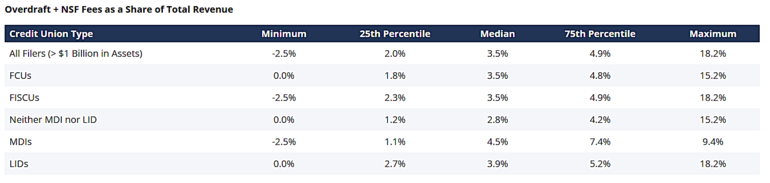
“Federal credit unions and federally insured, state-chartered credit unions are not significantly different in their reliance on such fees, with nearly identical medians and similar distributions. Credit unions that are Minority Depository Institutions and those with low-income designations tend to have slightly higher combined OD and NSF fee revenues as a share of total revenue relative to those without those designations,” the report states.

Michael Moebs
Fairly Priced Safety Net
Michael Moebs, economist and chair of Moebs $ervices, emphasized that as some credit unions may rethink their overdraft programs, they should recognize ODs are not going away.
“Overdrafts are not going away because people make mistakes and have emergencies,” said Moebs, who noted that for more than 40 years Moebs $ervices has been recognized as the leading source for accurate, statistical financial service data in the U.S. He emphasized that with the help of data experts and using AI to set overdraft pricing, the service can be a fairly priced safety net for consumers.