By Ray Birch
ALEXANDRIA, Va.—Credit union trade groups largely backed NCUA’s push to sharply reduce spending over the next two years, but used the agency’s public budget hearing Wednesday to urge the regulator to go even further in aligning cuts with industry realities and modernization goals.
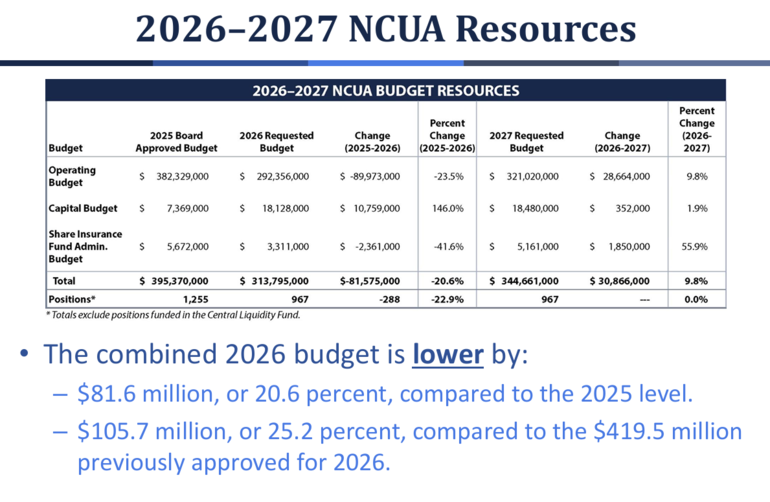
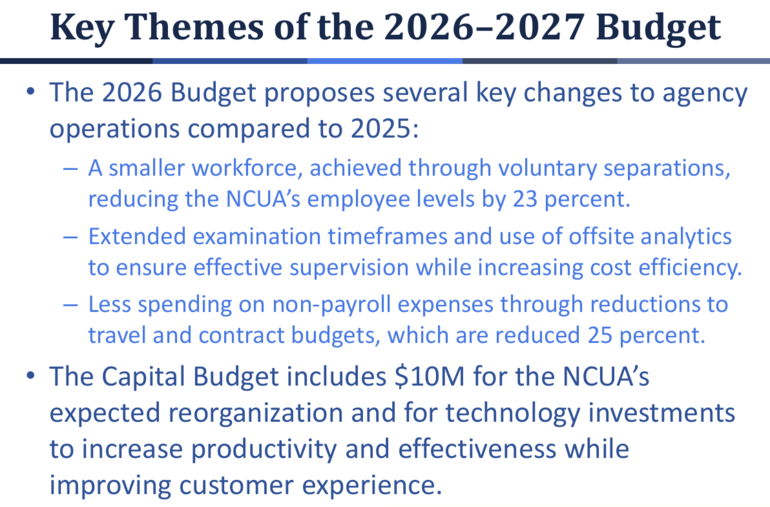
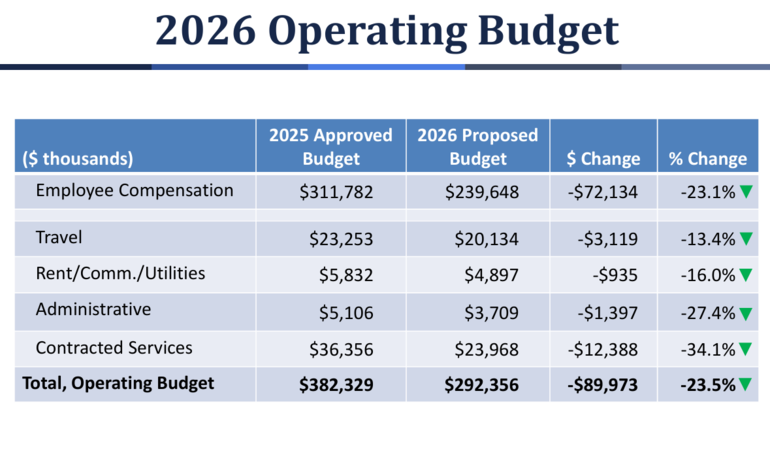
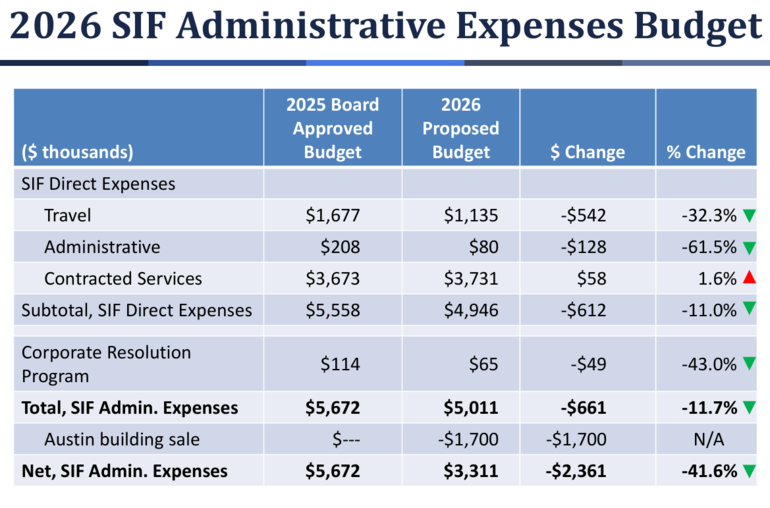
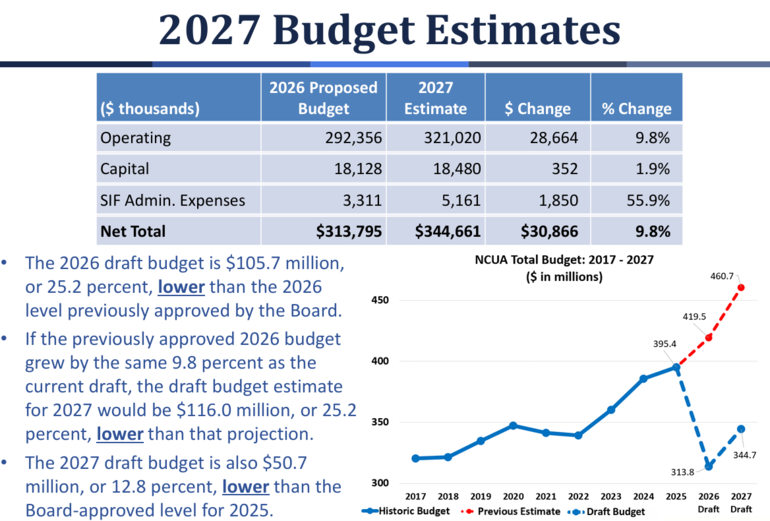
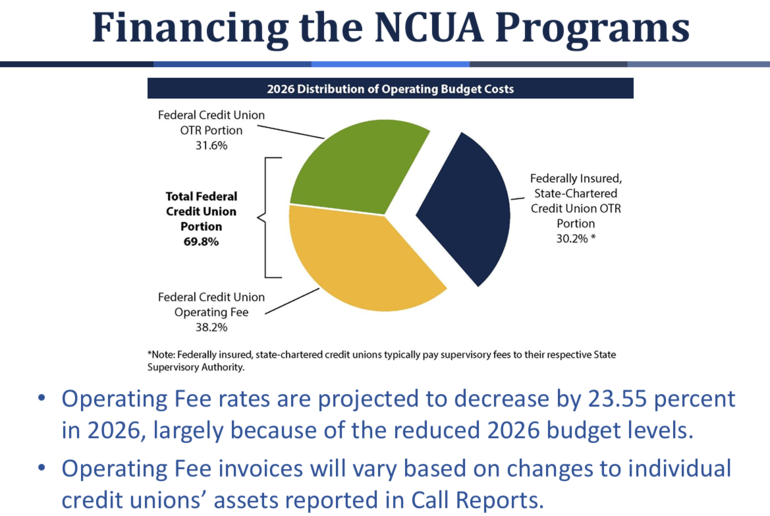
The NCUA has proposed a $313.8-million budget for 2026—down 20.6% from 2025—driven by a 23% reduction in staffing, a 34.1% cut in contracted services, and a 13.4% decrease in travel spending. The operating budget would fall to $292.4 million, supported by $18.1 million in capital spending and $3.3 million to administer the Share Insurance Fund (scroll to end of story for budget details).
During the hearing, the Defense Credit Union Council praised the reduced budget—saying it will ease costs for institutions that fund the agency and the Share Insurance Fund—but cautioned that the spending plan must more directly reflect the shrinking number of insured credit unions and increased reliance on digital exam tools.

DCUC said fewer credit unions should allow longer exam cycles for well-rated institutions and deeper travel savings. At the same time, it warned that steep cuts to the agency’s external affairs and credit-union-expansion offices could weaken stakeholder communication and support for low-income and minority credit unions. Instead, DCUC urged shifting more resources from the consumer-protection division, arguing supervision should follow risk and recent staff reductions at the CFPB.
America’s Credit Unions also applauded the budget’s significant reduction—calling the nearly 21% cut a welcome sign of improved efficiency and cost discipline—but pressed the NCUA to reinvest savings in modernization, automation and data analytics.
ACU encouraged the agency to pair staffing reductions and hiring pauses with operational redesign, not simply downsizing, and to expand virtual supervision for low-risk credit unions. While supporting reductions to supervision and administrative spending, ACU warned against eroding cybersecurity capabilities or examiner consistency and requested greater transparency around technology upgrades, including the MERIT exam platform and any AI deployment.
Together, the comments signal broad industry support for a leaner NCUA budget, but also a clear expectation that cost savings must be paired with smarter, tech-driven oversight and thoughtful prioritization—ensuring the agency trims where it can, invests where it must, and avoids weakening functions that directly support credit union growth, innovation, and member service.
DCUC’s Comments
An effective budget is made from strategic choices, noted DCUC Chief Advocacy Officer Jason Stverak during the hearing.
"Even in times of streamlining, the question should be where reductions will be made, as opposed to how much the reductions will be,” he stated. “We appreciate that the NCUA is providing a more streamlined budget for the next two years, which will save credit unions that must pay for the agency’s operations and the Share Insurance Fund.”
But there are ways, Stverak said, that budget decreases can be more strategic.
“First, we believe that fewer credit unions automatically warrant a proportional decrease in supervisory expenses, regardless of any directive to streamline expenses,” he said. “As of June 30, 2025, the NCUA supervised 163 fewer federally insured credit unions compared to the same time last year. This change alone saves time and money and should be reflected in the budget.
“Second, as examination staff and resources presumably decrease in the next two years, we encourage the NCUA to lengthen its periods between supervisory examinations further, for additional savings,” Stverak continued. “Periods can be extended for CAMELS 1 and 2 credit unions, ensuring effective supervision and protection of the Share Insurance Fund while freeing resources for higher-risk credit unions and priorities.”
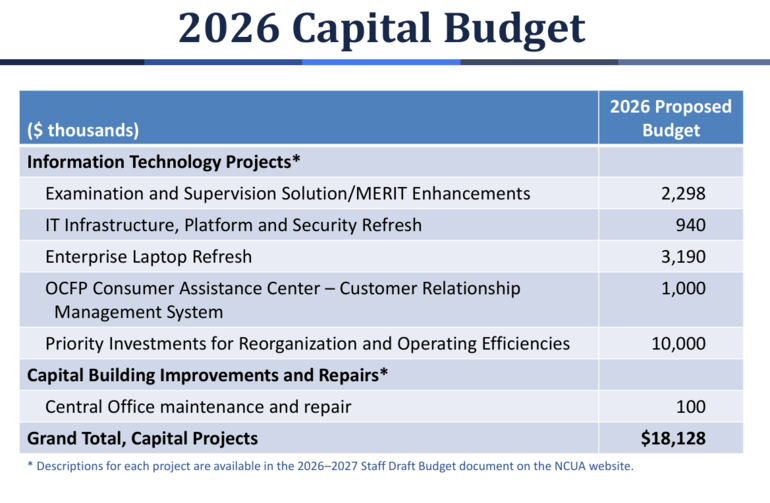
NCUA’s recent investments in technology and process improvements should enable longer examination cycles for qualifying credit unions, Stverak said, adding that NCUA should be able to capitalize on its $1.7-million investment in 2025 to update its Modern Examination and Risk Identification Tool, or MERIT, examination system, as well as its additional requested investment for 2026 currently proposed at $2.9 million.
“Third, we believe travel expenses can be decreased further,” Stverak said. “The NCUA stated that the budget is reduced for 2026 due to a 23% reduction in staffing, a 24% reduction to contracted services budgets, but only a 13% reduction in budgets for employee travel…Given the agency’s 23% staff reduction and increased reliance on digital examination tools such as MERIT—which will receive an additional $2.9 million—DCUC believes more supervisory interactions can be conducted virtually.”
Stverak also pointed out that DCUC is concerned that one of the largest proposed budget reductions—an 82% cut—is to the Office of External Affairs and Communications (OEAC).
“According to the staff proposal, OEAC will go from having 16 staff members in 2025 to only three in 2026 and 2027,” he said. “While a part of this reduction is likely the result of reorganizing functions in different divisions, the decrease is dramatic. Given the agency’s ongoing transformation, this is the wrong time to diminish a function that ensures open communication with industry stakeholders, Congress, and other regulators.”
NCUA Wednesday pointed out a number of the staff in OEAC will still perform the same roles, but have simply been moved to other departments.
ACU’s Analysis
Curt Long, America’s Credit Unions chief economist and VP of data and research, in his remarks Wednesday, emphasized the budget should not only fund ongoing operations but also drive internal efficiency, improve accountability, and ensure every dollar contributes to mission success.
“A well-structured budget should support the agency’s core goals of safety and soundness, access, and operational excellence, while promoting modernization and long-term savings,” he said. “The NCUA’s voluntary separation program and the federal hiring freeze, creates an opportunity to rethink operations and build a leaner, mission-aligned workforce. To accomplish this, the agency should consider redirecting hiring funds to modernization that reduces recurring personnel and travel costs, prioritizing collaboration and technology over duplicative roles through shared-service models for HR, procurement, and IT, and adopting hybrid or virtual field offices.”
Long said NCUA’s supervisory strategy should also evolve by focusing examinations and travel on the highest-risk credit unions, supervising low-risk institutions remotely using data and analytics, and tying staffing and travel budgets to risk tiers and performance history.
But Long emphasized that ACU is concerned with cuts that go too deep.
“The NCUA should avoid understaffing and ensure consistency in examiner experience and staff points of contact,” he said.
Long stated that ACU supports NCUA’s IT spending reductions, but urges caution to avoid weakening cybersecurity or system reliability.
“Prudent technology and cybersecurity investments are essential, but they must show measurable impact and efficiency gains,” he said. “The agency should provide greater detail on its capital projects, including any AI use and how those tools will improve productivity.
Long noted that if reorganization affects regional structures or examiner staffing, credit unions deserve transparency to ensure supervision remains responsive and regionally informed.
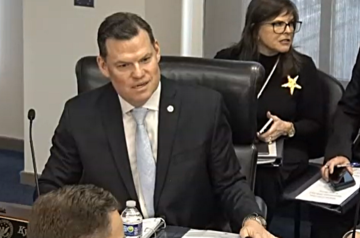
Kyle Hauptman
“We support modernizing examinations through MERIT. Regarding MERIT enhancements, the budget states that funds will ‘re-platform loan and share data analytics applications to the NCUA’s common analytics platform,’” Long said. “The NCUA should brief credit unions on MERIT’s progress and the status of this project, differentiate this re-platforming effort from prior cloud migrations, and improve transparency by posting future RFPs and notices of awards so that credit unions can track contracting budget changes from year to year.”
Hauptman: ‘Different Budget’
‘The 2026 budget looks very different from past budgets,” NCUA Chairman Kyle Hauptman noted Wednesday. “Since becoming chair, I made the decision to reduce my own staff by 20% and to lower operating expenses year over year. My colleagues have done a great job finding ways to reduce costs and refocus on the NCUA’s core responsibilities.
“In 2025 alone, we reduced contract spending by $16 million and decreased personnel by 23% through voluntary separations,” continued Hauptman. “Yes, we have a smaller workforce, but this team represents what efficient government looks like. Our support of credit unions has not stopped or slowed—we are driving efficiencies through improved technology, streamlined processes, and reduced unnecessary burdens for both credit unions and the agency. We are now in a rare position to refocus priorities and provide new opportunities for our staff to advance their careers.”