

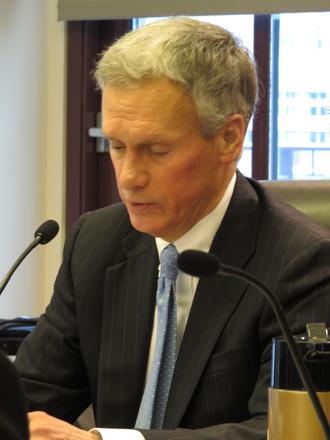
Mark McWatters, NCUA
ALEXANDRIA, Va.—While NCUA has now put out for comment its revised proposal on risk-based capital, one of the agency’s three board members has made very clear that he does not believe the agency is standing on firm legal ground with the plan.
Since joining the board in August of 2014, J. Mark McWatters has frequently been the dissident voice, speaking out against the agency’s 2015 budget and opposing the risk-based capital plan. In both areas McWatters has a related background; an attorney licensed in both Texas and New York, and who has previously serviced as the assistant dean for Graduate Programs and as a professor of practice at the Southern Methodist University Dedman School of Law and as an adjunct professor at the SMU Cox School of Business, McWatters is also a licensed CPA in Texas.
Despite being the 1 in several 2-1 board votes, McWatters has quickly gained support of the trade associations and many credit unions, which would like to see the agency’s budget reined in and which have generally opposed much of the risk-based capital plan.
In an interview with CUToday.info, McWatters discussed risk-based capital and what he believes lies ahead for the proposal, his impact on the agency, and his views on how credit unions should be regulated.
CUToday.info: Is a risk-based capital plan needed?
Mark McWatters: It’s not a matter of opinion, it’s a matter of what Congress said and what Congress mandates. Congress mandates a risk-based capital protocol in the (credit union) statue itself.
I am lawyer, so I tend to read the law. Section 216 (d)(2) in the Federal Credit Union Act says the board shall design the risk-based net worth requirement to take account of any risk. This is something Congress wants NCUA to do. Whether or not risk-based capital itself actually is implemented correctly and will protect the safety and soundness of the Share Insurance Fund and the credit union community is a matter of debate.
Look at what happened with risk-based capital and the banks. Back in 2008 and 2009, risk-based capital really did not work. The banks were undercapitalized because the risk-based capital rules, the way they were constructed, allowed for excessive risk with only a modest level of capital.
What I am saying is that the risk-based capital rules should be designed in a way to address the actual risk presented to the credit union community, not a pretend risk, not an FDIC want-to-be type risk, but the risk to the credit union community itself and to the Share Insurance Fund. And that requires some thinking outside the FDIC box.
CUToday.info: Do you believe the agency is skating on thin legal ice here with its legal opinion letter supporting the issuance of a two-tier rule?
McWatters: I have stated that I do not believe there was legal authority to adopt a two-tier system. Where did I come up with that? I have been a lawyer in large law firms for a long time. I have signed and reviewed a lot of legal opinions. When I read the Federal Credit Union Act, I thought “This does not seem to permit what the proposed rules are purporting to accomplish.”
So I went back and talked to (NCUA General Counsel) Mike McKenna, and Mike and I have a different view. I then found out that as recently as 2007 NCUA put out a white paper that (supported) a single-tier system, not a dual-tier system. I also found out there has been testimony before the board saying you can’t have a two-tier system—only one tier. So that got a little confusing
I think what happened is that NCUA, collectively, did not do the diligence when it put out the first set of proposed risk-based net worth rules, and simply relied on the statutory provision that says that NCUA’s risk-based net worth rules should be comparable to those of the FDIC, and the FDIC has a two-tier structure.
Unfortunately, that is not what the law says. I went back and read the Federal Credit Union Act, and what the Act says is a conjunctive. It says, first, the NCUA risk-based net worth rules must be consistent with the Federal Credit Union Act, and then they must be comparable to the FDIC rules.
In general, with rules of statutory construction, the specific mandate always trumps the general mandate. So the mandate Congress specifically addressed to credit unions has to trump the general rule of comparability to the FDIC.

You hear NCUA say that we have to have a two-tier system because the statute says our system must be comparable to the FDIC. But my rejoinder is that you have to read the entire statute, which says two things. Again, it says the NCUA risk-based net worth rule—number one—must be consistent with the Federal Credit Union Act, and then—number two—the NCUA risk-based net worth rule must be comparable to the rules adopted by the FDIC.
CUToday.info: Do you think there is any chance for litigation on this matter?
McWatters: Wearing my lawyer hat more than anything, and not really speaking as an NCUA board member, I analyze this and ask, “What do I gain by litigation? What do I do if I win? What if we take the rules back to a single-tier structure—is that something that really truly matters here?”
And, then, what is the cost of the litigation? Go through the federal and district courts here and you are talking about a huge check you will have to write for the litigation.
My instincts tell me, no, you don’t want to fight that battle, because do you believe that the risk-based net worth rules, at the end of the day, are going to be rules credit unions can’t live with? Credit unions may not love the rule, they may not like idea of two-tier, but they can live with the rule. And whoever files the lawsuit can live without having to go through all the litigation and writing a big check.
CUToday.info: What kind of interaction have you had with the agency's general counsel while this question was being debated?
As I said, Mike McKenna and I just disagree on our analysis of the rules structure. I believe NCUA was caught a little off guard by the member comments on the first proposal that challenged the agency’s legal authority. I think they were surprised, just assuming there was legal authority (for the two-tier structure) under the (FDIC) comparability standard. Then, a smart lawyer looked at this and said, “I am not sure . . .” Then NCUA had to sort of backpedal and retroactively justify what they were doing.
In order to bolster their position, NCUA went out and hired the Paul Hastings firm and paid them a lot of money to give them what I consider a relatively weak legal opinion supporting their legal authority.
CUToday.info: “Weak” because of the word “could” in the opinion letter, where Paul Hastings states that a court “could” conclude that NCUA has the statutory authority for a two-tier system? Or, are there more reasons?
McWatters: Principally, it is that word. That is a very important word. If you hire a lawyer, you want that lawyer to tell you, “You can do this. No issues. A court will support your action.” That is what you want.
If the lawyer gives you a “will” or “would” opinion, that is the next step down, basically saying there is a 90% chance a court would uphold your action. The next standard falls to a “should” opinion, which probably means there is a 75% chance you will win. The next standard is “more than likely,” in which the lawyer is estimating you have a 51% chance you will win in a court challenge.
Then you get to the “could” option, which is below 50-50. This is not a useless opinion, because it tells you that what you are doing is not frivolous, and there is merit to it. And there are lower opinions. But it’s not a “will” or “should” standard. It is a low standard. What is disconcerting to me is that this opinion is being marketed by NCUA as saying Paul Hastings “said we can do this.”
That is not what Paul Hastings said. What the firm is saying is that if NCUA’s action is challenged, a court could uphold it.
CUToday.info: These words, or terms you outlined, are they commonly used by lawyers?
McWatters: Yes. But these terms are not set by statute or by the American Bar Association. They are what has developed among law firms that give legal opinions, and there are varying forms of these terms. But I just wanted to provide a broad perspective on the legal (terminology) landscape.
CUToday.info: Have you had any interactions with anyone from the Paul Hastings legal firm?
McWatters: Yes. Paul Hastings was hired by the Chair (Debbie Matz) and the Chair had interactions with Paul Hastings that I was not a party to. Then Paul Hastings did their legal analysis and followed with an oral presentation to the board, which happened two to three months ago. They went through a PowerPoint presentation and reached the same conclusion they reached in their legal opinion.
I read the PowerPoint and listened to the presentation, and then I called the partner at Paul Hastings in charge of this matter and I had a discussion. I told him that “I am not with you” on this (conclusion).
CUToday.info: What have been your interactions on the proposal/legal opinion with NAFCU and CUNA?
McWatters: I met with CUNA when I first joined the board. We had discussions and they mentioned they were getting a legal opinion on the risk-based net worth rule. I said, great, I’d like to read that, please send it to me and other board members. It would be helpful for all of us to read that.
CUNA later sent the letter (in September, 2014), but I have not had any contact with the Venable law firm (which authored the legal opinion letter).
I spoke with NAFCU’s Carrie Hunt last year and she said the trade association had a legal opinion from the WilmerHale firm with respect to the individual minimum capital requirement. I asked to read that and she sent it over. I had no other contact with Carrie or the WilmerHale firm. As I noted in my (board meeting) statement, what is interesting is that within three hours of that legal opinion reaching NCUA, the decision was made to remove the IMCR from the risk-based net worth rules.
CUToday.info: Where to from here with RBC?
McWatters: Again, I really don’t see a legal challenge.
I suspect a lot of credit unions and trade groups are pleasantly surprised with these (latest) rules. There is still room for changes and improvements, and maybe a lot of comments, which is good—I like comments. Then NCUA will take another pass at the rules and probably be done with it at that point.
CUToday.info: Do you feel you are having a strong influence within the agency, despite being the 1 in the 2-1 votes?
McWatters: Strong influence, I don’t know. What I am trying to do is simply raise issues. At a board meeting two to three months ago the issue of fraud came up. I said we should try to spend credit unions’ money in the most efficient way we can and get the biggest bang for the buck. I suggested that we focus more on fraud and internal controls systems—all of these blocking and tackling type of things.
Because of that NCUA did some analysis from which the agency determined that over the last 10 years fraud losses (within credit unions) rose about 42%, and maybe over the last five years the loss rate is even higher. Those are losses to the Share Insurance Fund. Hopefully, because of a couple statements I made, the focus on fraud and internal controls systems will gain some traction.
I voted against the (2015) budget. NCUA is using other people’s money, and credit unions don’t have all of the money in the world, so we have to be careful and respectful of using their money. There should be transparency about how we spend it.
If you look at the (budget) disclosure and what is on our website today regarding the NCUA budget, compared to previous years it’s dramatically better, but still not good enough. I outlined a number of factors in my dissent about how there should be enhanced transparency. So hopefully the budget is another area where there will be improvements.
CUToday.info: Since taking your board seat, what have been your interactions with credit unions?
McWatters: I like to hold town hall type meetings when I go out to meet with credit unions, so I can ask questions and credit unions can ask questions. I get some amazing feedback from people who run credit unions on a daily basis.
I want this feedback because it is exceedingly difficult to try to regulate something unless you understand it. So you have to understand exactly what is going on with credit unions at the time you are trying to regulate them. The best way to do that is to actually talk to people who get up every day and go to the office to run credit unions.
CUToday.info: What is your regulatory philosophy?
McWatters: I think regulators sometime regulate with a shotgun. A shotgun has lots of pellets. You blast it out and chances are you may hit your target with one of the pellets. But the rest of the pellets hit something else, so you have collateral damage and unintended consequences.
People regulate with a shotgun because they don’t really know what they are regulating. If you really knew what you are regulating you’d use a rifle—hit the target right on the head and no collateral damage or unintended consequences.
The reason I do the town halls is to understand exactly what is going on within credit unions today—not last year or next year—so I can avoid the shotgun approach to regulating.
Related
CUToday.info Resource: Risk-Based Capital Central
McWatters Challenges NCUA’s Legal Authority To Issue Two-Tiered Rule
NCUA Board Approves Issuing New RBC Proposal
CUNA, NAFCU & NASCUS Weigh In On RBC
A Graphic Overview of NCUA's Risk Based Capital Proposal