

By Ray Birch
LAKE JACKSON, Texas—One credit union that has agreed to purchase a billion-dollar bank says two of the reasons for the decision are peer-to-peer CU mergers are difficult, and scale is increasingly necessary to compete.
TDECU CEO Isaac Johnson also told CUToday.info that pressure from Washington to reduce FI fee income, such as overdraft charges, makes it even clearer that scale is critical.
As CUToday.info reported, in one of the biggest bank buys to date, the $4.7-billion TDECU here has agreed to buy the $1.2-billion Sabine State Bank, based in Many, La.
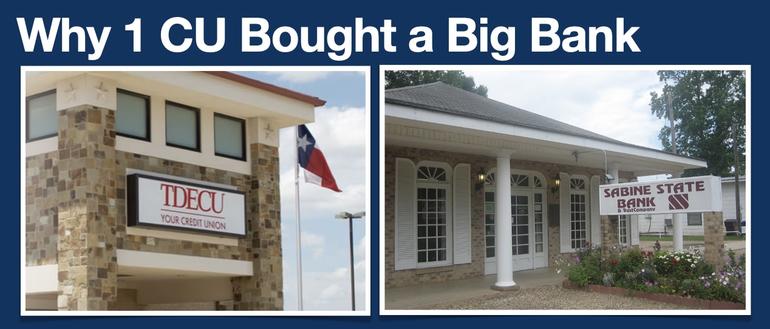
“When you look at it on paper, the numbers jump off the page,” Johnson said. “Yes, Sabine Bank is a large institution. But in addition to size, what is most important is our values align with theirs. They are focused, much like credit unions, on helping people.”
Johnson pointed out Sabine Bank is a profitable organization.
“They made a profit of around $30 million last year, and they are an efficient organization. They are well run,” Johnson said.
Johnson stressed the importance of scale, noting that TDECU has a goal of someday becoming one of the 20 largest credit unions in the United States.
“When you look at the larger credit unions throughout the nation, they have not only a strong consumer lending operation, but they also have commercial lending. Our intent is to diversify our portfolio, to go more into commercial lending and offer those products services to future businesses,” Johnson said.
Commercial Lending Operation
Sabine Bank has a strong commercial lending operation. With national concerns growing over commercial loan delinquencies, especially in real estate, is Johnson concerned about what might lie ahead?

Isaac Johnson
“TDECU has robust commercial lending lines of business,” Johnson said. “And, too, TDECU is retaining Sabine’s senior management team and lending personnel. So, TDECU will have the requisite human capital expertise to handle Sabine’s commercial lending products—and enhance TDECU’s commercial lending lines of business—from a continuity-of-business standpoint.”
Johnson said that as TDECU set out to find a bank or CU partner to either acquire or merge with, all of the pressure on fee income—largely from the CFPB—was on its mind. It’s no secret, said Johnson, that larger institutions such as big banks have greater ability to offset reductions in fee revenue.
“We need greater scale, and that was part of our thinking, to bring these two teams together. We gain greater efficiencies,” he said. “We looked at synergies and scale with this acquisition.”
Branches to More than Double
When the Sabine Bank deal closes, TDECU will grow to 86 branches from 34. The CEO said that brings with it no operational concerns.
“As I said, Sabine is highly efficient from an operational standpoint,” Johnson pointed out. “And, as I noted, TDECU is maintaining Sabine’s senior management team and employees, which should provide for a smooth merger consummation and integration of the employees and customers of Sabine.”
Johnson added that TDECU is also investing in its digital platform, including the CU’s online banking presence.
“We're looking at organic and inorganic growth. And that inorganic growth could be a merger with a credit union or it could be an acquisition,” said Johnson. “We still continue to have conversations, active communications, with other credit unions about mergers. And whenever we find there's the right fit—maybe the next agreement is a credit union, or it could be another bank.”
Ongoing Consolidation
Meanwhile, the credit union community continues to consolidate, reminded Johnson.
“As it does, we’re creating much larger credit unions,” he said. “Peer-to-peer credit union mergers are extremely rare, and very difficult, because at that point, you have you two sitting CEOs, you have two boards, you have two executive teams and then you have two brands that have a lot of value. So, peer-to-peer, or near peer credit union mergers, are extremely difficult. They're not impossible, but they are hard. I wouldn't say it was easy to go to the bank route. I would say it was easier to pick a partner who aligns with us, in fulfillment of our mission of people helping people and in growing our commercial portfolio.”
Johnson said the efficiencies from the merger will largely come from combining back-office operations.
“We're already on track to improve our efficiency through automation, through AI,” he said. “We will then be able to deliver greater support services to help our frontline, consumer and commercial lending staff.”
TDECU’s capital stood at $465 million (9.86%) through March, according to Call Report data. When the deal closes, and with credit unions typically paying 1.3-1.9 times book value for banks (TDECU has not disclosed the purchase price), the capital ratio will decline. But Johnson said that is not a concern.
Thorough Review
“We did a thorough review of Sabine’s balance sheet and income statements and their projected impact on TDECU’s pro forma capital,” said Johnson. “The board also received an independent valuation of the merger from an experienced investment banking/valuation firm specializing in credit union/bank acquisitions. Our pro forma capital is projected to make us ‘well-capitalized.’”
Johnson expects the combined organization will earn back much of that capital outlay, but has not projected when that might happen.
“Sabine is a high-performing bank, with ROA of 2.75% and ROE of 29.86%, based on its most recent call report data,” said Johnson. “The expected earnings of TDECU—on a combined basis with Sabine—will enable TDECU to earn back its dilution to capital expeditiously and the additional earnings will strengthen TDECU’s balance sheet and regulatory capital over the long term.”