

NASHVILLE, Tenn.—In a market far different from even five years ago, credit unions seeking to get to long-term value must be there “every day” for members, as primacy and loyalty to financial services providers have really taken a new form, according to the just-released results of a survey of CU members and non-members.
And even though an in-depth analysis of those surveys of consumer behavior reveals a clear trend, many credit unions are challenged to respond as organizations, because they were built for different strategies and cultures than the one they are looking to grow into, according to Velera (the new name for the merged PSCU/Co-op Solutions).
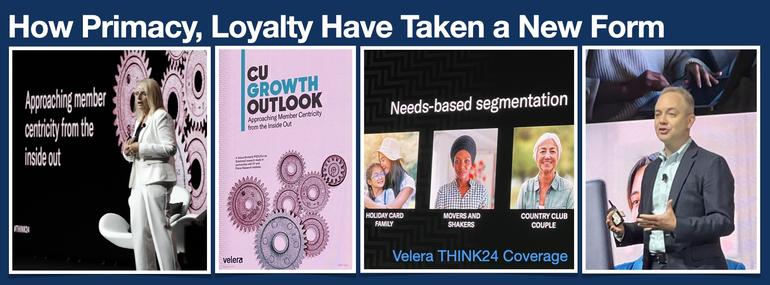
Credit unions attending the company’s THINK meeting here were given a first look at what the CU Growth Outlook research results reveals, as well as strategies for acting on the findings.
The research is part of a project that has been going on for several years. Beginning when it was still Co-op Solutions, the company has conducted voluminous amounts of research with members and non-members since 2020 in concert with EY and now, Filene. Each year it has surveyed 2,000 CU members and 1,000 non-members to dive deep into attitudes and behaviors around how consumers behave and how their minds tick.
Consumer behavior changes and trends that emerged during the pandemic and how they have evolved since are evident in the research, explained Carrie Stapp, VP-marketing with Velera. Stapp acknowledged it’s no surprise how the digital channel has emerged as a preferences and usage driver.

Carrie Stapp speaking to THINK.
Indeed, what the pandemic has led to is consumers now “demand” a digital option with just about every service.
Back in the Day
“I remember the days when we were talking about the ‘next most likely product’ and really generalized demographics, if you will, life-stage marketing,” she said “With digital, we really started to say we have to start looking at needs-based segmentation. We really started to move away from life stage into lifestyle marketing.”
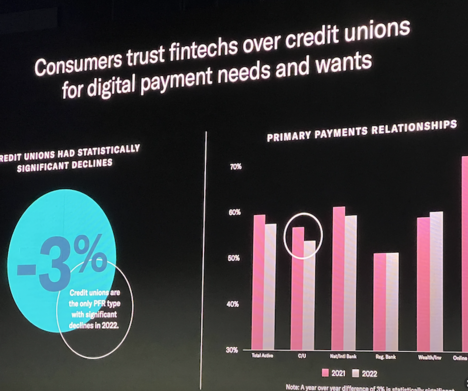
Stapp noted in 2021 the research began to show fintechs emerging among the most-trusted financial providers, grabbing turf that had been the long-term domain of credit unions. Even credit union members themselves in the survey identified PayPal as a highly trusted provider.
“PayPal met the immediacy challenge; they started to meet consumers where they were,” Stapp explained.
Different Questions
That led to new research and different questions that she said revealed “significant opportunities to grow relationships and net income.
“We surveyed those exact same segments again and asked how much do they want to choose credit unions,” Stapp explained. “Aligning personalized value propositions with needs-based segmentation promotes growth…What we realized is the digital path to growth was what was missing.”
Stapp said as 2022 got under way it was apparent embedded finance has “started to take hold.”
And there was a bigger trend at work, too. There was an “explosion” of interactions and relationships with financial services providers, said Stapp.
The lesson: “What we know is it’s not turning back.”
And while that lesson may be apparent, Stapp said so was a reality; a reality voiced by credit unions with which she had worked: it’s “really hard” to afford and to implement many of the technologies and responses needed.
Getting the Trust Back
The research and the focus by Co-op/Velera evolved to offer insights around how credit unions could “gain that trust back”
What was lacking, according to Stapp, was the interaction piece, that credit unions were not serving the daily needs of members.
She noted the research found approximately seven-in-10 members said that they didn't trust credit unions to bring them digital technologies.
“You heard us say last year that the definition of trust has now changed and it's evolved and it's important to know that with data privacy, security, we're still winning there. That’s the good news. Where we've been falling behind is in these additional capabilities and in meeting their daily interaction needs.”
How Do Credit Unions Catch Up?
Thanks to COVID and other economic issues, Stapp noted credit union C-suites have been absorbed by issues around earnings. At the same time, even when recognizing that reality, there remains the question of what does that really mean?, she told the meeting. Where should the CU invest? Upgrade? And how can it manage expenses?
“What we started to learn is that when you lean into daily interactions, you’re present, but consumers are starting to feel a little dis-integrated,” Stapp said. “They can’t keep track (of all their financial relationships, monthly subscriptions, etc.) They are kind of reverting back to saying, ‘I need a kind of traditional financial institution to help me make sense of this.’ But you can’t get to long-term value unless you are there every day.”
The numbers back up the research findings, according to Stapp, finding the top-performing credit unions saw 6% stronger membership growth than credit unions that have not leaned into that model of interaction. It turns out, Stapp said, that helping the member balance sheet is also very effective at improving the credit union’s balance sheet.
What the newest research has also made clear, according to Stapp, is that member-centricity is much deeper than products and services. What’s needed is alignment across the credit union, which must fit into the lives of members rather than vice versa, she said.
The Key Finding in 2024
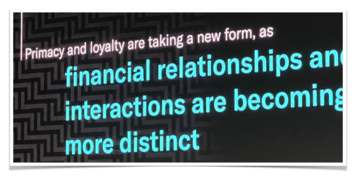
“The key finding this year is that primacy and loyalty to a financial institution is really taking a new form, and financial relationships and interactions are becoming much more distinct,” Stapp said. “What we mean by that is when you start to take a look at this idea of interactions, 10 years ago we were maybe doing bill pay. We weren't using buy now, pay later. We weren't using Venmo. So, this idea of daily interaction didn't exist in the form that it exists today. We were at the center as a financial institution, at the center of the way that that member interacted. But that’s completely changed, and what we're talking about is the difference between financial relationships and interactions becoming much more distinct.”
Much of this year’s research sought to home in on those differences between financial relationships and interactions. They are not mutually exclusive. Stapp said the research found 61% of respondents said they chose the same provider for relationships and interactions.
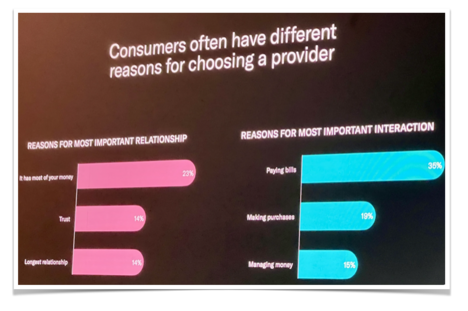
But where the problem lies, Stapp emphasized again, is that 10 years ago the idea of the “daily” interaction with a financial services provider didn’t really exist, and the survey found 32% of members are choosing a different provider and a different institution type.
Where Banks, Fintechs Lead
Where national banks and fintechs have been leading the way, she added, is in consolidating these relationships and interactions. The survey shows credit unions continue to also hold a strong share of those combination consumers, but there is also a caveat, Stapp noted, as two-thirds of those surveyed are already CU members.
Meanwhile, providers such as PayPal have made “financial wellness” a centerpiece of their strategies as they seek to be about more than transactions. It’s a strategy being pursued by many top-performing CUs, as well.
Among the findings:
- 73% of top performers are investing in payments innovation to attract new members, vs. 42% of bottom performers.
- Only 7% of top performers experienced increased member churn vs. 32% of bottom performers.
Where to Start
There’s been a “paradigm shift” in the groups of consumers Co-op and now Velera have been tracking, according to Stapp. The company has been following five “stages” of consumers that it has defined as:
- Non existent savings
- Minimal savings given income
- Balancing needs and goals
- Generating Wealth
- Established wealth
Importantly, said Stapp, where someone ends up in these groups has nothing to do with income, but their life stage instead and how it drives their decision making.
Looking for Action
To turn all the data and survey results into actionable tactics for credit unions, Velera has partnered with Filene to study some of the top-performing credit unions in the U.S.
Taylor Nelms, senior market insights and advisory services director with Filene, reiterated Stapp’s message that a credit union must be able to leverage daily interactions to build long lasting, mutually valuable relationships.
What’s Lacking, Not Lacking
“In our research we learned that credit union leaders do not lack for ideas, vision or ambition; credit union leaders know what they have to do to compete when experience is everything,” he said. “But we also learned that many credit union leaders, especially those at the top-performing credit unions, say there remain gaps in their ability to execute on the strategies they've laid out. The challenge for credit unions today is less about the why than the how of business transformation.”
Filene and Velera studied the strategic and operational barriers faced by top-performers, as well as what they are doing differently to bridge those. The research looked at 11 different metrics across earnings, experience and expenses, and ultimately identified the top 10 performing credit unions in nine regions.

Taylor Nelms speaking to THINK.
Those CUs average half-a-product more per member than the industry average, as well as approximately $3,000 more in assets per member, according to Nelms.
Filene hosted listening sessions with those CUs to get a better understanding.
‘Heard Over and Over Again’
“When we asked credit union leaders how they define success in their top-performing organizations, we heard over and over again about the importance of member service and experience as a differentiator,” said Nelms. “We heard over and over from them that they are focused on delivering high quality experiences that could drive member growth, engagement and retention. They were focused to a great degree on delivering that high-quality member service. Over 75% of credit union leaders told us that being a central part of members’ financial lives was something that their credit union was striving to do from day one.”
Nelms added that “experience-driven transformation is the vision of the most successful credit unions, experiences that change how people feel about money and financial services. Financial stability for these credit unions was rarely an end unto itself. It was, rather, an outcome.”
The Barriers
According to Nelms, 80% of the credit unions it surveyed see opportunities for more growth. But where they see barriers are in focus, financials and technology.
“Strikingly, focus is right at the top,” Nelms said. “Credit union leaders at top-performers have internalized the idea that trying to be all things to all people is not a formula for success long term. But focus is continually threatened by a noisy environment and all of the needs credit unions have.”
He said the research further found credit unions are starting to shift from product-centric sales to experience-focused strategy.
“There remains a gap, because credit unions as organizations have been built for different strategies and cultures from the ones they are looking to grow into,” Nelms said.
When those top-performers were asked what they see as foundational success factors, Nelms said the top responses included:

- Skilled and engaged employees
- Easy to use mobile app/digital experience
- Strong, aligned culture
- Effective internal technology
- Trustworthy partners and provider network
Barriers or Bridges?
The research also found credit unions have identified six issues that can be either barriers or bridges:
- Market knowledge
- Strategic focus
- Internal alignment
- Product experience
- Technology stack
- Partnership ecosystem
The Replacement Worry
“As credit unions grow, financial worries are replaced by information worries,” said Nelms.
The objective is to connect a larger more diverse market in a way that helps a CU inform some of those long-term structural pressures, rather than this “kind of hamster wheel of responding to short term environmental pressures,” Nelms said.
“Ultimately strategic focus done well should simplify decision making,” he added. “One of the CEOs (surveyed) said they absolutely needed to have a strong, aligned culture. People are how strategy gets executed; culture is how people make decisions in the absence of policy. So, it’s about the right culture for your strategy.”
The ’Core Lesson’
The ”core lesson” in all of the research that has been done, according to Nelms, is credit unions must close their implementation gaps by “transforming some of these really critical strategic roadblocks into bridges to business transformation, whether that's better understanding your members, driving strategic focus and alignment inside organization, or leveraging product technology and partnerships to really elevate the member experience. These are the things that credit unions are investing in in 2024 to be able to respond to the many demands and challenging operating environment that we've all experienced.”