

By Ray Birch
LAKE FOREST, Ill.—At the same time the first-ever compilation of OD/NSF CUs at large CUs has been released by NCUA, other brand-new data show credit unions set a record for overdraft revenue during Q1, which will likely draw even more media and consumer group attention—but one economist contends they are off-target in their criticisms of credit unions.
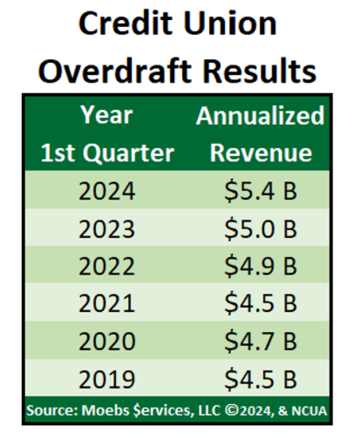
The latest Moebs $ervices data show credit unions had their best quarter for OD revenue in 30 years, reaching $5.4 billion annualized.

And, as CUToday.info reported here, last week NCUA released numbers showing credit unions above $1 billion in assets collected more than $915 million in overdraft and non-sufficient funds fees during Q1.
The total non-interest income reported by credit unions of more than $1 billion in assets during Q1 was $5.079 billion, according to NCUA’s new Quarterly Data Summary Report.
While the spotlight may be on credit unions right now, Michael Moebs, economist and chair of Moebs $ervices, is predicting that soon enough community banks and possibly even larger banks will become the focus of similar scrutiny, as well.
The Recommendation
In the meantime, Moebs is recommending credit unions keep communicating with their communities and with the nation on the benefits of CU overdraft programs and how higher limits are extending more help to lower-income Americans, keeping them away from the payday lending trap.
“Credit unions have their act together when it comes to fees in general, but I think they need to do a better job of telling that story,” said Moebs. “CUs deliver low-cost auto loans and low-cost mortgages. Fees are vital to CUs to offset those benefits due to the high cost of employees. As I have said many times, credit unions need to become much more efficient and therefore less dependent on fee income.”
What the Data Show
The new Moebs $ervices data show 443 CUs out of 4,670 claimed 68.5% of all the movement’s overdraft revenue in the first quarter of ’24. The other 4,227 CUs had 31.5% of the total OD revenue.
“The interesting element of this 443 group is their OD price matches the credit union average of $25.71,” said Moebs. “This means there are CUs in this group that do not offer checking. Some have an OD price at zero, or some have a very low OD price. The 443 group is bigger and represents what CUs will be like in the future.”
Why Consumers Turn to Credit Unions
In reviewing the data, Moebs believes it is clear consumers go to credit unions much more than to other FIs when they are short of funds.

“The reason is limits,” explained Moebs. “They have higher limits, so credit unions are there for the paycheck-to-paycheck consumer more than banks, but are being targeted for providing this needed service more than others. The Fed’s household numbers really tell the story. Credit unions are heavily middle class. These households, especially in the past five years, have had to watch every penny. Many of these households did not get full wages during COVID. Then the households get hit with massive inflation. Errors will be made with checking because of shortfalls in household finances, thus OD fees were incurred. CUs have expanded limits to account for these economic problems.”
As CUToday.info previously reported, credit unions’ median overdraft limit is about $800, which is about the same for thrifts, which have a much higher average OD price of $30.44. Banks and fintechs have substantially lower limits of $500 and $200, respectively. For FIs overall, Moebs data show 17.5% set their limits below $500, 31.7% set them at $500 and 50.8% set them above $500.
What’s Not Understood

Michael Moebs
Moebs believes banks, especially community banks, will be targeted next for their overdraft policies.
“The media and government do not understand how a credit union works,” he asserted. “Rates for deposits are high. Loans rates are low. There are too many employees. So, CUs charge reasonable fees to make up the difference. This is very different from how banks, thrifts, and even fintechs work.”
The Big If
Moebs said he is uncertain that the new OD targets will alleviate the national and local pressure on credit union overdraft programs.
“If the media and government believe overdrafts are wrong and evil, heat will be applied to all financial institutions,” said Moebs. “It is best for CUs to take a strategic position to constantly communicate their views on ODs and checking in general. No let-up on communication.”