

By Ray Birch
LAKE FOREST, Ill.—As credit unions scan the market to assess what bank competitors are charging for overdrafts, they might be surprised at what they find this year, one economist is asserting.
The effects of all the attention on overdrafts from Washington, consumer groups and lawyers has prompted a great deal of changes in bank overdraft pricing—and produced distinctive pricing styles—a new overdraft study from Moebs $ervices reveals.

“In some U.S. markets a bank charges $0 for an overdraft fee and just down the street another bank charges $42,” said Michael Moebs, economist and CEO at Moebs $ervices. “Pre-COVID, or four years ago, it was difficult to find an OD fee price spread this significant. In 2019 OD bank prices ranged from a low of $14 and a high $35. Currently the spread is more than double.”
Moebs $ervices has just completed a survey of more than 2,000 of the 3,926 U.S. banks offering checking and found the widest differences in overdraft prices, features, and approaches in U.S. history, said Moebs.
“This is good for the consumer who now has many choices,” Moebs noted.
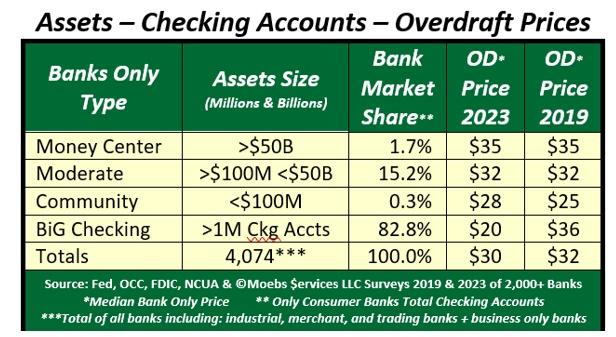
The Big Checking Banks
The “Big Checking” banks—those with more than one-million checking accounts—have made the most adjustments in the past years, the Moebs study reveals. These banks now have a median OD price of $20, compared to $36 in 2019 (see chart). Interestingly, community banks, have raised their median price over the last four years. These organizations now charge a median price of $28, $3 more than in 2019, the study found.
Moebs pointed out that the Big Checking banks claim 82.8% of all bank consumer checking accounts, but represent only 21 of the 3,926 banks across the U.S.
“Bank asset size no longer matters as much as the number of consumer checking accounts,” said Moebs, who added that pricing style makes a difference.
Three Distinct Styles
Moebs said three distinctive pricing styles have emerged from banks.
Those with more than $100 million in assets, less than $50 billion in assets, and less than one million checking accounts offer the “standard list” OD price of $32, according to Moebs.
“These banks do not like unsecured lending and shun overdrafts with high prices. (Banks) greater than $50 billion in assets charge 9.3% more, or $35. The price has not changed for all these banks in four years, including the COVID era,” said Moebs.
While community banks offer fewer checking benefits than the larger banks, these organizations have increased their OD price by 12% since 2019, the study shows.

Michael Moebs
“They are willing to charge less for monthly checking with the hope of getting more accounts,” Moebs said.
Finally, Big Checking banks were charging a dollar more for ODs in the pre-COVID era than all other banks, data show.
“Then, led by Bank of America, this group dropped their OD prices by 44%,” said Moebs. “Why? fear of compliance, greater reliance on relationship pricing, and lower overdraft price increasing revenue from more volume.”
The Options
Based on the data, Moebs outlined some options for credit unions deciding on a checking and overdraft strategy:
- If unsecured lending for overdrafts is a big risk, charge the highest OD price possible to avoid the service.
- Avoid the risk of unsecured lending by charging a low OD price coupled with low OD limits.
- Have checking be a profit center, not a cost center, and maintain a low OD price and high OD limit.
- To avoid risk of a regulatory or class-action lawsuit, keep the OD price and OD limit low as possible.
- Offer overdrafts but do not charge, keeping ODs strategically as a checking operating cost of business.
- Do not offer overdrafts and do not authorize transactions which overdraw a transaction account.
“The consumer has a wide number of checking and overdraft choices and so do the banks,” said Moebs. “There are distinctive styles and approaches in checking—with or without overdrafts. The worst course of action is to do nothing. The best course is to design what the user wants and constantly assess the design to meet needs.”