

By Ray Birch
ALEXANDRIA, Va.—Time generally tells the story about the effectiveness of any decision, according to Michael Fryzel, who believes the years have now cast a favorable light on the road NCUA traveled to stem the collapse of the corporate credit union system more than a decade ago—even as he concedes there is an “infinite list of blame.”
That isn’t to suggest things could not have been done differently and mistakes were not made, Fryzel said, stating that everyone involved with the corporate system, including the regulators, did not have “clean hands” when it came time to take responsibility for the failures.
The former NCUA chairman also said there were those back in the day who did not believe NCUA’s problems within the corporate system were as dire as they really were.
Fryzel’s comments are being offered as part of a series in CUToday.info in conjunction with the expiration of the NCUA Guaranteed Notes (NGN) program, which when initially created by the agency offered maturities that were more than a decade away at the time.
“It often takes years to determine whether or not the decisions made to resolve a problem were the correct ones,” said Fryzel, who was NCUA chairman from August 2008 to August of 2009, and who then remained on the board through August of 2014. “As in most cases there are those who disagree with the steps taken to correct a problem, believing that something else is the better answer. But those individuals usually are not privy to all the facts and base their comments on what they are being told or what they believe to be true. The credit union corporate crisis that came to light in 2008 was no exception.”
As CUToday.info reported, more than a decade after the failure of five corporate credit unions and after any potential recoveries and distributions seemed so far away that many in credit unions wrote off their capital investments as a complete loss, more than $368-million has just been distributed to more than 2,000 credit unions.
Not All Getting Payouts
The funds are being paid out as NCUA winds down its Corporate System Resolution program and its NCUA Guaranteed Notes (NGN) program (the last of which mature this month) and will go to credit unions that held capital in the former U.S. Central Credit Union, Members United Corporate FCU, and Southwest Corporate FCU.
The funds—as well as those paid out earlier as the Temporary Corporate Credit Union Stabilization Fund was wound down and merged into the National Credit Union Share Insurance Fund—have come with a tab of more than $1 billion paid out to the law firms the agency retained.

Capital-holders in the defunct Constitution State FCU in Connecticut and Western Corporate FCU (Wescorp) in California, which was the largest of the corporates, will not being seeing any payouts, according to NCUA.
The most recent payout is not the only one. In mid-2020, nearly 900 credit unions that had membership capital shares in the failed Southwest Corporate Federal Credit Union shared in a $171 million asset management estate payout. Southwest Corporate eventually merged with Georgia Corporate to create Catalyst Corporate FCU (which eventually absorbed much of the former Wescorp).
Looking back, Fryzel said that when told of the grave financial situation that existed in the corporate credit union system, some leaders in the industry refused to believe it was true. As CUToday.info has reported separately, it’s a denial that was confronted by a number of executives at the federal agency.
“They were close associates of those in charge of the failing institutions,” said Fryzel. “It was hard for them to imagine that people they trusted would allow circumstance to develop which would endanger the entire credit union industry.”
The Post-Mortem
But post-mortem analyses in the years that followed found commonalities at many of the failed corporates. An unhealthy period of competition among corporate CUs had many choosing risky investments—in a race for yield—in mortgage-backed securities that failed when the mortgage market collapsed in 2007-2008.
“It became clear to those at NCUA that we faced the collapse of the entire corporate structure and the failure of thousands of natural-person credit unions,” said Fryzel. “The only option was to act quickly, decisively and in a manner we believed would prevent the collapse of the industry and destroy the faith of the American people in the credit union cooperative system.”
Fryzel recalled the agency put together a series of actions that included securing from Congress all the tools needed to solidify the system and ensure there would be no collapse.
“They understood what we told them and the seriousness of what we faced,” he said. “In addition, they agreed with our plan of action and stated that we had their full support in moving forward. On May 20, 2009, Congress enacted, and the President signed into law, the Helping Families Save Their Homes Act of 2009.”
Legislation Expands Powers
The legislation amended the Federal Credit Union Act to:
- Create a Temporary Credit Union Stabilization Fund to mitigate near-term corporate stabilization costs with board authority to assess premiums over seven years
- Provide the NCUSIF authority to assess premiums over eight years to rebuild the equity ratio should the ratio fall below 1.20%
- Increase NCUA borrowing authority to $6 billion
- Establish NCUA emergency borrowing of $30 billion
“At NCUA we put together a team of highly qualified and dedicated individuals to analyze the situation and craft the solutions needed,” recalled Fryzel. “The team was headed by Chief of Staff Sarah Vega and Executive Director Len Skiles. Sarah had the legal knowledge of the regulatory environment and Skiles was a disciplined organizer and strategist. Their responsibility was to maintain control and direct every step taken.”
Good Bank/Bad Bank
As chairman, Fryzel proposed the good bank/bad bank approach to then NCUA Deputy Executive Director Larry Fazio. Fazio’s insights were shared in a separate report here.
“He understood the concept and put together the steps needed to begin the process of salvaging the corporate system,” said Fryzel. “I placed Scott Hunt as head of the NCUA corporate division and instructed him to rewrite the rules governing corporates, improve and modernize the examination of those entities and propose a plan to reduce the number of corporates to a size sustainable by credit unions.”
Fryzel said hundreds of hours were spent in staff meetings to discuss the creation of a Corporate Stabilization Fund, maintaining a strong insurance fund and how a new concept, “bridge corporates,” would work.
“We needed to make sure there was enough liquidity in the system and created numerous new programs through the Central Liquidity Fund to handle that need,” he said. “Owen Cole, then head of the Central Liquidity Facility, was given the responsibility to develop those programs.”
Critical to Listen
Listening to what everyone had to offer was critical, according to Fryzel, as ideas flowed as each step was discussed.
“Everyone understood that our concern for liquidity would quickly change to one of concern for capital,” said Fryzel.
Then General Counsel Robert Fenner was instructed to begin the process of finding outside counsel experienced in lawsuits relating to financial business transactions that would enable NCUA to seek recoveries from the those that had sold securities to and provided advice the corporates, putting the CU system at risk of failure, said Fryzel.
“Mr. Fenner also gathered as much information as possible relative to the advice the corporates had been given and the source of that advice,” Fryzel said. “He also began a review of the actions of individuals at the corporates who may have breached their fiduciary responsibility.”
Litigation Comes With a Price
Fryzel said the agency clearly understood the price tag that would come with paying for all the litigation to follow. Nevertheless, that price tag has over the years come under significant scrutiny, and not just from within credit unions, as the agency’s contingency agreements have led to a payout of more than $1 billion to two law firms: St. Louis-based Korein Tillery, and Washington-based Kellogg, Huber, Hansen, Todd, Evans & Figel. The firms represented NCUA in more than 25 lawsuits filed against various Wall Street banks for selling the failed mortgage-backed securities. In 2017, one member of Congress even pushed NCUA to renegotiate the agreements.
NCUA has since recovered more than $5 billion after placing five corporates into conservatorship a decade ago, with most of that coming from the legal settlements.
“The cost of outside counsel to handle such an intricate matter could easily range from $500 to $750 an hour,” said Fryzel, who is an attorney now in private practice in Chicago. “NCUA did not have that type of money in their budget and credit unions would have cringed at the thought of paying those rates without any guarantee of success. The only recourse was to pursue legal action on a contingency basis. The harder you work, the more successful you are; the more you recover for credit unions, the more money you will make. That was the most realistic approach and was proven to be the best for the credit unions. Had the lawsuits not been filed and those recoveries realized, credit unions would not have received the checks they did to mitigate the assessments they paid.”
Still Drawing Ire
Nevertheless, the eight-figure fees paid to the law firms continues to draw the ire of some.
“What was interesting were the comments from those who claimed the attorneys were paid too much,” said Fryzel. “They suggested the fees they kept for their work should have been renegotiated and that they should return what they rightfully earned. Some of those remarks were from individuals who were in a position to ask the law firms if they would reopen their compensation agreements. However, when they had the opportunity to make such a request, they did nothing.”
Now that most of the legal action is concluded and the bonds held in the good bank are being sold, Fryzel believes credit unions that held capital in the failed corporates should be happy.
“Thirteen years ago no one would have ventured to believe the outcome would be as good as it has been,” said Fryzel. “In addition, all advances plus interest were repaid to the U.S. Treasury before the required seven years of the first advance, and not one credit union member lost a penny of savings during that difficult period.”
‘Hard to Believe’
Fryzel believes most within the credit union community in retrospect can see the steps taken were the right ones and that the corporate system is better off now.
“It is hard to believe there are a few people who to this day claim the corporates should never have been conserved and liquidated,” said Fryzel. “Credit unions should consider themselves fortunate that those people were not in charge at NCUA.”
Fryzel reminded that during the corporate crisis he regularly wrote to the industry to keep all of the stakeholders informed of the actions being taken.
“I told them that NCUA’s primary goal is to minimize the adverse impact on natural-person credit unions and their members so credit unions remain a vibrant and healthy sector of the U.S. financial system,” recalled Fryzel. “Did the actions we took in 2008 and 2009 work? I think they did.”
No Clean Hands
But looking back again on how the road to stabilizing the corporate system began, Fryzel said when it became clear the credit union community was about to face its biggest-ever financial challenge, as the result of what Fryzel said was “everyone's failure” to see the problems created by concentration risk created by the investments in mortgage-backed securities, the initial reaction was to point fingers and blame others.
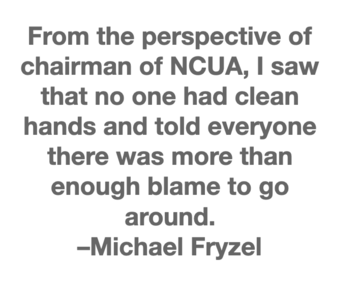
“From the perspective of chairman of NCUA, I saw that no one had clean hands and told everyone there was more than enough blame to go around. Big money was being made on the investments and everyone believed it would go on forever,” Fryzel said. “No one challenged the exposure level or questioned those in charge if there was a downside to the concentration risk. When the bubble burst and the potential loss of billions to credit unions along with the possible failure of both corporate and natural person credit unions became clear, people wanted heads to roll, but not theirs.”
Fryzel said the list of those who need to take responsibility is a long one.
“It includes the highly paid corporate executives who spent more time on the golf course than in their offices; the trade associations who up to the day the corporates where conserved believed what they were being told that nothing was wrong; the CEOs of credit unions who never questioned what the corporates where telling them to do; the investment firms making big profits on the money of credit union members and, of course, the federal regulator and insurer, NCUA.
“Safety and soundness is the utmost principal and responsibility of NCUA. They are charged with regulating, examining and insuring financial institutions. I always believed that the best regulatory philosophy is as much regulation as needed and as little as possible,” continued Fryzel. “Regulators must draw the line on requests to allow those they regulate to do more without the proper supervision in place. The NCUA examiners on site at the corporates became too comfortable and complacent. They trusted, but did not verify, what they were being told.”
‘Infamous List of Blame’
Fryzel added that the examination staff in the years heading into the housing crisis was not large enough and training had to be improved.
“Examiners needed to be given the tools to do their jobs,” he said. “Natural-person credit unions went years without an examination. Yearly on site exams of depository financial institutions are a must. The NCUA board, executive management, supervisory personnel all could have done a better job. No one could escape being on the infamous list of blame.”
More in the series: