

By Ray Birch
BIRMINGHAM, U.K.—Before turning 30 years old, Paul Norgrove was running one of the larger credit unions in the United Kingdom. Just four years earlier, he didn’t even know what a credit union was.

The CEO of the £64,000,000–Police Credit Union ($80 million) here says hard work, mentors, and simply not having the time to worry about whether he was ready for a next step have helped him advance within the movement.
Norgrove is among a number of young credit union professionals from across the globe CUToday.info is profiling as part of a regular series. Norgrove is a member of the World Council Young Credit Union Professionals (WYCUP) program and recently participated in an event during the World Council of Credit Unions’ World CU Conference in the Bahamas.
“I was presenting at board meetings within three months of knowing what a credit union was,” said the CEO of the CU that serves police and law enforcement, prison officers and the military throughout the U.K.
Norgrove rose quickly in the credit union, signing on in 2012 as finance administrator.
“I knew nothing about credit unions, but immediately believed in their core purpose,” Norgrove told CUToday.info. “Not having any financial services experience, I was a sponge and learned all that I could on the job. I was promoted to finance officer within nine months, and finance manager in two years.”

Paul Norgrove
2 Becomes 15
The credit union’s former treasurer, David Raine, who played a key role in the formation of Police Credit Union, came out of retirement to train and coach Norgrove for one year.
Norgrove was named acting CEO in June of 2016.
“In June of 2016, following a sudden change in leadership, I agreed to step into the CEO role on an interim basis for two months,” said Norgrove. “Two months turned into 15, and following extensive vetting and interviews, I was selected by the board of directors as the CEO from a pool of financial sector candidates. Some could call this happenstance. Some could call it hard work. Maybe it’s a little of both.”
But when he stepped in on an interim basis, Norgrove inherited a problem.
“PCU was on a legacy IT system. Although the system was robust and fit for purpose for the time, there was a fundamental need to look to move to a platform that would help facilitate growth,” he said. “I was asked by the board if I was willing to help steady the ship for two months, and I immediately said yes. I did not know the magnitude of the issues I would uncover, but the opportunity was once in a lifetime.”
A ‘Blink of an Eye’
Norgrove said it was a busy 15 months that disappeared “in the blink of an eye.”
“The data processing issue was successfully addressed, the credit union’s performance began to level out, and I was appointed to CEO in October of 2017 after laying out my strategic plans for the future of PCU,” said Norgrove, who said the decision to hire him surprised some of the staff, including other executives. “But that did not bother me and I’ve never looked back.”
In looking forward, Norgrove saw a need for PCU to reorganize and rebrand.
“In October 2018 we completely reorganized the credit union. All but a few roles within the credit union were restructured with a view to creating a ‘service excellence’ model, where the member and the service we provide is at the center of everything we do,” he said. “We are also in the process of re-branding the CU to provide more clarity and develop a closer identity with our members.”
The Challengers
Running a credit union in the U.K. is challenging, according to Norgrove, who said the country’s credit unions share one common challenge with those in the U.S.–attracting younger members.
Credit unions in the United Kingdom are also often not viewed as being mainstream financial services providers.

Police CU headquarters
“And there is the emergence of challenger banks and digital banks, which present a risk to the future of the movement,” said Norgrove. “Credit unions must focus on providing a service that the consumers of tomorrow want. We are continually looking at member experience and looking at ways of serving our members 24/7 via digital channels. We recently introduced open banking to our members and are looking at integrating several third parties into our customer journey for both onboarding and lending to minimize friction and ensure the credit union is available whenever members need us.”
A Three-Year Vision
Like Norgrove, Police Credit Union’s leadership is young—the management team’s average age is 35.
“We have a clear three-year vision for the credit union which focuses on innovation, efficiency and growth—again with ‘service excellence’ and the member experience at the center of what we do,” he said.
As part of the restructuring, PCU introduced an “IT and Innovations” role to engage with fintechs outside of the traditional credit union space and bring those ideas and technologies to Police Credit Union.
“We also recruited a business development manager from another large CU in the U.K. who I believe to be the best in the field in the U.K. sector for member engagement,” Norgrove said.
The credit union is growing, despite all the challenges, pointed out Norgrove.
“Strategically, we are not growing assets by reducing share intake due to a capital/profitability challenge. Our focus since my appointment in June 2016 has been to increase lending,” he said. “Membership has grown from 10% in the last 12 months to 30,156. The loan portfolio has grown from $40.75 million with a loan to asset ratio of 53% to $52.1 million and 66%, respectively, in the last three years.”
The Lending Mix Challenge
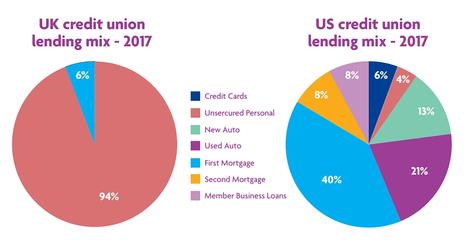
But the big challenge, explained Norgrove, is around revenue generation, largely due to lack of product diversification. Norgrove explained (see chart) the huge differences in lending mix between U.K. and U.S. credit unions.
Police Credit Union’s loan portfolio is almost completely made up of unsecured personal loans (94%). The remaining 6% is first mortgages.
“With a wider scope for lending and revenue generation, we could be able to invest in better technology and access channels and build awareness,” said Norgrove.
The lack of product diversity is something that most U.K. credit unions struggle with, leading to a common perception in the U.K. that credit unions exist only existing to serve the underserved, and aren’t full-service banking providers, Norgrove explained.
“There is a perception that credit unions here are the poor person’s bank, which I refute,” said Norgrove. “Credit unions do play a vital role in providing financial services to the unbanked and underserved but are capable and do provide so much more.”
Perception Issues
Norgrove said the perception creates awareness problems for credit unions across his country.
“We are capable of providing more products and services and could certainly get closer to providing close to full-service banking,” said Norgrove. “Unfortunately, there are regulatory and legislative challenges that need to be overcome in order to facilitate this. Having worked alongside CUs in America as part of the Association of British Credit Unions and Georgia Credit Union Affiliates partnership and seen first-hand the success of both direct and indirect auto lending, we have put together a business case to move into these areas of lending and offer secured car loans. Unfortunately this was blocked by the regulators (citing) references drawn to The Credit Union Act 1979. Without legislative reform of the Act, credit unions in the U.K. will continue to be limited in the products and services they can offer.”
Norgrove said that when he joined PCU at the age of 25 he never expected he would be CEO today.
“I have always been ambitious, and I believe in tangible goals,” he said. “The turning point for me was the World Council of Credit Unions World Conference in 2014 in Australia, which completely changed my outlook on what credit unions are and could become. It was an industry doing incredible work under the co-operative principles of people helping people, but also had the global scale which completely inspired me. I participated in the WYCUP program, which changed my life.”
‘Rolled Up Sleeves’
Norgrove said working with WYCUP inspired him to set a target of becoming a credit union CEO by the age of 40.
Now, with such an accelerated development path at his credit union, Norgrove said he never had time to think about being ready or whether a challenge was beyond his ability.
“Ultimately I just rolled up my sleeves and got the job done,” he said. “Hard work plays a key role when we are looking at progression and hiring at PCU. I have been fortunate throughout my career to have mentors who invest time and create an environment to allow talent to flourish. I believe you can teach anyone to do anything, but you can’t teach hard work. You have to create the landscape for people to shine and allow them to make mistakes.”
A Big Part of Life
WYCUP has become a big part of Norgrove’s life.
“I am extremely passionate about WYCUP and participating in the program has been a catalyst for changing my perception on credit unions and advancing my career. When I became a part of WYCUP I knew I wanted to forge a career within the movement,” he said. “Not only does the program give individuals an opportunity to develop and learn alongside like-minded young professionals, but also explains the global challenges and opportunities we must overcome if the movement is going to be relevant and sustainable in the future.”
Norgrove said he still gets comments like “you are too young to be CEO.”
“But my age has opened as many doors as it has closed,” he said. “I am proud to be a young professional, and I look forward to providing this same opportunity for those who follow behind me.”