

HOUSTON—As the “digital revolution” takes hold, one company sees the role of the first FI self-service device—the ATM—only becoming larger.
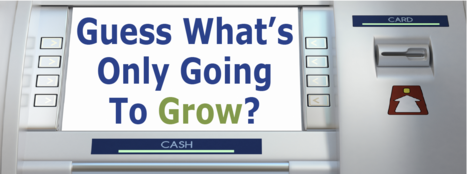
“A massive financial services industry transformation—technologically, operationally and culturally—is under way as credit unions and banks scurry to meet shifting member and customer needs,” said Bill Knoll, executive vice president and managing director at Allpoint. “For financial institutions, this transformation reflects consumers’ increasing demand for convenience, digital engagement and self-service. And it’s made re-evaluating what is, and what isn’t critical infrastructure essential for all financial services providers.”
Knoll said it’s a daunting task to execute for an industry that’s slow to change, but there is no choice in order to serve digitally savvy consumers.
“Most visibly, the transformation is embodied by shrinking branch office networks, trimming the associated costs and redeploying that capital to digital initiatives,” he said. “And yet this creates an infrastructure problem—ATM attrition—prompting credit unions and banks to rethink and to seek more flexibility in how they operate.”
Cash Demand
Despite the rapid rise of mobile banking and payments, the demand for cash has continued to grow, Knoll pointed out.
“A recent Mastercard report, Measuring Progress Toward a Cashless Society, concluded that ‘Despite this progress, cash today remains the most commonly used method of payment when looked at from a global perspective.’”
Cash continues to play an important role in the payment landscape, continued Knoll.
“When Mercator Advisory Group, in a 2016 report, asked respondents if their use of cash increased, decreased, or stayed the same within the past year, cash usage had a strong showing at the polls,” he said.
While in the study most consumers (64%) noted that their cash use has remained steady, more consumers reported their cash use increased (21%) than decreased (15%) during the previous year.
“With cash continuing to play an important role in consumer payments, and ATMs becoming the most popular method of obtaining cash, it’s quite logical that Mercator also found the ATM to be the most popular self-service banking platform,” Knoll said.
'Foundation' Of Self Service
Knoll contends that today’s ATM is the “foundation” of the self-service, digital revolution and an essential complement to the convenience of mobile banking.
“In the definition of critical infrastructure, the ATM is central to many consumers’ self-service banking world,” Knoll said.
Knoll acknowledged that it can become an expensive and time-intensive task for a credit unions and banks to manage a fleet of ATMs, noting that many FIs are supplementing their in-house ATM services, and in some cases outsourcing ATM operations altogether.
“Increasingly, they are turning to ATM specialists to help them deliver always-on access to cash for their members and customers,” he said.

Bill Knoll
Knoll gave the example of Fifth Third Bank, which owns and operates 1,200 branch offices and 2,600 ATMs. The Cincinnati-based bank expanded surcharge-free ATM access for its customers by joining the Allpoint Network earlier this year.
“It was a significant milestone. Like many transforming financial institutions, Fifth Third is investing in digital channels,” Knoll said. “At the same time, Fifth Third customers want what all consumers want--convenient surcharge-free access to cash, despite going digital in other areas of their banking relationship.”
The fact that Allpoint has relationships with 24 of the top 100 credit unions is evidence that the ATM channel is critical infrastructure that’s part of the digital transformation, according to Knoll. Also, a 2013 Federal Reserve study showed the ATM channel accounted for more withdrawals and deposits within the U.S. than branch tellers.
“Speaking to the value of ATM services, a 2014 Visa study indicated that 57% of consumers consider ATM convenience the No. 1 reason they choose their financial institution,” said Knoll. “For many of the rest, it’s the No. 2 reason.”
Millennial ATM Use
A Chase Bank investor day presentation earlier this year revealed that a greater percentage of Millennials (80%) use the ATM channel than non-Millennials (63%), and 2016 Mercator research similarly found ATM use is rising among young adults and mobile banking users.
“Specifically, Mercator found that ATM use is widespread—four in five consumers use ATMs at least a few times a year—with rising use among young adults and mobile banking users, with half of young adults—up from two in five in 2014—using ATMs weekly or more,” he said.
Against the backdrop of a digital revolution marked by branch office transformation and in some cases reduction, ATMs are a critical part of the solution for lowering costs and providing the convenient self-services consumers demand, reiterated Knoll.
“In spite of the hype surrounding mobile payments and digital P2P, these payment alternatives play on the margins in comparison to cash and cards. And that’s reflected among Millennials, a generation raised on technology that, perhaps not so surprisingly, use ATMs to get their cash,” said Knoll. “Alongside a pullback on physical assets, perhaps it’s difficult for credit unions and banks to justify growing their in-house ATM fleet, but that’s exactly why the partnering trend of financial institutions working with ATM specialists to supplement their in-house networks has emerged.”