SOPOT, Poland–There’s volunteerism, and then there’s the extraordinary thing Jakub Osipow is preparing to do.
With assistance from credit unions in the U.S. and Poland, Osipow is getting ready to drive a refurbished “ambulance” more than one-thousand kilometers from Poland to the front lines of the war being waged in eastern Ukraine with Russia. There, he plans to not just help ferry injured soldiers to hospitals in Ukraine, but as a highly trained EMT to also train Ukrainians in some of the basics of first aid for trauma victims, saying he has personally watched as lives were lost as the result of giving poor help to those who needed it and too much to those for whom it was too late.
Osipow’s ambulance is a refurbished Toyota Land Cruiser that has been purchased with assistance from the Via Stella Foundation, a joint effort between credit unions in the U.S. and Poland.
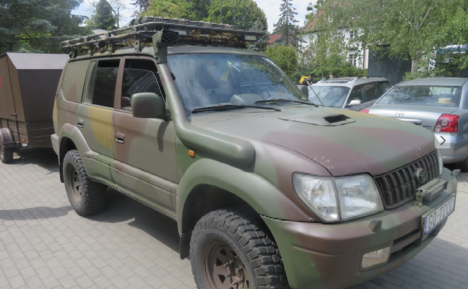
Ambulance set to be driven to Ukraine's front lines.
Not long after Russia attacked Ukraine, the Via Stella Foundation was created in April of 2022 by Brian Branch, the former president of the World Council of Credit Unions, and Sue Mitchell, CEO of Mitchell, Stankovic & Associates. They in turn reached out to Rafal Matusiak, president & CEO of Poland’s trade association, the National Association of Credit and Savings Unions (NACSCU), who now chairs the Via Stella Foundation. From day one, Matusiak has emphasized NACSCU is covering all costs related to operating the foundation and 100% any money donated goes directly to those it seeks to help.
An Up Close Tour
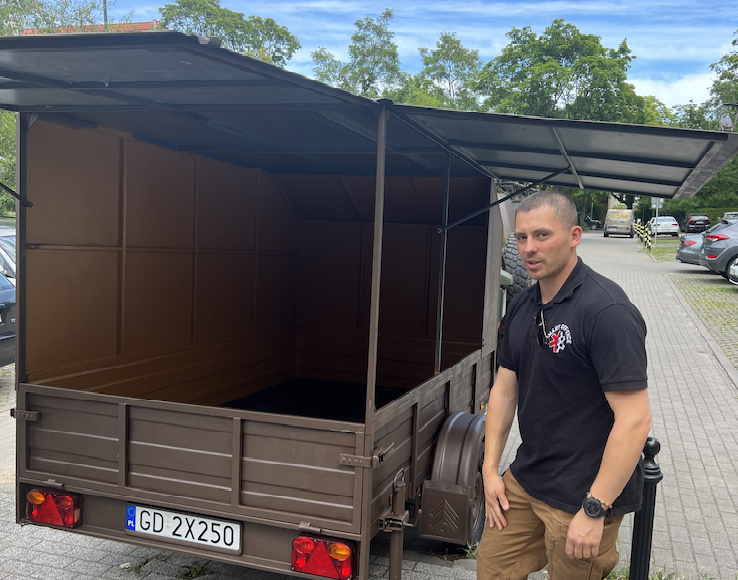
In the parking lot of NACSCU in Sopot, Poland, Osipow gave a tour of the ambulance, as well as a trailer that has been purchased to carry additional supplies and spare parts, and to function as a place to provide training.
While the role he is undertaking comes with obvious tremendous risk—the Russians are known to target ambulances and for that reason the vehicle has no markings—Osipow downplayed any concerns in an interview with CUToday.info, joking he has no family and no money so he is ideal for the task. Besides, he added, he is a former member of Poland’s military, and has already been to the front and knows what to expect.
He also leads an organization called Smart Defence.
In Ukraine, Osipow said there are doctors and nurses, but no trained medics, and if there was any training, it was poor.
“We’re trying to create as many professional medics as we can,” he said. “We can provide cheap training at a high level.”
Osipow is not being paid for his work in Ukraine—the Army provides fuel, food and accommodations. His travels will often take him within one kilometer of the trenches at the front, as the time between injury and treatment has a strong affect on outcomes.
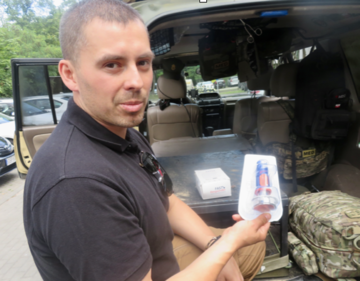
Jakub Osipow showing inside of ambulance, supplies.
Looks Can Be Deceiving
He plans to work in the Dnipro region and, given the targeting of ambulances, says he carries a camouflage net while trying to hide beneath trees to avoid being spotted by drones.
“On the outside it looks like a Land Cruiser; on the inside, it’s an ambulance,” Osipow said.
He does have blue flashing lights, but carries those inside the vehicle. The vehicle can handle one patient lying down and two sitting up. If need be, another person can ride on the roof.
The Via Stella Foundation, which continues to seek contributions, has purchased five ambulances to date along with other medical equipment. The ambulances typically cost around $13,000-$15,000.
At the time Osipow met with foundation members at the trade association’s headquarters, he was awaiting delivery of a medical mannequin he said will be critical to teaching soldiers how to properly load and unload patients, how to apply a tourniquet (it’s often done wrong at the cost of limbs, he said), how to intubate someone, how to clear airways, and more. He is also awaiting a new defibrillator.
He said he has unfortunately encountered many “fake instructors who give shitty training.” Moreover there are often very little standards or quality control, he added.
A TCCC Specialist
Osipow specializes in what’s known as TCCC for tactical combat trauma care (TCCC appears on the new ambulance’s license plates).
“My goal is to convert these people into tactical medics,” he said. “I found that with a lot of equipment they don’t know how to use it. The instructions are often in English, and they do not know English.”
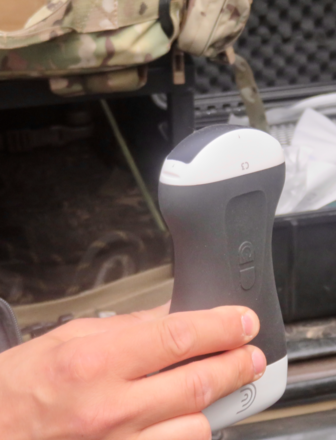
A hand-held scanner for use on battlefield.
Osipow said tactical medicine focuses on those victims who can be saved, including those with pneumothorax issues, injuries to extremities, airway management and then evacuation.
Most of the victims Osipow said he attempts to treat have been hurt by land mines and IEDs. He treated one soldier who was crawling along the ground as a machine gun fired on him, creating long “scratches” along the soldier’s back that he described as looking like someone had “spooned the meat out.”
Osipow has seen Russian attacks up close. He was at a hospital when it was hit by a missile, and said there is little one can do when that happens other than tighten your helmet.
What About Fear?
When asked if he isn’t afraid when under attack, Osipow said he is not, but it’s also a “complicated” issue. He said his time spent as a soldier, engaging in extreme sports and working as a shooting instructor when people were firing over his head makes the war a “normal day of work.” It’s all about “stress management,” he added.
“I am prepared. They do not want me to go to combat. If they kill me there is not a second guy” to replace him as a trained medic, Osipow explained.
Even when he gets the injured to a hospital, the situation can remain dire, he said, noting some don’t even have toilets, while others have everything. “There are no standards. Everyone is doing the best they can with what they have,” he said.
Expensive Shopping List
During a tour of the ambulance and trailer (the latter was empty but will be filled with supplies prior to leaving Poland and will also act as a training facility in the field as he seeks to “train the trainers”), Osipow reviewed a number of highly mobile—and expensive—devices that he said make a critical difference, including clamps to stop bleeding, especially with abdominal wounds; one-time use tourniquets that cost $500; a $3,000 respirator; and a $10,000 ultrasound device that can be linked to a phone or tablet to review images of abdominal wounds, the lungs, or to scan behind one’s eyes to measure pressure inside the skull.
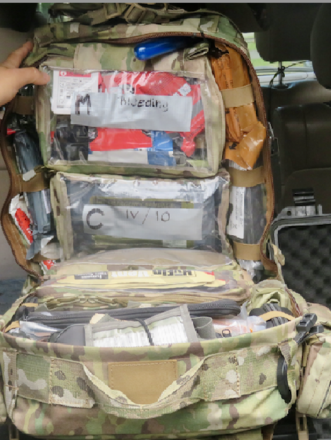
A bag stuffed with medical supplies.
Osipow had previously used a refurbished pick-up truck as an ambulance (the shelf life of ambulances in Ukraine is less than a year), and said the Land Cruiser is a significant upgrade, as everyone is in the same cabin, there is more headroom (important when wearing a helmet) and it rides higher off the ground following modifications. The windows have also been taped to prevent flying glass fragments in the event of an explosion.
‘Many, Many Miles’
“I hope to go full and come back empty and leave them with the equipment and training,” said Osipow. “I hope this trailer can do many, many miles in Ukraine and Poland.”
And if he loses his ambulance, he plans to take his own personal Skada and drive back to get the trailer.
At the front lines he described morale as good, but said just three months ago it was “high,” as the slow slog has been taking its toll.
Ukraine’s policy is to send soldiers back to the war after they have healed from injuries, and that even includes those with prosthetic legs, according to Osipow. Those who have lost hands are less likely to return.
‘My Conflict’
In Ukraine, Osipow said he has encountered soldiers, medical personnel and volunteers from many other countries, including the U.S., in addition to his fellow Poles.
Many in Poland believe that were it not for Ukraine, their country would be the next target of Russia. Osipow agrees.
“This is my conflict; that is my viewpoint,” he said.
For info on the Via Stella Foundation, go here.
Below, trailer to be loaded with supplies that will also act as a training center.