

TAMPA, Fla.–Three credit union CEOs are offering some insights into what is now driving their decision-making, why credit unions should never think of themselves as tech companies, and even on what lessons Taylor Swift can offer CUs, among a range of other issues.
Their comments came during a panel discussion at PSCU’s Member Forum. The three CEOs included Christine Blake, president and CEO of the $288.9-million Cardinal Credit Union in Mentor, Ohio; Kelly Botti, president and CEO of the $2.95-billion TruMark Financial Credit Union in Ft. Washington, Penn., and Tansley Stearns, president and CEO of the $1.52-billion Community Financial Credit Union in Plymouth, Mich. The panel was moderated by Mark Sievewright, founder of Sievewright and Associates.
Before beginning the Q&A. Sievewright offered his own perspective on what he called the “five C’s of change,” including:
- The Consumer. “The consumer will continue to be more demanding, more digital, and want more personalization.”
- The Conveyer Belt. Consumers and credit unions are all on the conveyer belt together moving through life, Sievewright said. Looking to younger Americans, he pointed out everyone is holding a mobile device and prefers them over all other forms of interaction. The bad news: 57% of the combined Gen Z/Millennial market have relationships with the big four banks, and that matters as Millennials alone control $1.6 trillion in spending.
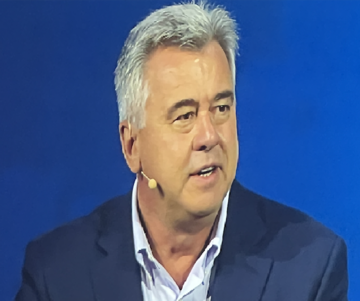
Mark Sievewright at PSCU Member Forum.
- Competition. Sievewright quoted JPMorgan Chase CEO Jamie Dimon as once saying traditional FIs should be scared of fintechs. And he’s the CEO of the largest bank in the country, noted Sievewright.
- Consolidation. “When we get to 2040 we will have the same number of credit unions as the year,” predicted Sievewright. “And by the end of this decade the number of credit unions will begin with a three. Instead of being threatened by that, we need to embrace that.” (There are approximately 4,800 credit unions today.)
- Crossing the Chasm. That stands for technology and its impact, Sievewright said, adding the next challenge is “humanizing what digital can do.”
The Q&A
Below is a look at what was discussed during the Q&A:
Q: When you think about what’s next and what inspires us, what is your perspective?
Botti: What keeps coming back to me is partnership. I think that we have seen so much talk about humanization, personalization, innovation, but what we do as credit unions is partner with our members and we do it better than anybody else. (A colleague) used an analogy last night that I think really sums it up: we are our members’ golf caddies. We are the people that tell our members what club to use and how rough the terrain is, but ultimately it's their choice. We have to be available and ready to help them and partner with them strategically, so they can leverage the tools they need to be successful.
I think if we focus on that we'll be able to really create a compelling story for our members.
Stearns: I think we have a couple of things to lean into. The first is how we modernize our organizations. When I think about the future, I think about my 12-year-old daughter who has been swiping an iPad since she was one. It demonstrates what the next generation expects from us…We have to think about how do we create a physical experience that invites that digital first approach?
Blake: To attract the youth we have a course that we teach in all of our student branches. It's an eight-week course that we designed called “Real Accounts, Real Learning.” (We do education) each week. Maybe it's budgeting, what is Venmo, how do you establish credit, and then it culminates in a scholarship competition. We've been doing this since 2012. We have to update our curriculum every year. We didn't have crypto in it five years ago, but we have it in there now.
Sievewright: Moving onto investments in technology and the people/technology balance, where do you focus?
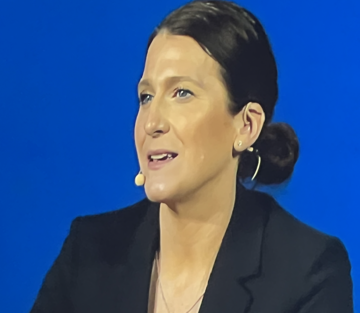
Kelly Botti at PSCU Member Forum.
Botti: I lead with people. When I took office we had outgrown our operating model. We started by rightsizing our model in aligning talent with purpose. For most people it’s not the paycheck that motivates them, it’s seeing the value in the work they do. That’s what a force multiplier is to me. It’s finding one person who can go out and impact so many more people. It’s the domino effect of talent. When you find people aligned in that purpose, you get so much more impact.
With legacy systems, it becomes very difficult to compete. You have to be very specific. You have to be agile and intentional about your strategy, so when members tell us what they need we can deliver on that faster.
Sievewright: Talk to me about operational tempo.
Stearns: I believe as credit unions we have an obligation to our members, to this nation, to move more quickly. What we have talked a lot about at Community Financial is that we have to do that in a very human way. We win with people. But we have to be moving because we have work to do to wake up from the nineties and then to get well beyond that. We can’t always be playing catch up.
In our three-year strategy we think about what can we do today to have an impact? We think about where can we go to get ahead? I don’t think we can win across the entire tech stack; we have to win in a couple places with our target market.
What we don’t want to do with our tempo is to race really hard in 2023 and then be out of breath. We have to get to a place where we can get ahead so we are the next generation’s first choice.
Sievewright: On fintechs, we’ve heard credit unions are laggards in technology, and conversely, technology and fintechs can be our friend. How do you manage?
Blake: Third-party management is very important. It’s all about collaboration. We can’t do it alone. As a single CU we can’t do it, but collectively we have buying power through third parties like PSCU. Real-time payments. Crypto. We can compete when we have partners who provide us those services.
Sievewright: When I go visit credit unions, I see fintech strategy as being everything, everywhere, all at once, or nothing nowhere ever at all. How do you handle the investments?
Botti: I’m a big believer in following members’ needs. I think you have to be disciplined in fintech investments. You can get really geeked out by the developments in the marketplace, but you have to be disciplined and ask what do our members need? We are a low-income designated credit union. Our members’ needs are very different than somebody else who doesn’t serve that market. You have to go to that strategic agility mindset around how you can do that smarter.
Sievewright: You have a great focus on relationship as a strategy.
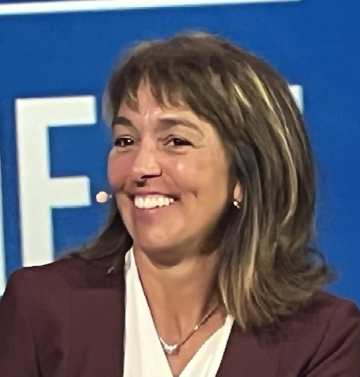
Christine Blake at PSCU Member Forum.
Botti: Before the pandemic, I heard a lot of industry-related commentary that financial institutions and credit unions are now technology companies. I have a very physical reaction when I would hear that. I would completely disagree. We are not technology companies, we are relationship businesses. People helping people is at the core of what we do. When you forget that and you are seeking growth for growth’s sake, we lose the spirit of industry. What I invite everyone to think about is the power of relationships. Living in that spirit is very important to me, that you are focused on authenticity. That’s what leads to trust and relationship building.
Sievewright: We have Chase and Citi and BofA all highly present in your market.
Botti: But all of them are trying to create localization strategies. Anyone in a large market like ours, it’s all about trying to be local. They’re saying ‘We get you.’ I think our members see that and when they come in and interact with our team members, they feel like they are interacting with community members. It’s how we do business. How we do business matters always. When you don’t act authentically in your operating model, it will speak volumes.
Sievewright: One of the reasons credit unions have slipped behind in the American Consumer Satisfaction Index is that now the big banks are trying to be more like us. BofA has its ‘Life Plan’ financial well-being program. And they signed up six-million people and $34 billion in deposits in the first 12 months. Chase has Chase Chats, a financial well-being program. With that sobering thought, talk to us about the importance of the credit union brand.
Stearns: It is the thing we have to take more seriously. I started my career as a marketing specialist. Marketing is a strategic imperative in our businesses. Storytelling is the thing that we must do to ensure we are no longer a best-kept secret The awesome news is we have the story. Our competitors are trying desperately to have our story to share. We have the story, we need to elevate it. That’s what I’m excited about and what I hope more credit unions will lean into how collaboratively. We are better served when others are telling our story rather than telling it ourselves.
Sievewright: How do you differentiate?
Blake: It’s a crowded space, we have the banks in what was our value proposition. We keep it very simple. We are about financial education, financial wellness, and being the trusted advisors. And we stick to it. That’s how we develop testimonials and examples and bring that to the community. We aren’t trying to create stories like the banks, we are living our story.
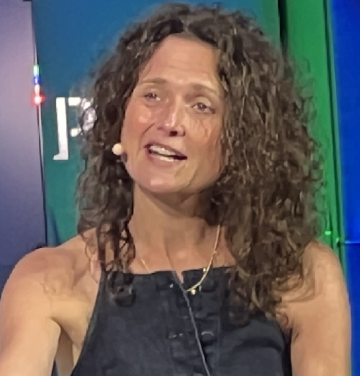
Tansley Stearns at PSCU Member Forum.
Sievewright: We have been focused on ‘mullet banking’ for a long time, that is looking great from the front, but from the back we’re a mess. Our next phase of investment is going to be around clearing up that back office. Thinking about payments and the speed of change, how do you think about the notion of money movement?
Botti: I think members care about two things: who they are paying and when it’s going to get there. We are very creative in this industry in how we get things done, but we have a bad habit movement-wide of using bank or financial vernacular when our members couldn’t care less about that. We shouldn’t put the onus on our members to know the difference between ACH and real time payments and FedNow. Simplifying that decision for our members is really what I focus on with our members.
Sievewright: How do you think about real time payments?
Blake: it’s one of our initiatives. As a smaller credit union, we can’t do it alone. But in order to compete we have to have it. How do we obtain it? We look for partners.
Sievewright: We are moving very quickly beyond plastic cards. The future can be seen in other countries and in buy now, pay later. How do you think about the BNPL market?
Stearns: The place for us to find solutions is to listen to what members are looking for, what nonmembers’ needs are, and marrying that to our subject matter expertise. What I hear is angst around BNPL and I think the place where we win is when we stop that and identify what those pain points are and get ahead of that. Do we want to find solutions or not be around in 10 years?
Sievewright: Why does Taylor Swift remain so popular and what can we learn from her?
Botti: Actually, (Taylor Swift offers a) lot to be learned about reinvention. It’s up to us as leaders as we navigate what this next chapter might hold to constantly think about how do we play at the best of our game always.
Sievewright: Tell me about importance of trust and CU message:
Blake: For us, trust happens in the small moments. It could be when a member calls and we are there for their questions and walking them through an answer. The small moments all add up and it does matter. You build it one staff member at a time.
Botti: Trust is the name of the game. For all of us, as the geopolitical world just gets more complicated, our members are looking for a safe place. At TruMark, we talk about being the first place our members turn.
Stearns: Two things come to mind. The first is about brand and storytelling. With all that has happened in last 45 days we have the opportunity and obligation to tell the story of credit unions that we have been trustworthy from the beginning and not a single member has lost money. The second thing is that with the next generation, trust is not what it was. They will not trust us if our technology isn’t what it should be, if it’s not engaging. To do that we have to transform our credit unions.