

By Ray Birch
LAKE FOREST, Ill.—Just 23% of the 8,603 banks, credit unions, thrifts and fintechs that offer checking accounts make money on them, according to a new study. And the person behind the analysis is saying if various groups “continue their assault” on these transaction accounts, consumers will ultimately pay the price.
The study also suggests credit unions have some big decisions to make in the new year.
The Functional Cost Analysis Report from Moebs $ervices predicts that if the pressure persists—driving legal expenses up and overdraft charges down—many financial institutions will shift to accounts that come with monthly charges.
“Regulators, class-action attorneys, and consumer groups who target financial institutions because that’s where the money’s at might want to rethink moves against T-accounts (transaction accounts), because checking is the key to financial services relationships, which brings in the deposits that fund loans,” said Michael Moebs, economist and CEO at Moebs $ervices. “If pushed too hard, depositories may switch to a pay-as-you-go T-accounts and institute monthly fees, not authorize debit card purchases, or put multi-day holds on direct deposits or limit the amount of the deposit which can be used for several days.”
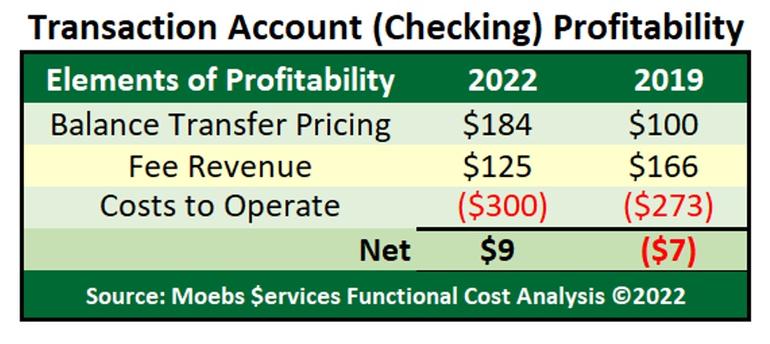
As financial institutions navigate their way through a changing checking account environment in 2023, Moebs noted there are many elements affecting checking account pricing and several approaches to profitability, as outlined below.
The Approaches
According to Moebs, those approaching include:
- Balance transfer pricing. “What are deposits worth? Three methodologies decide this. Are deposits a profit center, cost center, or neither—just part of overhead? The profit center approach incentivizes deposit operations to go after low-cost needed deposits and compensate the employees who get this done. The cost center method treats deposits as gasoline which feeds the loan engine, and instructs deposit operations to efficiently get the lowest cost for deposits.“The no-cost approach can impact effective loan price, understating loan value while treating deposit operations like a dog who is happy with one meal a day and water bowl and wag his tail in gratitude,” Moebs said.
- Fee revenue. Overdrafts, service charges and interchange.
- Cost to operate. Direct T-account costs: tellers and salespeople. Indirect costs: IT, software; overdraft losses, checking fraud, and overhead costs—branch expenses.
Enormous Increase
“Balance transfer pricing increased enormously in the COVID era versus the pre-COVID era,” explained Moebs. “The main reason is the stimulus funds given to the consumer. This boosted the value for T-accounts since the consumer is not spending—but hoarding—this money. The current holiday season will give insight into how much the consumer is willing to hoard versus spend.”
All of that has driven an 84% increase in demand deposit account balances, which is unprecedented in U.S. financial history, Moebs explained.
“This did not happen in two world wars, the Great Depression, nor the Great Recession. Can financial institutions count on this massive deposit increase as core?” Moebs asked. “This is the critical question facing depositories.”
The Prediction
Moebs is predicting that overdraft revenue will bottom out in 2023 and then start rising.
“The 25% decline of fee revenue is entirely due to lower OD prices by Walmart (dropping from $25 to $15) and Bank of America (dropping from $35 to $10),” Moebs noted. “Walmart and BOA collectively claim 31.8% of the 543.3 million consumer checking accounts in the U.S. Yet OD revenue will bounce back as those consumers who do use overdrafts will do so at a higher pace due to the lower prices. Interchange will just keep growing with increased debit card usage. By 2024, fee revenue will be back to pre-COVID levels and beyond.”
But in the short term, with the continuing legal threats to and regulatory scrutiny of OD revenue, and with falling overdraft prices—along with cost to operate accelerating as same-day payment processing takes hold in 2023—banks and credit unions have decisions to make, Moebs said.

Michael Moebs
Potential Actions
Moebs offered these recommendations to credit unions in response to the changing market:
- “Everything must be done to keep consumer T-account balances from leaving. Using pricing to thwart balance loss is critical—from paying higher interest to lowering fees,” Moebs said.
- Streamline T-account offerings like Walmart and BOA…by having only one consumer checking account.
- Maximize T-account competitiveness with digital wallet applications.
- Give incentives to deposit sales personnel to get and maintain T-accounts and their balances.
- Reward interchange usage by using some of the interchange value to offset fees on deposits and loans thus reducing the cost substantially of third-party reward programs.
- Purge unprofitable T-accounts unless the household relationship is profitable.
- Consider introducing free T-accounts with interest tiers.
- Raise the interest paid for higher balances maintained.
Headed in the Right Direction
Moebs said financial institutions are moving in the right direction with their checking offerings.
“In 2019, only 6% of all T-accounts were profitable, and now the percentage is 23%,” he said. “That is a significant improvement. Successful depositories are starting to recognize making T-accounts profitable is achievable and can contribute to the financial institution’s bottom line instead of draining the bottom line. Transaction accounts have always been the stepchild of financial services, but now have a chance to become Cinderella.”