

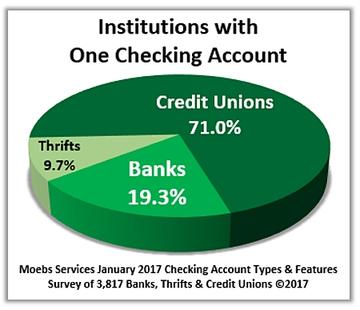
LAKE FOREST, Ill.—A new study shows that among all financial institutions, only one in nine offer a single checking account—but among those that don’t offer multiple accounts, more than 70% are credit unions.
The Study on Checking Account Types & Features from Moebs $ervices shows the trend toward offering only one checking account has been increasing in recent years. The move leads to greater efficiency and a better likelihood that the checking account will be profitable, according to the study’s findings.
“Currently, 11.4% of all depositories offer only one checking account. This is a 17.4% increase in the past three years and the largest increase of any checking type offered,” said Michael Moebs, CEO and economist at Moebs $ervices. “This is a reflection of greater efficiency and an assertive effort to increase the cross-selling of other services.”
Examining those that offer a single account, 71% are credit unions, whereas only 19.3% of banks and 9.7% of thrifts similarly have the limited offering. The average asset size of those offering single checking is about $1.2 billion, the study shows
“The asset size of those offering free accounts varies greatly between types of financial institutions,” said Moebs. “Thrifts have the highest average assets at $3 billion, while banks average about $2.3 billion and credit unions $660 million. This includes a large range of depositories—from Ally Bank at $115 billion to a small $59,000 credit union in Chicago.”
Efficiency The Key Factor
Moebs explained that several key factors influence an FI to offer only one checking account: cost, cross-sell, compliance and size.
“Efficiency is the dominant feature of a single checking account–keep costs down and make it easier to cross-sell other services,” said Moebs.
Growing cost of compliance is another factor found in the study when it comes to what drives FIs to seek low-cost solutions for offering a single checking account. Of course, many financial institutions simply have limited resources due to size and just cannot afford offering and maintaining more than one checking account, added Moebs.
“Credit unions are the leader in single account checking primarily to keep servicing costs to a minimum, and secondly, many credit unions under $100 million in assets cannot justify the cost of two or more checking accounts,” said Moebs.
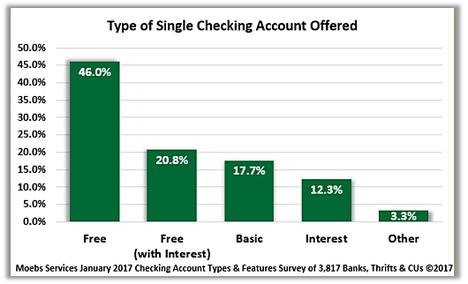
Among those offering the single checking account option, about two thirds offer a free account. Within the free account product category offerings include both interest bearing and non-interest bearing products, the study shows.
“A basic checking account will charge a monthly fee (that) is avoidable with a minimum balance. This makes up 17.7% of FIs offering a single account,” said Moebs. “Interestingly, 3.3% of FIs that only offer one account offer a flat fee checking account. Flat fee checking charges a monthly flat fee that cannot be avoided, and will be charged every month with no balance requirements, or interest paid.”
Moebs said the biggest reason for big gap between the number of banks and CUs offering only one checking account is because many more credit unions still offer free accounts.
“The CUs are sticking with free checking—the banks are not. This is truly separating the banks from the credit unions. It also allows those CUs with limited resources to be competitive,” said Moebs, who believes this can be a competitive edge for credit unions. “Credit unions that stick with free checking and couple it with a single checking account can definitely have a competitive advantage. First, doing free single checking separates the credit union from much of the bank competition. Second, by keeping the use of resources down, CUs can make checking profitable—this is something less than 10% of CUs not have achieved.”
Checking 'Renaissance'
Moebs credits Bank of America for starting a “renaissance” in checking in 2010.
“First, BofA stopped offering debit card overdrafts. Then, starting in 2013 and ending in 2014, the bank took its 11 checking account types and reduced them to two,” noted Moebs. “BofA did this to improve efficiency in selling and to reduce resources devoted to checking. Many banks, thrifts, and credit unions have followed the BofA example and reduced the number of checking account types offered.”
The Moebs Study on Checking Types and Features shows one single checking type may have multiple tiers of fees, rates, and balances.
“However, the direction is to do as Bank of America did by 2014—promote efficiency in selling and resource use—fewer checking types is the future of the transaction account business.