

ST. PETERSBURG, Fla.–With member credit unions of both PSCU and Co-op Solutions now having voted in favor of merging two of the largest CUSOs in the country, and with the new board meeting for the first time today, the official combination is now just two weeks away—and the CEOs of both are offering an update on what is taking place now and moving forward.
As CUToday.info has reported, in early November the two long-time rivals primarily in the payments space announced they had been in discussions for most of the year about merging. The combined CUSO, which has yet to be named, will serve thousands of credit unions and have more than $1.3 billion in annual revenues.
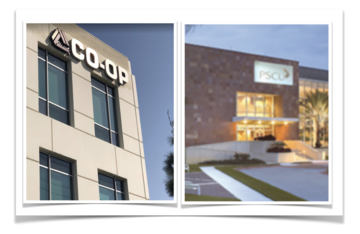
Plans call for PSCU President and CEO Chuck Fagan to lead the merged company, which will be headquartered in St. Petersburg, Fla., where PSCU is currently housed. A role for Dean Michaels, president and CEO of Rancho Cucamonga, Calif.-based Co-op, has not been announced, but Michaels is one of the individuals overseeing the Integration Management Office that has been created to oversee the integration of the two companies.
Nine members of the PSCU board will serve on the board of the combined company. They will be joined by four members of the Co-op board. The 13 members will be meeting for the first time today in St. Petersburg.
With the merger official on Jan. 1, 2024, pending approval by the Department of Justice, there are countless significant and minor issues to be dealt with.
Below, Fagan and Michaels share an update on where things stand, what’s planned and more in this interview with CUToday.info:
Q: What can you tell us about the vote on the merger, which took place Dec. 13?
Michaels: It was overwhelmingly positive for both organizations. More than 90% of the shareholders from both organizations supported the combination. There are still a few other things we need to work through in order to be able to close the transaction by the end of the year, probably the largest one being regulatory approval.
Over the course of the last month both organizations have been spending, to the extent we can, time together forming our Integration Management Office (IMO). Last week the teams met in Fort Worth, Texas in one of Co-op’s locations to do what we can from an integration perspective. That’s basically creating charters and the planning around what we want to do for the first 100 days.
Post the close of the transaction is a great opportunity for the teams to spend a little time with each other to get to know each other. Obviously, they're going to have a tremendous amount of work to do together.
A really important part of that integration office is that we have participants from both Co-op and PSCU across all of what we call our functional work teams (around) how we integrate from a product perspective, from a operational perspective, from a risk and security perspective.
We want to really emphasize that this is a combination of two entities and having representatives from both Co-op and PSCU participate in that. So far, the teams are diving right into it.
Fagan: I would only add that Dean and I have been pretty active out in the market as well, so in addition to the overwhelming approval from the memberships, we have been at the AACUL meeting and at different meetings in D.C. The feedback has been ‘What took you so long? This is something that needs to happen for the industry.’
Part two is around the Integration Management Office. You would have been hard-pressed to identify who was from what team. They really started collaborating right away.
Pending the close we have our first board meeting with the combined group in the second weekend of January, so fully expect that group to collaborate right off the bat as well.
CUToday.info: What specifically do you hope to accomplish in the first 100 days?
Michaels: Obviously, we've yet to announce that first level of leadership for the go-forward organization, so expect to see that communicated early on. Chuck has identified what he wants that go-forward leadership team and organization to look like.
Expect over the course of the first 100 days that we'll be able to make substantial progress to solidify what the next layer of leadership will look like. What's vital for us in the first 100 days is that we ensure the ongoing operations for each organization are not disrupted as we begin integration.
Branding is something that is obviously early in the organization's life and will be important. It’s something that's being worked on. I’m not sure if that gets announced in the first 100 days, but I think, obviously, somewhere in the first half of the year. We’d like to get it out for some really big industry events, but we want to make sure we give the teams enough time to do it right.
Towards the end of the first half of the year is when we really want to have the teams to have a more forward-looking outlook on the product roadmap in particular, on how we start to integrate some of the solutions and be able to communicate that to our clients to help set expectations.
Fagan: As you look at the strategic plans for both organizations, which we haven't been able to fully dive into because we're still separate organizations until the DOJ approval, based on what we know there's such alignment around where Co-op is headed, where PSCU is headed. I would look for those first 100 days to really solidify the best out of both strategic plans.
GAC is a pretty huge event in the industry and I think it will be one of those right at the top of the list for the combined organization, and then we have the PSCU Member Forum and THINK (meeting) right on the outside of the 100-day window. Those will be tremendous opportunities to really solidify the support from the industry, support from the member-owners.
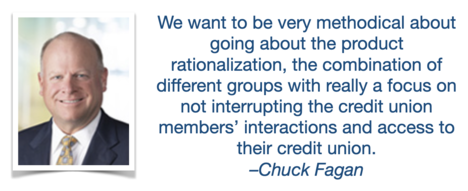
We want to be very methodical about going about the product rationalization, the combination of different groups with really a focus on not interrupting the credit union members’ interactions and access to their credit union.
CUToday.info: You both had mentioned there was overwhelming support for the merger. But what kind of pushback did you hear, what kinds of concerns were raised?
Fagan: It was well over 90% approval, so it was a minority in terms of those that didn't support it. I would say there was a concentration in our group with somewhat smaller credit unions—and we did have support from smaller credit unions—that ‘This is going to be a change to us and we we've got our strategic plans in place. We’ve got limited resources. It's going to be tough for us to be able to handle what changes come out.’
I think we, as a combined organization, have to be sensitive to that. Outside of that, I think there were a few that felt that it was healthy to have the competition between PSCU and Co-op. But we still have that with FIS, with Global Payments and TSYS, so I think a natural evolution within the payment space is really necessary, because so much of it's about scale these days.
Michaels: It was a low number for us, as well. We held two shareholder webinars prior to the vote and through those I was able to hear some specific questions and feedback from credit unions. I'd say in terms of the concerns a couple of them were just about disruption; ‘Hey, things are working really well. I know mergers can be disruptive.’ We stressed how we've already invested a decent amount and will continue to invest in making sure that we do the integration right and make it as least disruptive as possible. That really helped a lot of folks to get over the hump.
Some of it was people just really like what they were getting from Co-op, and I'm sure they really liked what they were getting from PSCU. They like the people they're working with and wanted to make sure the DNA from both organizations was going to live and go forward. That really helped reassure a lot of the client shareholders I spoke to about this and how this is truly going to be a merger of two companies working together to come out on the other side with a better combined entity. It was a little bit of a point of pride for me that I did not end up getting off the phone with anybody who originally had concerns that by the end of the call was not in support.
CUToday.info: Regarding the Integration Management Office: There is lot of talent in the management of both companies, but perhaps not a lot of experience in managing mergers. Is it correct you are using McKinsey & Co. to help guide the IMO?
Fagan: We are using McKinsey. They obviously have incredible depth of experience. But we do have talent that has had experience (in mergers). Dean is a great example, coming from First Data and just being in all the acquisitions that were done. I know there are members of Co-op’s team and PSCU’s team with experience in mergers.
Our commitment is to minimize the disruption for the credit union member and the credit union staff, and in order to do that we need an outside partner to come in who can really guide the process. We've got to keep the day-to-day business flowing and follow through on the commitments we have made to credit unions over the last years after they've signed with either organization. To me, the only way to do that is to really have some external support and they've been a tremendous partner.
When you engage with a company like McKinsey, you get all of McKinsey and they come in with their experts around the various functions.
Michaels: On the Co-op side, it was almost seven years ago but there are still a lot of senior leaders at Co-op who were here for the Co-op/TMG merger. I think we learned a lot through that in terms of some things that we thought were really well done and some things that were areas for improvement. One of the things that we did not do at that time was really have a third party work with us to move through that and, so, just reinforcing Chuck's point in terms of how valuable so far McKinsey has been in that regard.
CUToday.info: In any natural-person credit union merger a big issue is systems integration. Is there much overlap between the systems PSCU and Co-op run, and what is your timetable?
Fagan: At a platform level, both organizations are representing the former First Data now Fiserv Optis platform. PSCU does have business on the Fiserv Wilmington platform. Co-op does have business on the FIS Connex platform. So, those will stay for at least five years. Where there is technology overlap, such as Co-op has Springboard and PSCU has QuickAssist, we have to go through and figure out what's the best of the best of both those applications and decide whether to choose one as the foundational system and insert enhancements from the other. There’s a McKinsey person in the middle of that who is a technology expert.
So, we'll get an opportunity to go through and do the best of the best.
But I would (agree with) Dean’s timetable, really, the six-month time frame (before) we would come out and identify what route we're going to take. It’s highly unlikely there's much change in the first 12 months; it probably starts to kick into gear in 2025.
CUToday.info: So, if I’m a Co-op or PSCU credit union, I’m not seeing lot of big changes for another year?
Fagan: Yes, I think we are a bit different than a public company. We get to do it in a way that's in the best interest of our member-owners and their natural-person members. That's something we're going to be held accountable for by the board of directors as they represent the membership.
CUToday.info: Efficiencies and scale are something both companies have frequently cited. Is there one thing you point to where you think, ‘We’re really going to see efficiencies in this particular area’?
Fagan: PCI compliance and cyber are two pretty baseline areas.
Michaels: Just in general terms, where do we have similar systems and where can we end up collapsing those? From an investment perspective, to the extent we are both investing capital in similar reporting systems or compliance or information security, not having to double up on those is a tremendous efficiency.
I think we’ll see efficiencies just around general administrative proficiency. You only need one CEO in an organization. There will be efficiencies from a back office operations perspective, particularly where we have relationships with vendors. We’re going to be an organization twice the size; that's going to help us really drive efficiencies.
CUToday.info: It’s a tough issue, but when speaking to efficiencies a key issue is headcount. Obviously, both companies have some overlap. How are you addressing that, what are you hearing from your employees, and do you have a timetable for any related announcements?
Fagan: We’re doing it from a focus around service. If doing away with an individual is going to impact service, then service is going to win.
There is some duplication. We’ll announce the executive team right after the deal closes and after that each of those members of the executive team will be building out their organizations and they get an opportunity to really start with a blank sheet of paper and build it in a way they think is best.
There are going to be positions that probably don't need to exist because of duplication, but there are going to be positions that pop up. We’re going to do everything possible to ensure that those individuals who might be displaced get an opportunity for some of those new positions. I'm thinking faster real-time payments, blockchains, crypto; you've got all kinds of things surfacing in our space.
Michaels: Some people are much more optimistic and excited, but some people value stability more overall. The new organization is going to offer a lot more opportunity in terms of career development.
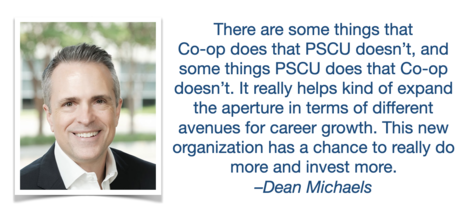
To Chuck's point, there are some things that Co-op does that PSCU doesn’t, and some things PSCU does that Co-op doesn’t. It really helps kind of expand the aperture in terms of different avenues for career growth. This new organization has a chance to really do more and invest more.
One thing I think that's important to stress, and it's very much sort of two sides of the same coin, is there are conversations with clients that are really transparent around the fact that this is a combination that's going to occur over the course of years from an integration perspective. We don't want to really create disruption for our clients. We want to make it as seamless as possible.
It is very much the same theme from an employee perspective. This is something that we've both been very intentional in terms of holding off on hiring for some open positions. This is going to be a combined organization that will be growing, hopefully, by double digits for the foreseeable future.
So, over time there is a pathway to really grow as much as possible. When you're growing 10% a year you need more people to do that work and it gives you an opportunity to sort of grow into those synergy benefits.
That doesn't mean there will not be any impacts. Obviously, the integration team is going to be thoughtful around where do we have opportunities.
CUToday.info: One final question: The two companies have long been friendly rivals. The upside is it forces you to stay on your toes: a Co-op CU could leave for PSCU for a better deal, and vice versa. What keeps you paranoid now? What forces the merged company to compete at the level you have in the past for credit unions’ business?
Fagan: I think number one is a consistent commitment to investing back in the business. Both organizations are all about annually putting significant dollars back into development. I think the combined organization is going to be around $80 million (to invest in the business annually), somewhere around 6% of our revenue base, which is $1.3 billion. (We want to make) that investment wisely and make sure it aligns with credit unions.
I would say as it relates to overall speed, that's something where we need to win. And credit union relevancy is obviously very important.
As credit unions grow, we grow, so if we don't position them to be competitive in the market then certainly that’s a miss on our part and we'll see the effects of that.
Even though Co-op and PSCU have been friendly competitors for many years, there's still plenty of competition out there. We don't see any curtailing of us having to stay on top of things.
Michaels: Two things come mind for me. We were not just competing against PSCU. There is FIS, Fiserv, Visa DPS. They are obviously much better capitalized and resourced even than the combined organization, so, that doesn't go away whatsoever. I expect, if anything, they’re going to step up their game and will probably be more formidable competitors going forward.
I would use not the word paranoia but there are expectations. Chuck and I both needed to convince our boards that this was going to be pro-competitive and we would come out on the other side with better service and better solutions. I expect the combined board of the new entity is going to have expectations around delivering that.
About the Companies
As CUToday.info reported earlier, PSCU serves more than 2,400 financial institutions and processes more than eight-billion transactions annually, and offers payment processing, fraud and risk management, data and analytics, digital banking, strategic consulting and real-time payments platforms, along with 24/7/365-member support via its contact centers. The CUSO is 45 years old.
Co-op Solutions serves 2,650 credit unions, and also process more than eight-billion transactions annually. Founded in 1981, it also manages a nationwide ATM network of more than 30,000 and a 5,700-location shared branch network.
About the Board
Members of the board of the combined company include, from the PSCU board:
- Frank Weidner, chair of the PSCU board and president and CEO of Wings Financial Credit Union
- Craig Esrael, president and CEO of First South Financial Credit Union, Tenn.
- Sean Rathjen, CEO of Consumers Credit Union, Ill.
- Andrew Rosen, president and CEO of Hawaii State Federal Credit Union, Hawaii
- Chris Shockley, president and CEO of Virginia Credit Union, Va.
- Amy Sink, CEO of Interra Credit Union, Ind.
- Rob Stuart, president and CEO, OnPoint Community Credit Union, Ore.
- Nathanael Tarwasokono, president and CEO of Firstmark Credit Union, Texas
- Cathie Tierney, president and CEO of Community First Credit Union, Wis.
The members of the current Co-op Board who will serve as members of the combined company’s board are:
- Jackie Buchanan, president and CEO, Genisys Credit Union, Mich.
- Dennis Devine, president and CEO, Alliant Credit Union, Ill.
- Ezra Eckhardt, president and CEO, Spokane Teachers Credit Union, Wash.
- Rudy Pereira, president and CEO, Premier America Credit Union, Calif.
Associate Directors
The organizations said the following PSCU Associate Directors will remain in the same roles as part of the new combined board:
- Christine Blake, president and CEO, Cardinal Credit Union, Ohio
- Todd Lane, president and CEO, California Coast Credit Union, Calif.
- Maria J. Martinez, president and CEO, Border Federal Credit Union, Texas
- Mark Robnett, president and CEO of Justice Federal Credit Union, Va.