

By Ray Birch
LAKE FOREST, Ill.—Will “Big Checking”—defined as those FIs and companies with more than one million checking accounts—steal away even more checking dollars from the smaller players?
That is likely if more banks and credit unions don't recognize there’s an entirely new depositor with checkbooks in hand, says one economist, who insists the only way to retain that busienss is to tier deposit accounts.
It’s a move to not only stem the outflow of dollars to the likes of Walmart and BofA, but also to address consumers' desire to move their liquid funds to higher-paying vehicles outside of FIs, says Michael Moebs, economist and chair of Moebs $ervices.

“With the end of the COVID pandemic, the saver has graduated to higher levels of competitive rates,” said Moebs. “Big Checking now employs a strategy of different rate levels, or tiers, to keep big savers content. Their rates for the key services match Wall Street money funds. Many FIs with less deposits and assets do not match Big Checking rates, as we see in our data.”
The More Sophisticated Member
Moebs said credit unions are now dealing with a more sophisticated member who is not just a riskless saver, but has become an investor who wants Wall Street Rates for their money.
“CUs, like community banks, must deal with the rate price at the same level as the loan price,” insisted Moebs. “This means understanding the risk of pricing a deposit.”
He said tiers are important, but it comes with a caveat.
“Yet, much more than two or three tiers confuses members,” Moebs said. “This is like going to fill the gas tank and seeing three prices based on octane grades. Most drivers ask a family member or mechanic what grade should they buy. Another example is, where do you set the temperature level of your water heater? A low setting results in more water being used, whereas high setting uses less water. Most municipalities charge for water consumption. Which level is best for you? What rate level is best for a member’s savings account or checking?”
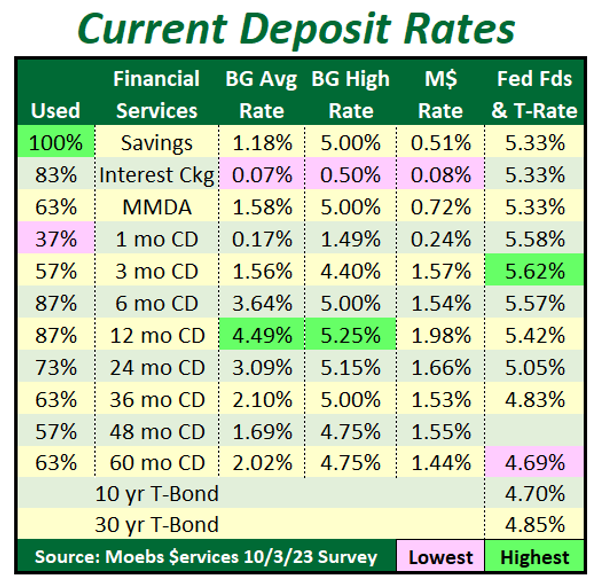
Data based on a large sample of all bank, credit union, fintech, & thrift rates for 1st week of October 2023
Operating on Different Levels
Moebs explained Big Checking operates on several different levels.
“Below $100,000 deposits, the level is substantially under market rates. Why? Savers are riskless and deposit insurance is essential to savers, so much so they will take a very low rate,” Moebs told CUToday.info.
Above $100,000 and up to the $250,000 deposit insurance limit the saver wants a competitive rate but is still willing to forgo some rate to maintain deposit insurance, he said.
“Beyond $250,000 there are no savers, and the depositor becomes an investor demanding a Wall Street highly competitive rate,” he said.
Why Tiers Work
Moebs emphasized tiering works because it keeps depositors whether they are savers or investors.
“Credit unions must now deal with not only the riskless saver but the more sophisticated investor,” he reiterated. “This is new territory for the non-stock collaborative CU movement.”

Michael Moebs
As Moebs has stated in past reports, credit unions must become more efficient, but now another reason for doing so is to pay more attractive rates on higher balance tiers.
“The CU must now perform beyond just rate pricing and become efficient providers with low non-interest expenses,” he said. “The IT perspective is a key component. It is better for the credit union to employ AI systems than to pay for highly trained sales or new account people to get the new member.”
The Wall Street Rate
Moebs said in the current market the savings account has become the key account for all depositories.
“The highest dollar tier must have a Wall Street rate,” Moebs said. “And, interest checking needs to be structured like savings, or not offered.”