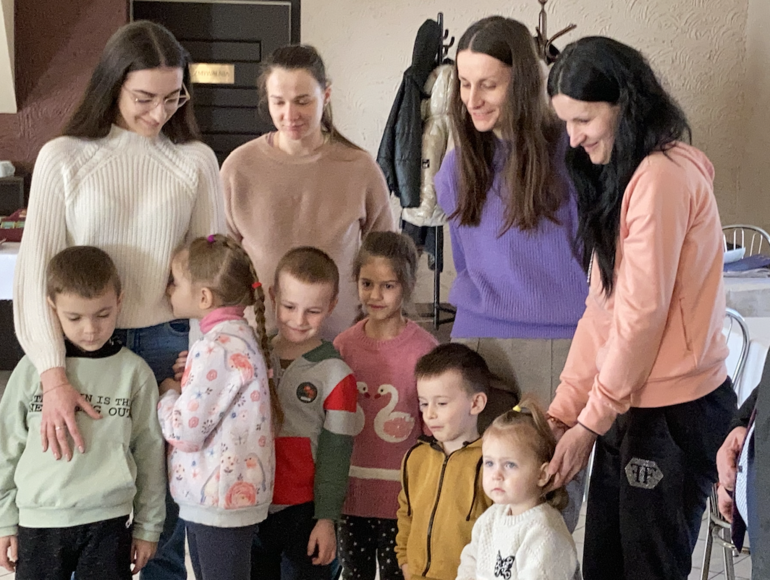
LUBLIN, Poland–Speaking from a city just 60 miles from the border with Ukraine, two U.S. credit union representatives and the leaders of Poland’s credit unions have offered an update on the crisis created by Russia’s invasion of Ukraine, as well as what’s being planned. CU employees in Poland have been among those taking refugees into their homes, while the credit unions themselves have been collecting aid and even buying ambulances.
As CUToday.info reported here, just a week ago the former president of the World Council of Credit Unions, Brian Branch, and Bruce Foulke, CEO of American Heritage Credit Union in Pennsylvania, traveled to Poland, which shares a 300-mile border with Ukraine, to see how credit unions in the U.S. and around the world can assist their fellow co-ops in Poland and Ukraine as they go to great lengths to help the refugees themselves.
American Heritage CU is sponsoring the trip.
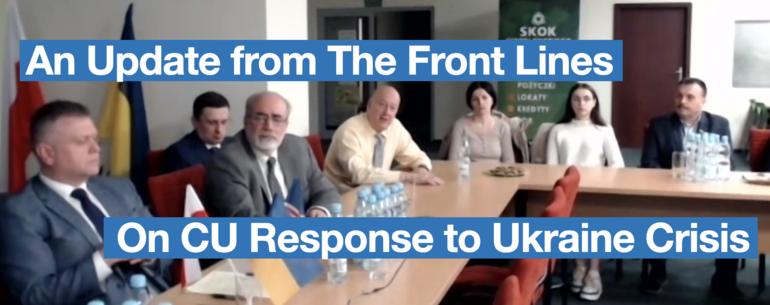
Branch and Foulke were joined by Rafal Matusiak, president of the National Association of Cooperative Savings and Credit Unions (NACSCU) and chair of World Council of Credit Unions, who helped translate some of the comments made by other Polish CU leaders. Also on hand were several refugees from Ukraine. The attendees offered a virtual update on what they have found in being so close to a war zone and what is also now in the works.
The virtual presentation was set up by Mitchell Stankovic Associates and its CEO, Sue Mitchell, who has been active in credit unions internationally.
The refugee situation—as many as three million people are expected to eventually cross the border-- in Poland has been overwhelming, reported Branch, but so has the “human warmth” of Poland’s citizens who have welcomed people fleeing the war, including offering them places to stay n their own homes.
Branch, who has continued to serve on a World Council advisory committee assisting Ukrainian credit unions since his retirement, made clear he traveled to the country as a private citizen and not as a representative of WOCCU. He noted the U.S. and Ukraine’s credit unions have had a long working relationship.
WOCCU Staff in Ukraine
Branch said he has met with or talked to WOCCU staff still on the ground in Ukraine who work with the country’s credit unions, which are still operating.
“As you can imagine, as many families are uprooted and need to leave, they need to access their savings and credit union accounts,” he said. “The World Council has made liquidity support available to these credit unions to help them respond to the withdrawal needs. WOCCU has worked with the National Bank of Ukraine so that the regulators are addressing the stresses in a conflict environment. That work is ongoing. We have to appreciate what the World Council is doing.”
Foulke, who said his arrival in Poland made it apparent just how “real” the war is, explained he is a volunteer firefighter and believes in doing what’s necessary to “get the job done.” He brought with him a pallet of first aid kits that have since been distributed for use in Ukraine.
Foulke said he traveled to a site where more than 300 volunteers were distributing packages—including the First Aid kits--that were going out every single day to Ukraine.
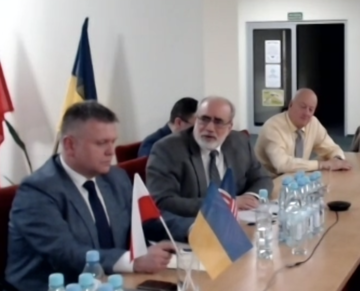
From left, Rafal Matusiak, Brian Branch and Bruce Foulke.
“I met a young woman today who is 22 years old. She had come here for college and then the Russians attacked. She’s worried about her parents, who are elderly. What is she doing? She’s arming herself to go get her parents out. That’s surreal.”
Foulke added he is committed to helping people and not just talking, and that he has 100% support from the American Heritage board.
“We’re going to make things happen,” he said.
Ukrainians Granted Near-Equal Rights
Poland’s Matusiak said the country’s government is not setting up any refugee camps and instead is counting on the country’s citizens to provide housing around the nation. There are numerous “reception points” in Poland to handle the arrivals, where they can find food, water, a place to rest and clothing, as well as information on how to travel to other points in the country or European Union.
“In addition, our government prepared a new law that guarantees equal rights and treatment to refugees from Ukraine,” he said. “All refugees of Ukraine have almost the same rights in our country as Polish citizens. This is very important, because a lot of these people are not just looking for a safe place but also looking for a place where they can live and work. They need to access not only health services, but financial services. This is also the space for activity by credit unions. We are trying to find how we can help, how we can deliver this help in all these places.”
Branch urged credit unions in the U.S. to imagine what the arrival of three-million refugees would mean, and the United States has a population eight times larger than that of Poland.
“People here were talking about how this community, Lublin, was doing work to receive the refugees,” said Branch. “They call it the ‘power of our community.’ It's a spontaneous outreach to help support the people coming into their community.”
The Waves of Refugees
Branch, who during his career at World Council worked with credit unions in other refugee crises, said the typical pattern is the first wave of refugees are higher income and have assets. The second wave tends to be less wealthy and in need of greater assistance. The third wave is those who are health challenged and elderly.
“We looked at the model of what Poland is doing and we asked how can we help support them, because they tell us this is something that's going to last for a while, this is something that will will continue…even after the conflict is over,” Branch explained. “Those of you who know me know I'm all about credit unions and I firmly believe that credit unions are one of the best community organizations to help provide that support.”
Branch said he believes credit unions in Poland, known as SKOKs, and Ukraine are uniquely positioned to help in both the short and long term.
Polish CEO Describes Situation
The CEO of one of the two SKOKs in Lublin said his credit union and its staff have been working to help refugees from the very earliest days of the war. He said the credit union has acted as a collection point for items needed by refugees and has joined with other co-ops and organizations to distribute those items. It collected enough money to purchase three power generators, which have been delivered to Ukraine. It has also collected funds to pay for transportation of medicines to Ukraine and, like other CUs, is allowing Ukrainians to transfer funds to people in their home country at no charge.
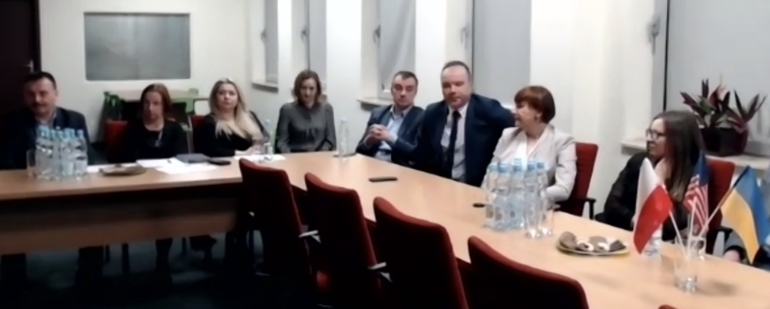
Some of the participants in meeting in Poland who shared their stories and experiences.
One Woman’s Story
During the virtual discussion from Lublin around which more than a dozen people had gathered, one woman from Ukraine shared her own story of her family’s travels out of the country. She said she now felt safe, but her brother continues to work as a driver in Ukraine to help other people escape from unsafe areas. She expressed worries over the education of children, an issue the credit unions hope to address.
Buying Ambulances
Branch also expressed concern over the safety of families left behind in Ukraine.
“One of the small projects the credit unions and the national association in Poland have engaged in has been the acquisition of ambulances to go back into Ukraine and to bring out family members who are ill and mothers who may be pregnant,” Branch said. “Everyone here is concerned about family members left behind…What is so impressive here in Poland is the human warmth with which the refugees are being welcomed and made to feel safe.”
Branch said that from the time he and Foulke arrived a primary question has been what kind of material aid and what kind of financial aid can be provided. That included meeting with the Ukrainian consulate for its input.
“A lot of it was medical supplies, but we also found that a lot of the items are available in Poland. When we looked at the expense of shipping and the amount of time needed for goods to arrive here, our conclusion was to focus on financial aid,” said Branch.
A Two-Step Process
To that end, Branch said he and Foulke have been working with the Polish association on a two-step process.
“Our objective here is to support the work the Polish credit unions are doing to provide an immediate and then long-term impact for the Ukrainian refugees,” Branch explained. “We have started the process of creating a fund that can receive financial support and be housed that within the (Polish foundation). We have been able to establish an account in that foundation and that’s important for three reasons. One, we can send funds from the U.S. without having to go through a third-party institution and it can arrive in that account with no overhead or administrative costs. Second, funds in that foundation account are not subject to any Polish taxes. And three, the foundation has said whatever monies they receive, they will pass through without taking any costs or overhead themselves.”
The fund, said Branch, will offer access to all credit unions providing support for Ukrainian refugees. Poland’s credit unions have said they will match the funds raised and they—not the foundation—will direct where the funds go, Branch added.
More details on that fund are to come, Branch said, but the first grants from the fund will provide families with rent for a year so the can get jobs and put their children in school.
Why Financial Services are Critical
“In the longer term, and this is what makes credit unions different and special, people need to see stability and an economic future,” Branch stated. “(Poland’s credit unions) will be working with this fund and together to help provide accounts and financial services so people can open a savings account, so they're starting to invest in the future, so they're starting to build a sense of economic security, so they have access to payment systems and can do the transactions necessary for daily living and also to qualify for credit.
“We've talked about putting in place guarantee funds that will help support the (credit unions) as they're dealing with the regulators on providing loans to refugees who have limited history here and who have limited assets,” Branch continued. “It’s a long-term investment in the refugees’ sense of security, and that also provides a stake of ownership in their community. That's what helps provide that sense of economic stability, social stability and political stability. It also helps provide a sense of bonding and connection.”
A Final Message
Matusiak said Poland’s credit unions are also looking for financial assistance from the European Union. But he also appealed to the people of another country.
“We would like to walk this way together with the United States,” he said.
Below, in photo shared by Poland's credit unions, a group of refugees from Ukraine.