

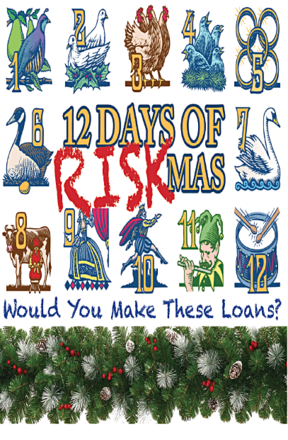
THE NORTH POLE—It’s getting tougher these days for a True Love to give gifts for the 12 Days of Christmas—to say nothing of the challenges for any credit union that might attempt to provide financing.
The rising price tag for those unique presents immortalized in song—$34,130.99 according to PNC’s annual Christmas Price Index—is simply getting beyond the means of most. And the gifts would certainly topple personal balance sheets if someone followed the intent of the song, handing out 364 gifts all told.
Even if a credit union is considering a loan for a member bent on gifting everything from a partridge in a pear tree to 12 drummers drumming, analysts who spoke with CUToday.info said it’s almost certain Grinch-like examiners would put extra scrutiny on the collateral due to all the risks involved.
“From a risk standpoint, one of the first things that jumps out at me is just how ‘fowl’ these gifts are,” said Dan McGowan, CEO at the $191-million Pioneer West Virginia FCU in Charleston, W.Va. “Six of the 12 gifts call for repetitively loading up on swans, geese, calling birds, French hens, turtle doves and, of course, the partridges. Where the heck are these birds going to roost each night, especially as more and more are delivered each day?”
Checking It Twice
McGowan said he has two words that sum up his own aversion to risk when it comes to financing the 12 Days of Christmas—“bird flu.”
And he’s not alone in checking this list twice.
“What’s with all the geese, calling birds, French hens, turtle doves and that partridge that comes along with its own tree?” asked Dale Verderano, CEO of the $174-million Matadors Community CU, Chatsworth, Calif. “If sent to the credit union would the examiners cry ‘fowl’ play? We would not want to flip them the bird.”
McGowan is also concerned about safety issues resulting from all the lively gifts.
“With all of the dancing and leaping going on, there’s bound to be an injury somewhere along the line, probably someone slipping on bird poo,” he said. “Who’s liable? And is the injury covered under Obamacare?”
While CUs are left to speculate about the composition of drummers and pipers—there are 10 lords, nine ladies, and eight maids, for example, McGowan said those gifts seem “pretty segregated by sex. It doesn’t seem to pass the political correctness test. What if some of the lords wanted to dance or milk? Or some of the ladies or maids felt a need to leap?”
But McGowan’s overarching advice to recipients of such extravagant gifts: “Don’t accept gifts that eat.”
Examiners Getting Tougher

Roy MacKinnon, principal at MacKinnon Marketing and Branding, agrees that it’s not going to be easy getting around NCUA examiners, who will be looking for solid collateral.
“I am not sure what a credit union loan officer might do here, since the last time I checked there is not much of a market for a used partridge in a pear tree,” said MacKinnon.
On the positive side, MacKinnon noted that prices for financing the 12 days of Christmas, in the current economy, have not taken off with low inflation.
According to PNC, which each year updates the costs related to each of the gifts included in the famous Christmas song, the cost for 10 lords-a-leaping rose 3% in 2015, while the nine ladies dancing cost approximately the same as 2014. The eight maids-a-milking, the only unskilled workers in the index, have held steady for the sixth straight year.
And while gold prices have declined 12% since last Christmas, MacKinnon observed that the cost of golden rings was unchanged for the second consecutive year, bringing into question whether the retail price would really be reflected in the event of a repossession.
And the swans-a-swimming could also be a real issue on the West Coast, added MacKinnon, who lives near Hollywood. “We have a big problem here. We are facing a major drought—people are draining their pools to water their lawns. Yeah, you make the loan for the swans, but where are they going to swim?”
Value Of Collateral?
Still, the good news for those who have asked Santa for swans-a-swimming this holiday season is that the gifts are mostly more affordable, said Bill Vogeney, senior executive VP of lending and finance at the $4.2-billion Ent FCU in Colorado Springs, Colo. “Low rates mean low payments, so the affordability of the 12 Days of Christmas gifts in recent years has been better than it has been in a long time.”
Like MacKinnon, Bill Handel, VP of research at Raddon Financial Group in Lombard, Ill., is concerned over the true valuation of the collateral, noting that the PNC Index may be overpriced given the extended Black Friday and Cyber Monday sales promotions this year.
Lenders should also be cautioned, reminded Matadors Community’s Verderano, that borrowers may not be taking into account all the potential costs beyond the gifts themselves, including shipping.
“First, which service would be selected to send these things? The U.S. Postal Service, Fed Ex or UPS? They all have increased their cost so much that My True Love would have to take out a hefty credit union loan just to pay for the mailing. Plus, there is no assurance if delivered by the USPS they w
Bill Handel, Raddon
ill ever get there by Christmas.”
A bigger problem, for those hoping for the unusual gifts, is that there are just a lot of people involved in the tradition. But Evan Clark has a plan.
“I don’t know if anyone has ever noticed this but there are 50 people mentioned in this song other than My True Love,” said Clark, CEO at the $340-million Department of Commerce FCU in Washington, said. “What I’d do is invite them all over for supper and then after supper I’d send them out to do the chores—namely taking care of the 23 critters mentioned in the song.”
Holiday Plastic Instead
If a credit union won’t grant the loan, there are always credit cards, which sources agreed have likely been financing some of these gifts for many years.
For those CUs wanting to finance gifts for the 12 Days of Christmas for a deserving member, Verderano cautioned not to get too excited even if the examiners sign off, as another Scrooge will eventually spoil the tradition.
“I am sure the Consumer Financial Protection Bureau would do its best to put a stop to all this increased loan volume, wealth building, and all around good clean fun,” said Verderano.