

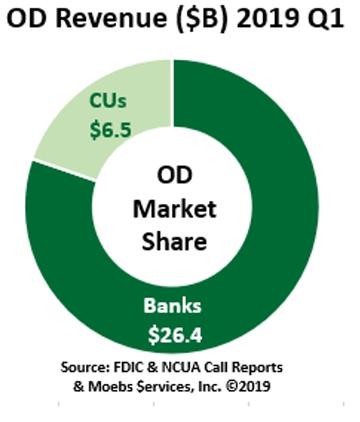
LAKE FOREST, Ill.—As expected, overall financial services overdraft revenue ($32.9 billion) was down in the first quarter of 2018. But what was not predicted is the size of the drop, says one economist, who notes credit unions experienced their first Q1 OD revenue decline in five years.
And the reason for the drop—overdraft pricing, according to Michael Moebs, economist and CEO at Moebs $ervices. Moebs said his company’s quarterly overdraft report generally finds first quarter overdraft revenue declines from the previous quarter.
“The expectation was about 0.5% decline, or drop of $200 million in OD revenue,” said Moebs. “The deep decline of 4.6% for the start of 2019—more than eight times higher than normal—is very unusual.”
Comparing Q1 overdraft revenue to the previous year’s first quarter performance typically shows an increase, explained Moebs. But not this year.
“We see a decline of $700 million, or almost 2.0%, when we compare overall overdraft revenue from the first quarter of 2019 to the first quarter of 2018,” he said.
Overall, the overdraft revenue decline was 4.2% for banks and 5.3% for credit unions, the Moebs Overdraft Study shows. Overdraft transactions fell for much of 2018, picked up in the fourth quarter of the year, and then dropped another 50 million transactions in the first quarter of 2019.
“Falling overdraft revenue is expected in the first part of every year,” said Moebs, “January is the best month for OD revenue for the year, followed by the worst month in February, with March just average,” he explained. “It has been five years since CUs’ overdraft revenue declined in the first quarter. Bank ODs have declined in the first quarter for the past two years.”
Cause & Effect

Michael Moebs
Moebs noted the causes of the higher-than-unusual decline:
- In the last half of 2018, overdraft prices increased to $32 from $30 for banks and $30 from $29 for CUs
- This triggered overdraft transactions in the first quarter of 2019 to fall much more than normal
- The moves in price and transactions caused OD revenue to substantially decline
What’s Ahead
What’s ahead for 2019?
“The major conclusion of the Moebs Overdraft study is OD prices are no longer inelastic,” said Moebs. The days of increasing the OD price and expecting an increase to the bottom line are over. Now an increase in overdraft price decreases overdraft revenue. The only way to increase OD revenue is by reducing the cost to the consumer. An amazing thing will result from this. It is classical supply and demand. More revenue for financial institutions coming from more transactions at a lower price.”